


Introduction
In recent years, artificial intelligence (AI) has expanded rapidly, thereby transforming numerous social contexts, including education. Various literature reviews show that AI is no longer a peripheral tool but has become a structural element that is redefining the ways we teach, learn, and assess (Kamalov et al., 2023). In line with this trend, there has been a significant increase in AI research in educational settings since 2019, with a particular focus on adaptive learning, machine learning, and intelligent teaching support systems (Kaban, 2023). Additionally, recent studies on ChatGPT and other conversational AI systems indicate that these tools are directly influencing classroom dynamics—affecting both teachers and students—and generating both positive and negative pedagogical opportunities (S. Zhang & Liu, 2025).
In the context of secondary education, the reviewed literature suggests that AI can enhance learning if it is appropriately integrated into pedagogical models, such as blended learning. In this evaluation, blended learning environments are specifically accounted for, as they represent the primary pedagogical frameworks where artificial intelligence applications—such as intelligent tutoring systems and conversational chatbots—are operationalized and blended with traditional instruction. Similarly, recent meta-analyses, such as that by Wu et al. (2025), suggest that incorporating AI into educational settings is positively associated with academic performance. At the same time, systematic reviews on assessment in elementary and secondary education, such as that by Martínez-Comesaña et al. (2023), indicate that AI is already being used to automatically grade written assignments, predict student performance—including the ability to detect potential learning difficulties—and analyze learning processes, thereby transforming traditional forms of assessment. Other studies, such as that by Liu et al. (2025), show that the way students interact with AI has a significant impact on their behavioral, emotional, and cognitive engagement, arguing that it is not enough simply to introduce this technology; its pedagogical design is also crucial.
Regarding the issue of student motivation and emotions, reviews such as those by H. Zhang et al. (2025) and Zong and Yang (2025) maintain that AI in education can stimulate creativity, emotional regulation, concentration, and well-being by addressing students’ affective and cognitive needs. A robust conceptualization of academic emotions requires looking beyond primary affective labels (e.g., joy or sadness) to encompass adjacent, non-explicitly labeled emotional constructs that dictate the student experience. In educational technology research, academic emotions are structurally intertwined with constructs such as perceived self-efficacy, cognitive load, academic uncertainty, performance anxiety, and technological attitudes. For instance, tech-anxiety and perceived risk directly modulate students' emotional avoidance behaviors, while low self-efficacy serves as a psychological precursor to negative achievement emotions. Consequently, this review operationalizes academic emotions through this multidimensional lens, ensuring that variables like anxiety, procrastination, and self-efficacy are synthesized as core components of the student's affective ecosystem during AI interactions. In turn, the use of chatbots for emotional support demonstrates the role of agent design; for example, the inclusion of voice is linked to satisfaction and perceived rapport, suggesting that the affective dimension of AI is related to educational effectiveness (Xu & Ma, 2025).
To understand these dynamics, a cohesive conceptual framework linking AI-supported environments, student engagement, and emotional outcomes is essential. According to educational psychology, technology-mediated learning does not affect performance in isolation; rather, it activates cognitive and affective appraisals. When AI tools offer personalized feedback or scaffolding, they are linked with higher student perceptions of autonomy and competence, which relate to increased intrinsic motivation and behavioral engagement. This positive engagement subsequently fosters pleasant academic emotions (such as enjoyment or curiosity) while mitigating negative ones (such as boredom). Conversely, poorly designed AI interfaces or excessive technical demands can trigger cognitive overload, leading to performance anxiety, frustration, and eventual emotional disengagement.
In more specific contexts, AI has been shown to increase positive emotions and reduce negative emotions such as boredom (Omar et al., 2025). However, it can also cause anxiety or depersonalization, as noted in the review by Lin and Chen (2024).
Another important factor is students’ attitudes toward AI. Abdaljaleel et al. (2024) argue that the use of AI is influenced by variables such as perceived ease of use, perceived usefulness, and social influence. In turn, students report that motivation toward learning and procrastination are related to dependence on ChatGPT; thus, low motivation and high levels of procrastination may contribute to the misuse of AI (Galindo-Domínguez et al., 2026). Furthermore, studies such as the one by Cotino-Arbelo et al. (2025) indicate that although many students do not understand how this technology works, they believe it can contribute positively to their emotional well-being and communication.
The need to conduct this literature review is also justified by the ethical and social challenges associated with its use in education. In the university setting, as evidenced in the study by Consuegra-Fernández et al. (2024), professors have reported difficulties distinguishing texts written by students from those written by ChatGPT, raising questions about assessment and academic authorship. Furthermore, reviews such as that by Ming et al. (2025) warn of potential biases in AI that could exacerbate inequalities and discrimination if frameworks for critical and equitable use are not developed.
Secondary and higher education environments are addressed together in this review because they represent the two transitional academic stages where students interface most intensely with independent digital learning technologies. Analyzing both levels simultaneously allows for a comprehensive evolutionary mapping of AI adoption, contrasting the emerging, highly scaffolded interactions of adolescent learners in secondary schools with the more autonomous, instrumental utilization of AI tools by university students.
While previous literature reviews and meta-analyses have broadly addressed the impact of artificial intelligence on educational outcomes, there remains a critical gap regarding how these technologies simultaneously intersect with learning motivation and specific academic emotions. Many existing studies focus strictly on technological implementation or general academic performance, leaving the affective and psychological mechanisms under-examined. This systematic review addresses this specific gap by synthesizing recent empirical evidence across both secondary and higher education, mapping not only the cognitive benefits but also the precise emotional outcomes and psychological risks associated with students' direct interactions with AI tools.
Methodology
Study Design
This study follows a systematic review research design, in accordance with the guidelines established by the PRISMA statement (Page et al., 2021). This type of design allows for the examination of previous research, as well as the integration and evaluation of findings from scientific studies on AI in secondary and higher education published in recent years.
Therefore, this article presents a literature review aimed at analyzing the associations between the educational use of AI on learning, academic performance, motivation, and emotional variables among secondary and higher education students, as well as identifying the main risks associated with its implementation. Based on this objective, this study seeks to address several key questions that structure the review. First, it analyzes the effects of AI use on learning and academic performance among secondary and higher education students. Second, it examines its impact on motivational variables such as academic commitment and engagement. It also explores the main emotional variables involved, as well as the potential risks associated with the use of these technologies in educational contexts. Finally, the study identifies the types of AI tools and applications most commonly used in the analyzed studies.
Research Questions and PICO Criteria
This systematic review was structured using the PICO model (Population, Intervention, Comparison, and Outcomes), which served as a guide to define the main elements of the literature search and organize the selection of studies. Due to the heterogeneity of the included study designs—some of which were descriptive, correlational, or non-experimental—not all studies included an explicit comparison group.
The main research question was as follows:
What associations and predictive relationships exist between the educational use of artificial intelligence-based tools and learning, academic performance, motivation, and emotional variables among secondary and higher education students, and what risks are associated with their use?
The PICO components were defined as follows:
- Population (P): secondary and higher education students, including college students from various degree programs, age groups, and educational backgrounds.
- Intervention (I): the use of artificial intelligence-based tools, systems, or applications within teaching and learning processes. Included, among others, were generative AI tools such as ChatGPT, intelligent educational agents, adaptive learning systems, educational chatbots, and machine learning models applied to predicting or improving academic, motivational, and emotional variables.
- Comparison (C): teaching conducted without artificial intelligence tools, conventional educational methodologies, comparisons between different types or levels of AI use, or analyses of associations between variables in studies without an explicit control group.
- Outcomes (O): effects related to learning and academic performance, intrinsic and extrinsic motivation, academic engagement, academic emotions, emotional regulation, and student well-being. Outcomes related to potential adverse effects were also considered, such as tech anxiety, dependence on ChatGPT, procrastination, loss of autonomy, reduced critical thinking, and other ethical or educational risks associated with the inappropriate use of these tools.
Based on this main question, the following specific questions were posed:
- What relationships exist between the educational use of artificial intelligence and students’ learning and academic performance?
- How is it associated with motivation and academic engagement?
- What emotional variables are associated with the use of artificial intelligence tools?
- What risks or negative consequences have been identified?
- Which artificial intelligence tools and applications are most commonly used in the studies analyzed?
Search Strategy
The literature review was conducted in February 2026 using four scientific databases selected for their relevance and multidisciplinary coverage: Web of Science, Scopus, Dialnet, and PubMed. To analyze recent trends in the use of artificial intelligence in education, a time frame of a ten-year interval was established, spanning from 2016 to 2026.
The search strategy was designed based on the following keywords, expanded to encompass adjacent conceptual constructs to ensure comprehensiveness. These concepts were organized into three thematic sections:
- A first section related to artificial intelligence, which included terms such as “artificial intelligence,” “AI,” and “ChatGPT.”
- A second section addressing educational, motivational, and emotional variables. To ensure conceptual coherence and address the multidimensional nature of academic emotions, this block explicitly included terms for direct affective states as well as adjacent psychological and cognitive markers structurally intertwined with the student experience, using terms such as “motivation,” “academic emotions,” “anxiety,” “self-efficacy,” “cognitive load,” and “blended learning” (operationalized as the primary pedagogical framework where educational AI tools are blended with traditional instruction).
- A third section aimed at defining the population and educational context, with terms such as “secondary education,” “higher education,” and “university students.”
Terms within the same block were combined using the Boolean OR operator, while different conceptual blocks were linked using the AND operator.
The exact search strings developed for each database were executed as follows:
- Web of Science (WoS): TS=(("artificial intelligence" OR "AI" OR "ChatGPT") AND ("motivation" OR "academic emotions" OR "blended learning") AND ("secondary education" OR "higher education" OR "university students"))
- Scopus: TITLE-ABS-KEY(("artificial intelligence" OR "AI" OR "ChatGPT") AND ("motivation" OR "academic emotions" OR "blended learning") AND ("secondary education" OR "higher education" OR "university students"))
- Dialnet: (Texto libre) = ("artificial intelligence" OR "AI" OR "ChatGPT") AND ("motivation" OR "academic emotions" OR "blended learning") AND ("secondary education" OR "higher education" OR "university students")
- PubMed: (("artificial intelligence"[Title/Abstract] OR "AI"[Title/Abstract] OR "ChatGPT"[Title/Abstract]) AND ("motivation"[Title/Abstract] OR "academic emotions"[Title/Abstract] OR "blended learning"[Title/Abstract]) AND ("secondary education"[Title/Abstract] OR "higher education"[Title/Abstract] OR "university students"[Title/Abstract]))The narrowness of these combinations explains the highly refined and relatively small number of final records retrieved, ensuring that only articles strictly addressing all three conceptual pillars simultaneously were captured.
The following filters were applied in all databases:
- Publication period between 2016 and 2026.
- Language: English or Spanish.
- Document type: scientific articles.
- Full-text availability for the works selected during the eligibility phase.
The search was conducted on February 3, 2026. Initially, 28 records were identified in Web of Science, 11 in Scopus, 11 in Dialnet, and 10 in PubMed, yielding a total of 60 results before duplicates were removed and the selection criteria were applied.
Study Selection Process
The study selection process was conducted in accordance with the PRISMA statement guidelines, using a four-phase procedure: identification, screening, eligibility, and inclusion. Applying these phases allowed for a transparent organization of the process of locating, evaluating, and selecting studies related to the educational use of artificial intelligence.
The selection was carried out by applying the previously established inclusion and exclusion criteria.
In the initial identification phase, a total of 60 records were retrieved from the four databases consulted: 28 from Web of Science, 11 from Scopus, 11 from Dialnet, and 10 from PubMed. After reviewing the results, 3 duplicate records were removed, leaving 57 publications. Subsequently, 8 records were excluded prior to screening because they did not meet the established publication period or language requirements, leaving 49 studies to proceed to the next phase.
During the screening phase, a manual review was conducted of the titles, abstracts, and keywords of the remaining 49 records. At this stage, 21 studies were excluded because they did not directly analyze the use of artificial intelligence in learning processes, did not evaluate motivational or emotional variables related to education, or did not focus on students in secondary or higher education. As a result, 28 articles were selected for full-text review.
During the eligibility phase, the 28 potentially relevant articles were examined by reviewing the full text and applying the inclusion and exclusion criteria. During this process, 22 publications were excluded: 2 because the full text was not available, 15 because they were systematic reviews, and 5 because they did not meet the established inclusion criteria.
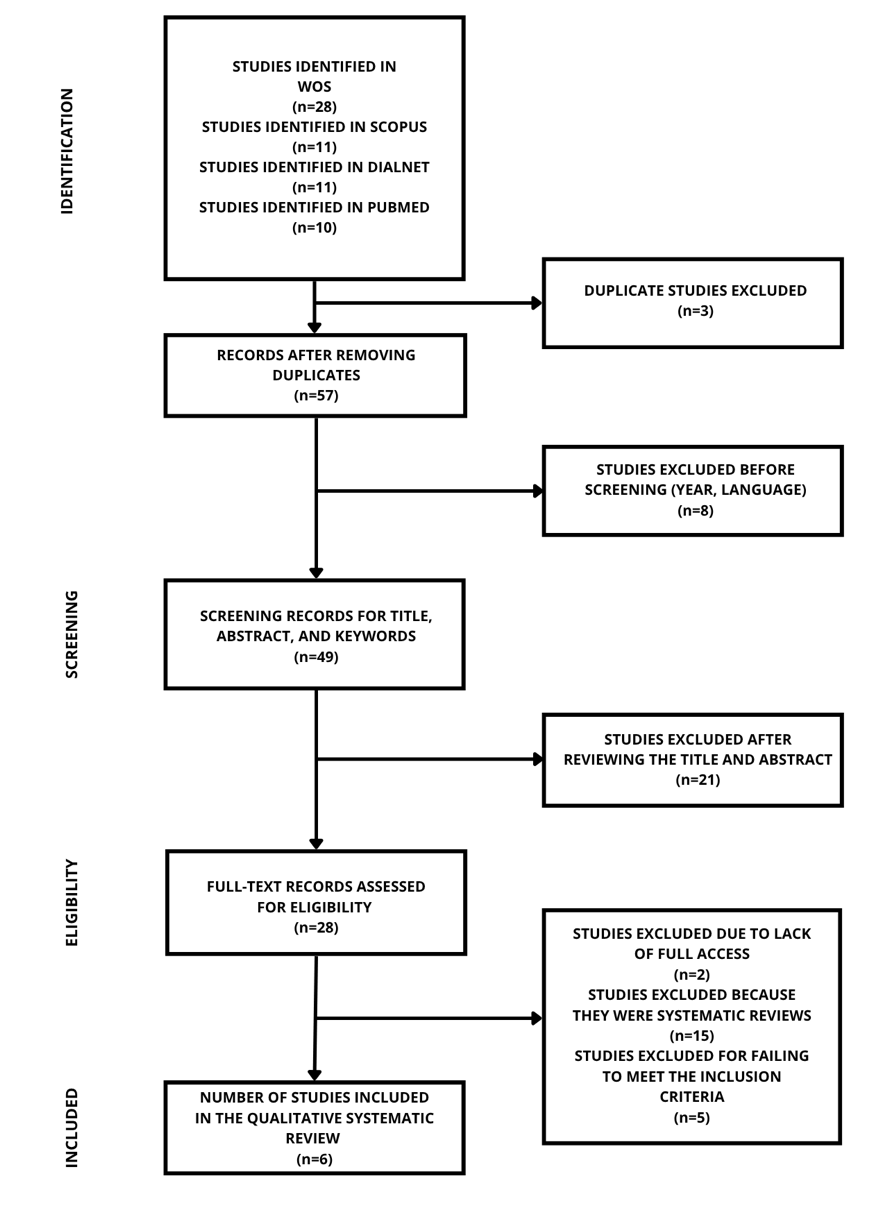
Finally, after completing the various phases of the selection process, 6 empirical studies were included in the qualitative synthesis of the systematic review. These studies demonstrated a direct relationship between the use of artificial intelligence tools and one of the variables considered in the study, such as learning, academic performance, motivation, academic engagement, emotions, or the risks associated with the use of these technologies.
Table 1. Screening of Excluded Studies After Reviewing the Title and Abstract
| Reason for Exclusion | n |
| It did not directly analyze the use of AI in the learning process | 8 |
| It did not assess motivational variables or emotions related to learning | 6 |
| It was not part of secondary or higher education | 7 |
Table 2. Studies Included in the Systematic Review
| Authors | Year | Country | Participants | Design |
| Ma et al. | 2025 | China | 1,708 high school students | Cross-sectional quantitative analysis |
| Abdaljaleel et al. | 2024 | Egypt, Iraq, Jordan, Kuwait, Lebanon, Saudi Arabia, and Tunisia | 2,240 college students | Cross-sectional study with multivariate analysis |
| Galindo-Domínguez et al. | 2026 | Spain | 467 college students | Quantitative, cross-sectional, and non-experimental analysis with a descriptive-correlational approach |
| Zong & Yang | 2025 | China | 816 college students | Cross-sectional quantitative analysis |
| Lin & Chen | 2024 | China | Qualitative phase (15 college students and 8 professors); Quantitative phase (120 college students and 30 professors) | Mixed methods with descriptive analysis |
| Liu et al. | 2025 | China | 533 high school students | Mixed methods |
To mitigate the risk of selection and interpretation bias inherent in this single-reviewer phase, a rigorous verification protocol was implemented. The eligibility criteria were strictly operationalized a priori based on the PICO framework to minimize subjective decision-making. Furthermore, a random subset of 20% of the screened records was independently cross-verified by an external educational researcher from our department. Discrepancies were discussed until 100% consensus was achieved, thereby ensuring the reproducibility and transparency of the selection process.
A conceptual distinction must be made regarding the dual role of artificial intelligence within the selected literature. In this review, AI is evaluated both as an educational intervention (where students actively interact with applications like chatbots or tutoring systems) and as an advanced methodological tool (where machine learning models are deployed to analyze and predict student emotional and behavioral data). The study by Ma et al. (2025) was explicitly retained under the latter category, as its deployment of predictive algorithms directly advances the understanding of how behavioral and school variables predict negative academic emotions, matching the core outcome criteria of this review.
Inclusion and Exclusion Criteria
The following section outlines the inclusion and exclusion criteria used, which were established at the outset of the review to precisely define the evidence regarding the relationship between AI and learning, performance, motivation, and academic emotions among students in secondary and higher education.
Inclusion Criteria
- Were published between 2016 and 2026.
- Were available in English or Spanish.
- Used a quantitative, qualitative, or mixed-methods design.
- Focused on students in secondary or higher education.
- Examined the use of AI in educational contexts.
- Assessed at least one variable related to learning, academic performance, motivation, academic engagement, academic emotions, emotional well-being, or risks associated with AI use.
- Reported a direct relationship between AI use and at least one of the variables examined in the review.
Exclusion Criteria
- Focused on AI without examining its application in education.
- Did not directly examine the use of AI in teaching or learning processes.
- Did not assess any variable related to learning, academic performance, motivation, academic engagement, academic emotions, emotional well-being, or risks associated with AI use.
- Did not involve students in secondary or higher education.
- Were systematic or narrative reviews, conference abstracts, editorials, or other non-empirical publications.
- Were not available in full text.
Data Extraction
The analysis focused on the following key variables:
- Artificial intelligence (AI): a branch of computer science dedicated to designing systems and programs capable of performing advanced tasks by simulating human intelligence.
- Learning: the process by which an individual acquires or develops knowledge, skills, or behaviors through experience, study, or practice.
- Motivation: the process by which behavior is planned and directed using appropriate resources for the purpose of achieving a goal.
- Secondary education: a compulsory and free stage of education that completes basic education.
- Higher education: a stage of education that specializes in different areas of knowledge and follows secondary education.
To organize the information extracted from the documents included in the study, the following variables were considered:
- Study characteristics: year of publication, country, number of participants, and research design.
- Variables analyzed: AI, learning, motivation, secondary education, and higher education.
- Key findings: the relationship between AI and learning, as well as its influence on motivation.
To synthesize the results, the included studies were qualitatively coded. The information was grouped into four main categories: learning/performance, motivation/engagement, emotional variables, and risks associated with AI use. In addition, descriptive variables for each study such as authorship, year, country, sample, design, and main findings were recorded. No quantitative statistical analyses were conducted due to the descriptive nature of the review. The information gathered was synthesized into descriptive tables that clearly present the main variables, methods, and results of the studies analyzed.
Assessment of Methodological Quality and Risk of Bias
To assess the included studies, a methodological quality assessment was conducted using the 2018 version of the Mixed Methods Appraisal Tool (MMAT) (Hong et al., 2018). This tool allows for the analysis of studies with different methodological designs, including descriptive and quantitative studies. For each study, criteria related to the appropriateness of the design, the representativeness of the sample, and the clarity of the results were evaluated.
The methodological quality assessment using the MMAT tool was initially conducted by a single reviewer. To avoid evaluation bias, the operational definitions of each MMAT criterion were strictly followed, and a random sample of 20% of the quality assessment sheets was independently cross-verified by an external researcher from our department. Consensus was achieved for all reviewed items, confirming the reliability of the high and medium quality classifications.
Table 3. Assessment of Methodological Quality
| Study | Q1 | Q2 | Q3 | Q4 | Q5 | Overall Quality Score |
| Ma et al. (2025) | Yes | Yes | Yes | No | Yes | 80% (Medium) |
| Abdaljaleel et al. (2024) | Yes | Yes | Yes | Yes | Yes | 100% (High) |
| Galindo-Domínguez et al. (2026) | Yes | Yes | Yes | No | Yes | 80% (Medium) |
| Zong and Yang (2025) | Yes | Yes | Yes | No | Yes | 80% (Medium) |
| Lin and Chen (2024) | Yes | Yes | Yes | No | Yes | 80% (Medium) |
| Liu et al. (2025) | Yes | Yes | Yes | Yes | Yes | 100% (High) |
Note: Q1 to Q5 represent the specific MMAT core appraisal questions regarding sample representativeness, measurement validity, data completeness, control for confounders, and statistical appropriateness. Scores are calculated as the percentage of criteria met.
Results
Table 4 below provides a summary of the objectives, variables, measures, and main results of the studies included in this review, which analyzes the impact of AI on the learning and motivation of students in secondary and higher education. These studies addressed various topics related to the use of intelligent tutoring systems, educational chatbots, and AI-based adaptive learning tools, as well as their influence on cognitive, motivational, and emotional variables. Specifically, they examined aspects such as improvements in academic performance, intrinsic motivation, the perceived usefulness of AI, and potential effects associated with technology anxiety. The six included studies, conducted in countries such as China and Spain, as well as the Middle East region, take a predominantly quantitative approach with large sample sizes. Collectively, they analyze the impact of AI on variables related to learning, motivation, emotions, and academic engagement among high school and college students.
Table 4. Analyzed Variables and Primary Outcomes
| Study | Objective | Variables | Measures | Results |
| Ma et al. (2025) | To predict negative academic emotions in high school students using machine learning methods | Emotions related to academics and behavioral variables | Teacher Discipline Scale, Resilience Scale, Multidimensional Multiple Attributional Causality Scale (MMCS), Academic Self-Efficacy Questionnaire, Academic Emotions Questionnaire (S-EES) | The most important variables for predicting negative academic emotions were identified. The statistical model with the best predictive performance was the Random Forest |
| Abdaljaleel et al. (2024) | To analyze the factors that influence attitudes toward and use of ChatGPT among college students and to validate the TAME-ChatGPT instrument | Attitude toward ChatGPT and its use | 5-point Likert scale, scores summed by construct (7 dimensions of TAME-ChatGPT), multivariate linear regression, and confirmatory factor analysis (CFA) | Approximately half of the students had heard of ChatGPT, and more than half had used it. Attitude and use were associated with greater perceived usefulness, perceived ease of use, social influence, lower anxiety, and perceived risk. The 7 dimensions of the TAME-ChatGPT instrument were validated using confirmatory factor analysis (CFA) and multivariate linear regression |
| Galindo-Domínguez et al. (2026) | To examine the effects of learning motivation and procrastination on dependence on ChatGPT | Intrinsic and extrinsic motivation, procrastination, and dependence on ChatGPT | 5-point Likert scale for Academic motivation, 5-point Likert scale for academic procrastination, and 5-point Likert scale for dependence on ChatGPT | A predictive model was used in which low intrinsic motivation and high academic procrastination served as significant predictors of dependence |
| Zong and Yang (2025) | To assess the effects of AI-enhanced social-emotional learning on student’s engagement and emotional well-being. | Social-Emotional Learning Enhanced by AI (AI-SEL) and Emotional Well-Being | Three questionnaires using the Likert scale (25 items each) | AI has a positive and significant effect on emotional regulation and academic engagement. The analysis was conducted using structural equation modeling with SPSS and AMOS on a model consisting of three questionnaires, each with 25 items |
| Lin and Chen (2024) | To explore the effects of AI-integrated educational applications on college students’ creativity and academic emotions. | AI, motivation, emotional regulation, academic uncertainty | Motivation Questionnaire (28 items across 7 dimensions), Emotional Regulation Questionnaire (10 items across 2 dimensions), Academic Uncertainty Scale (14 items across 3 dimensions) | AI improves motivation and emotional regulation and reduces academic uncertainty. The reliability of the scales was assessed using Cronbach's alpha |
| Liu et al. (2025) | To analyze middle school students’ interaction and engagement patterns with AI teachable agents in mathematics learning. | Modes of Interaction, Behavioral, Emotional, and Cognitive Engagement, and Learning Performance | Mixed-Methods Approach | The students who improved their performance in math were those who engaged in the most constructive interaction with AI |
AI Applications, Learning and Academic Performance
With regard to learning and academic performance, the results suggest a positive link between AI variables and performance. In particular, Ma et al. (2025) demonstrated that machine learning models can effectively predict negative academic emotions by identifying variables such as self-efficacy and emotional control as key predictors. Similarly, Liu et al. (2025) found that students who interact more actively with AI tools tend to perform better in mathematics, suggesting that the quality of the interaction influences academic performance.
Impact of AI on Student Motivation and Engagement
Regarding motivation and engagement, several studies agree that there are positive associations, albeit with some nuances. Zong and Yang (2025) show that AI-based learning environments-especially those that incorporate social-emotional learning-are significantly and positively correlated with student engagement. Similarly, Abdaljaleel et al. (2024) observed that attitudes toward the use of ChatGPT are associated with greater perceived usefulness, lower anxiety, and greater ease of use, suggesting that a positive perception of AI is significantly related to students’ use of it in learning. However, other findings point to potential adverse effects, as noted by Galindo-Domínguez et al. (2026), where lower intrinsic motivation is associated with greater passive use of tools such as ChatGPT, linked to a dependence on the tool.
Academic Emotions and Educational Risks Related to AI Use
Regarding emotional variables, Ma et al. (2025) found that factors such as low levels of self-efficacy among students significantly influence the emergence of negative emotions. Meanwhile, Zong and Yang (2025) demonstrated that AI can promote emotional well-being by providing personalized learning environments and real-time support. Lin and Chen (2024) observed that the use of AI helps improve academic motivation and emotional regulation.
The reviewed literature also warns of potential adverse effects associated with the use of AI in educational contexts. Recent studies indicate that inappropriate or excessive use of AI—such as conversational systems—can lead to dependency or a reduction in student autonomy (Lin & Chen, 2024). In this context, attitudes toward AI play a key role, as variables such as perceived usefulness, ease of use, and social influence shape both the acceptance and the educational impact of these technologies (Abdaljaleel et al., 2024).
Discussion
In addition to the quantitative studies and meta-analyses previously summarized, other contributions—such as that of Mujica-Sequera (2024)—propose classifications of AI tools with the aim of optimizing teaching and learning processes. These classifications are theorized to facilitate the pedagogical integration of AI into educational systems and potentially support educational equity. Along these lines, recent reviews highlight the potential of AI in teaching and learning processes through the prediction of academic performance, the early detection of school dropouts, and the personalization of educational interventions (Forero-Corba & Negre Bennasar, 2024), while also emphasizing the need to integrate these developments through an ethical and equitable approach that guarantees access and prevents the reproduction of educational inequalities.
Deroncele-Acosta et al. (2024) highlight 10 pillars of AI in science education, including machine learning, natural language processing (NLP), and Intelligent Tutoring Systems. From an evolutionary perspective, Kyambade et al. (2025) describe the transition from guided AI models to student-centered programs, in which content and teaching strategies are adapted in real time. Furthermore, Chen et al. (2020) demonstrate how AI has evolved from an administrative tool to an educational one, capable of personalizing content and learning paces according to students’ needs, thereby improving the learning experience and outcomes.
Other studies indicate that AI helps improve instructional planning, automated assessment, and personalized learning in the field of science (Almasri, 2024; Xia et al., 2025). More specifically, Morbidoni et al. (2026) analyzed the performance of GPT models in solving chemistry problems at the secondary and university levels, observing improvements in conceptual understanding, though they also noted the persistence of errors. These results suggest that AI can support learning as long as there is pedagogical supervision. Authors such as Heung and Chiu (2025) warn of the risks associated with a potential overreliance on ChatGPT in educational contexts.
Likewise, G. Lee et al. (2026) highlight the usefulness of AI for conducting automated assessments and analyzing written responses, emphasizing its potential to support science teaching and assessment processes. These systems are primarily based on NLP techniques, which offer advantages such as the provision of immediate feedback, among others (H. S. Lee et al., 2019). Complementarily, Alasadi and Baiz (2023) note that AI helps reduce the teaching workload in tasks such as assessment and the production of materials, although they emphasize the need for critical and responsible use of these technologies.
From a perspective focused on human-AI interaction, Cukurova (2025), through the concept of hybrid intelligence, argues that AI should not replace students’ cognitive processes but rather be used as a support system to expand students’ capabilities. From this perspective, findings on motivation and engagement suggest that the positive outcomes associated with AI depends on the balance between automation and active student participation. The systematic review by Yuvaraj et al. (2025) highlights the exponential growth of the field of affective computing in education, emphasizing the ability of intelligent systems to detect and regulate students’ emotional states in order to optimize learning processes. In turn, reviews such as those by Bettayeb et al. (2024) report that ChatGPT increases engagement and facilitates access to information, although it requires teacher supervision and guidance to prevent inappropriate use.
However, the reviewed literature also points to significant tensions; Alier et al. (2024) describe the coexistence of instrumental benefits alongside risks associated with academic integrity, technology dependence, and socio-emotional effects. Likewise, Lin and Chen (2024) identify a dual nature to the impact of AI: while it coexists with higher creativity and engagement through personalized feedback, it can also generate performance anxiety and emotional disengagement. Furthermore, the use of chatbots can lead to cognitive dependence, a loss of critical thinking, and issues with academic integrity if limits are not established (Yang et al., 2024). In this regard, Sardi et al. (2025) warn that using AI as a substitute rather than as a tool can undermine students’ deliberate practice and autonomy. The fact that some AI-generated texts achieve quality levels comparable to those of humans reinforces the need for teacher guidance and the development of critical thinking to prevent excessive delegation of cognitive effort (Kresoja et al., 2026).
From the perspective of teachers in secondary and higher education, there is a widespread pattern of acceptance of ChatGPT as a tool for planning and generating materials, accompanied by persistent concerns about plagiarism, ethics, and the development of critical thinking—which highlights the need for specific training and institutional policies (López et al., 2025). As for students, Avila et al. (2024) note that students need to develop strategies for critical engagement and the proper formulation of prompts to avoid uncritically accepting incorrect answers. At the secondary education level, other studies reveal an emotional ambivalence toward AI, ranging from interest and the perception of technological opportunity to ethical concerns and fear of losing critical thinking skills (Reza et al., 2025).
These results are consistent with the experimental findings of Carter et al. (2025), who, using an experimental pre-post design with a control group, established a causal baseline showing a significant decrease in positive affect among students who used chatbots to complete academic tasks, particularly among those with less technological familiarity. For their part, Lin and Chen (2025) found evidence suggesting that AI can increase students’ motivation and emotional regulation. However, Arguedas et al. (2016) emphasize that the emotional outcomes associated with AI are not uniform but depends on variables such as emotional awareness and self-regulation strategies, which either mitigate or intensify affective and motivational effects.
Similarly, studies focusing on adolescents show that more frequent AI use was associated with lower levels of emotional intelligence and less authoritarian parenting styles, reinforcing the need for educational guidance that promotes a critical and balanced use of these technologies (Piombo et al., 2025). The results indicate that a significant proportion of adolescents exhibit moderate and severe levels of emotional vulnerability, underscoring the importance of supervised educational interventions from a pedagogical perspective. Furthermore, Barrios-Tao and Díaz Pérez (2024) warn that AI algorithms learn which stimuli emotionally trigger users and prioritize the display of content aligned with these patterns. In this context, it is particularly important during adolescence to ensure that these digital systems do not encourage impulsive behaviors or negatively influence the development of young people’s self-image and personal identity.
The reviewed studies indicate that these technologies are transforming teaching and learning processes in secondary and higher education, particularly through the personalization offered by this tool. The evolution of AI ranges from intelligent tutoring systems to models based on machine learning and learning analytics, capable of predicting performance and adapting content in real time (Guan et al., 2020; Luan et al., 2020; Zhai et al., 2021), helping to build confidence and reduce academic demotivation. These findings are consistent with recent meta-analyses that highlight the positive associations of AI on performance when it is used in a structured way within pedagogical models, such as blended learning or personalized learning (Wu et al., 2025). However, the studies also caution that simply incorporating the technology does not guarantee educational improvements, reinforcing the idea that AI must be aligned with specific instructional objectives.
Various reviews highlight the presence of positive emotions such as interest, curiosity, and satisfaction, while reducing negative emotional states such as boredom and demotivation, as demonstrated by H. Zhang et al. (2025) and Omar et al. (2025). These effects are particularly relevant during secondary education, a period characterized by significant developmental changes and increased sensitivity to the emotional factors involved in learning. Other studies, such as those by Ren et al. (2026) and Suriá-Martínez et al. (2025), reveal that the effects of AI use may be mediated by variables such as emotional intelligence and self-regulation ability. Furthermore, the development of systems based on affective computing and physiological signal recognition suggests that AI could adapt based on a student’s emotional state; however, this approach presents ethical and privacy challenges that must be carefully considered (Shu et al., 2018).
Another issue to discuss is the unequal distribution of research across educational levels. Although scientific interest in AI in education has grown exponentially in recent years (Kaban, 2023), most studies focus on higher education, limiting the generalizability of the results to secondary education. Various reviews confirm that the number of empirical studies on secondary education remains low, especially those addressing the motivation and emotions of adolescent students (Martínez-Comesaña et al., 2023). This gap underscores the need for more in-depth, context-specific research that takes into account the cognitive, emotional, and social variables specific to this educational stage.
A critical nuance overlooked in general evaluations of educational AI is the profound developmental and contextual difference between secondary and higher education cohorts. In secondary education, students are predominantly adolescents undergoing significant socio—emotional and cognitive maturation. As highlighted by the findings of Piombo et al. (2025) and the algorithmic risks noted by Barrios-Tao and Díaz Pérez (2024), adolescents exhibit higher psychological vulnerability, making unsupervised AI use a potential risk for technological dependence, emotional instability, and distorted self-image. Conversely, university students generally possess more developed self-regulation strategies and meta-cognitive skills, allowing them to utilize generative tools like ChatGPT as instrumental aids for research and writing, provided academic integrity is monitored (Consuegra-Fernández et al., 2024). Consequently, while AI can foster autonomy in higher education, it requires highly structured, teacher-led pedagogical scaffolding in secondary classrooms to prevent cognitive passivity.
Conclusion
The results suggest that AI, when integrated in a pedagogically planned manner, can contribute positively to academic performance, student engagement, and the development of more personalized and adaptive learning experiences. Tools based on machine learning or chatbots demonstrate the ability to support learning processes.
At the same time, the significant role of AI in the emotional and motivational dimensions of learning during adolescence is highlighted. Various studies suggest that these technologies can promote positive emotions-such as increased engagement with learning and interest-and reduce negative emotions such as boredom. In this regard, the findings suggest that the impact of AI does not depend on the technology itself but rather on how it is integrated into coherent, student-centered pedagogical models.
Several methodological limitations must be acknowledged to contextualize the conclusions of this review. First, the limited number of final included empirical studies (n=6) restricts the ability to establish definitive overarching trends. Second, the high methodological heterogeneity among these studies-ranging from predictive machine learning models (Ma et al., 2025) to mixed-methods designs evaluating teachable agents (Liu et al., 2025)-prevents a quantitative meta-analysis, rendering a descriptive-qualitative synthesis the only viable approach. Third, because the screening and quality appraisal steps were executed primarily by a single reviewer, the potential for individual selection bias remains a constraint, despite the post-hoc external verification protocol applied. Finally, the stark imbalance between higher education samples and secondary education data severely limits the generalizability of the findings to younger populations, emphasizing that the current evidence base is heavily skewed toward university contexts.
This study contributes new insights to the educational technology field by providing an integrated synthesis that maps the direct mapping between AI deployment and students' multi-layered affective constructs. Unlike prior reviews that evaluate performance in isolation, this work illuminates the critical threshold where proactive, pedagogically scaffolded AI interaction transitions into passive, high-procrastination dependence. By identifying the specific psychological mediators-such as self—efficacy and tech-anxiety—that govern student-AI interaction, this review bridges a significant research gap and establishes a foundational framework for designing affect—aware educational AI policies across transitional academic stages.
In conclusion, AI emerges as a tool with high potential to enrich learning and motivation in secondary and higher education, provided it is used responsibly and in alignment with pedagogical principles. Likewise, it is essential to conduct future empirical research focused specifically on secondary education in order to explore the long-term effects of AI on the learning and emotional well-being of adolescent students, as well as to integrate it into teaching practice while taking its affective dimensions into account.
Recommendations
Future empirical studies must move away from cross—sectional surveys and prioritize longitudinal and experimental designs with clear control groups. Research should specifically track the long—term impact of generative AI on student autonomy, critical thinking, and emotional regulation over multiple academic terms, specifically focusing on the under—researched secondary education stage.
Educators should implement explicit pedagogical strategies such as: (a) establishing clear protocols for supervised AI use during writing tasks; (b) designing specific training sessions to teach students how to critically evaluate the veracity of AI-generated content; and (c) actively monitoring students' behavioral engagement to ensure technology acts as a cognitive amplifier rather than a substitute for active processing.
Generative AI Statement
As the authors of this work, we used the AI tool ChatGPT (OpenAI) to support the revision and formatting of the reference list according to APA 7th edition, as well as to improve the linguistic clarity and consistency of the text. After using this AI tool, we reviewed and verified the final version of the work. We take full responsibility for its content.
Funding
This study is part of the CITEMEMO-V project, carried out under the collaboration agreement between the Department of Education, Youth, and Sport of the Autonomous City of Melilla and the UNESCO Centre of Melilla, signed on March 19, 2026, published in the BOME on April 10, 2026, and entered in the Registry under number CON2600067.
Authorship Contribution Statement
Ortega Caballero: Conceptualization. Gómez-Alvado Abderrahman: Methodology and design. Ortega Caballero: Writing. Nieto Regaña: Supervision.