


Introduction
Students at all educational levels face daily challenges, such as exams and final assignments, which can be very stressful. To cope, some students use productive strategies such as seeking information or practicing appropriate study habits. Others, however, may engage in dishonest behaviors such as using unauthorized materials or practices in the academic environment to gain an advantage in their grades or academic performance (Henderson, Chung, Awdry, Mundy, et al., 2023; Zhao et al., 2023), copying from other students (Bernal Arellano et al., 2024), plagiarism (Davidovitch et al., 2025), faking their performance during exams by using unauthorized notes (Negash & Gasa, 2025), among other unethical behaviors.
The selection of the coping strategy will depend in part on the individual resources available to the student (e.g., self-regulation skills, time management abilities) (Aruğaslan, 2024), the structural conditions of the academic system at the pedagogical level (e.g., evaluation system, curriculum, student–teacher relationship) (Bretag et al., 2019), technological level (e.g., internet access) (Désiron & Petko, 2023), and institutional level (e.g., supervision mechanisms, academic policies) (Djokovic et al., 2022), the social environment (e.g., group pressure, normalization of cheating) (Brimble, 2016) and the context (e.g., health emergencies) in which the students develop their activities. For example, with the arrival of the pandemic in 2020, there was an accelerated adoption of digital technology; it was difficult to implement effective controls for evaluating remotely, and these conditions facilitated dishonest academic behavior (Maryon et al., 2022). Hill et al. (2021) reported that during the pandemic, it became easier to hire third parties to perform academic work and present it as one's own.
In addition, the introduction of artificial intelligence into educational settings has raised new concerns about ensuring academic integrity (Cotton et al., 2024). In this context, different efforts have been made to establish more secure and efficient digital assessment mechanisms (Djokovic et al., 2022), to create more conducive digital and in-person learning environments (e.g., Dawson et al., 2020; Dede, 2014), and to design pedagogical strategies focused on academic integrity (e.g., Sbaffi & Zhao, 2022). However, despite these efforts, academic dishonesty remains a global concern (Aruğaslan, 2024; Ortiz-Bonnin & Blahopoulou, 2025). This suggests that, while external conditions are relevant, they are not sufficient to explain the emergence of this behavior in academic environments fully.
Individual factors may influence decision-making regarding dishonest behaviors; the extent to which these variables affect the occurrence of dishonest behaviors across contexts, and in the presence of other structural, pedagogical, or technological factors, remains to be explored further. In this regard, the individual factors associated with academic dishonesty include personality traits, moral disengagement (Sirca & Billen, 2024), social norms, and anticipated moral emotions (Johnson-Clements et al., 2025). Perceptions, evaluations, and competing motivations also influence students’ decisions to cheat (Waltzer & Dahl, 2023). Furthermore, cheating intentions and perceived behavioral control seem to predict cheating behavior in online exams (Ababneh et al., 2022). Overall, these studies highlight the importance of psychological and motivational processes in understanding why students may consider academic dishonesty and what may lead them to act on those considerations. However, less attention has been given to the desire to cheat as a specific motivational experience. In this regard, Simkin and McLeod (2010) reported that the desire to gain an advantage was an important motivation for cheating. More recently, Alotaibi et al. (2024) found that the reason most important to cheat during exams was obtaining high grades.
The previous studies provide relevant information about why students may be attracted to dishonest academic behavior; however, they do not examine the desire to cheat itself, which warrants attention because the desire to cheat in academic evaluations represents a distinct motivational dimension. Its exploration may contribute to a more comprehensive understanding of the psychological processes involved in academic dishonesty. In this regard, few studies have specifically addressed the desire to cheat during examinations. Of particular interest to the present work is the study by Morales-Martinez et al. (2019), who examined the psychological processes involved in the valuation and cognitive integration of factors related to testing conditions—such as the instructor’s style, the type of examination, and the mode of administration—that may influence university students' judgments regarding their desire to cheat academically. The study’s findings indicated that the importance attributed to these factors varied by participants' gender and their level of desire to cheat, although the patterns of information integration remained similar across groups. Nevertheless, it remains to be determined whether these patterns of evaluation and integration persist across different educational contexts.
In this context, the present study analyzes the cognitive mechanisms of valuation and information integration involved in forming judgments about the desire to cheat during examinations, considering three distinct periods: before, during, and after the COVID-19 pandemic.
Literature Review
Academic dishonesty undermines educational fairness, interferes with the learning process (Zhao et al., 2024), and negatively affects students' academic and personal development (Alan et al., 2020; Lee et al., 2024). The implications of deceptive behavior extend beyond the academic sphere. In this regard, Zhao et al. (2023) noted that academic cheating affects a student's morality by crossing a line that makes it easier for them to continue cheating during their professional career. Along these lines, Ariail et al. (2025) observed that in accounting, students who committed dishonest acts were more likely to commit fraud in their professional practice. Park et al. (2014) found that nurses who cheated on exams or assignments during their academic training were more likely to commit dishonest acts in clinical practice. Although these and other studies clearly point to the negative implications of dishonest behavior in academic life, it remains widespread in the educational context.
A high percentage of students in seven Latin American countries (Argentina, Brazil, Colombia, Costa Rica, Mexico, Peru, and Puerto Rico) reported engaging in dishonest practices at some point during their academic careers (Medina Díaz & Verdejo Carrión, 2016). Of relevance to this study is Mexico, which, according to Transparency International (2022), has the highest perceived corruption index. However, there are no official figures regarding the incidence and evolution of dishonest behavior in academia in Mexico. Some studies conducted before the pandemic found that more than 60% of Mexican students surveyed reported having committed some act of dishonesty (Díaz Castellanos et al., 2015; Diez-Martínez, 2014; Diez-Martínez et al., 2013). Reskala (2020) found that Mexican students used new technologies to commit dishonest acts; for example, they would email an attachment-less message to gain the teacher's indulgence and send the file later.
In addition to the range of possibilities that technological advances have opened for diversifying acts of dishonesty, especially after the COVID-19 health emergency, other factors also influence the prevalence of academic dishonesty. During the pandemic, exams were conducted entirely online—a factor that may have influenced how the exam administration method was perceived. Many students engage in dishonest behavior during academic evaluations due to a lack of supervision during online testing (Alguacil et al., 2024). In line with this finding, Newton and Essex (2024) reported that cheating on online assessments increased significantly during the pandemic-related lockdown, with the primary reason cited being the ease and opportunity to cheat. Johnson-Clements et al. (2025) found that during the pandemic, many students admitted to engaging in academic dishonesty—particularly on unsupervised online exams. The researchers linked this to shifts in perceptions of norms regarding how common cheating is without supervision, as well as reduced anticipated moral guilt, given the low probability of detection.
Sonbuchner et al. (2022) conducted a survey to examine U.S. STEM (science, technology, engineering, and mathematics) educators' perceptions of academic dishonesty during online exams. They found that both faculty and students identified the fear of being caught cheating as one of the most significant factors discouraging students from engaging in dishonest behavior during exams. Interestingly, the study revealed that students considered both a desire to learn and respect for the instructor to be relevant factors in preventing academic dishonesty. In contrast, faculty members rated these factors as the least effective protective measures. In this regard, Madriaga (2026) found that students reported that a teacher’s permissive or severe style did not influence their engagement in dishonest behavior during assessments. However, if a teacher was perceived as strict, students were more likely to engage in plagiarism or fabricate academic work.
On the other hand, Newton and Essex (2024) reported that exam conditions affect students' temptation to cheat. They noted that open-book exams were encouraged during the pandemic, as these assessments were intended to focus on measuring higher-order thinking skills and reducing the temptation to use unauthorized materials to answer questions that do not require cognitive elaboration. In this regard, Henderson, Chung, Awdry, Ashford, et al. (2023) pointed out that closed-book exams created a significantly higher temptation to cheat than open-book exams. This suggests that perceptions of an exam type may shift based on the perceived level of complexity required to complete it. Consistent with this premise, Novick et al. (2022) explored perceptions regarding stress, cheating strategies, and exam mechanisms among 502 students in STEM and related fields via an online survey. The results indicated that students viewed multiple-choice exams as the least effective at discouraging cheating. In contrast, assessments involving oral presentations were perceived as the most effective at preventing cheating—though also the most stressful.
Along these same lines, Harper et al. (2021) used self-reports to examine how university students perceived the relationship between different types of academic assessment (e.g., multiple-choice exams, short-answer exams, essays, etc.) and dishonesty involving third parties; they then compared these self-reports with instances of dishonesty actually detected by instructors. The results indicated that students reported higher levels of cheating on multiple-choice exams, and lower levels on assignments such as essays or reports. In contrast, teachers reported lower rates of third-party cheating on traditional written assignments (essays and reports) than on multiple-choice exams. In this regard, Sonbuchner et al. (2022) reported that instructors considered oral exams to be the most effective strategy for reducing academic dishonesty, followed by essay-based questions, while they deemed multiple-choice exams the least effective for discouraging such dishonest behavior.
Furthermore, Henderson, Chung, Awdry, Mundy, et al. (2023) found that variables such as gender, prior experience with dishonest behavior, and attitudes toward academic cheating may be associated with variations in dishonest behavior, as well as with students' perceptions of such behavior. They reported that male students showed the highest frequency of academic cheating behaviors. Furthermore, factors such as low academic averages and the desire to obtain a passing grade (Mejía & Ordóñez, 2004; Negash & Gasa, 2025), low self-confidence (Negash & Gasa, 2025), lack of motivation, procrastination, lack of organization (Amigud & Lancaster, 2019), competition (Garavalia et al., 2007), negative evaluation of teaching work (Houser, 1982), tolerance towards dishonest behavior (Choo & Tan, 2008), and lack of knowledge about the requirements of scientific writing (Rancich et al., 2016), and beliefs and justifications about dishonest behavior (Ismail & Omar, 2017) can encourage students to cheat in school.
These studies are useful for identifying factors associated with academic dishonesty (e.g., fraud, cheating during exams) and examining the relationships among them. However, they offer limited insight into how students psychologically value and cognitively integrate these factors when judging their desire to engage in academic dishonesty, or whether these cognitive functions operate differently across various contexts. These limitations may relate to the nature and purposes of commonly used research instruments, such as scales and self-reports, which are not specifically designed to examine how information from multiple factors is valued and combined to produce a unified response about the desire to cheat in complex academic evaluation scenarios. One way to address the problem of multiple determination is through studies grounded in Norman H. Anderson's Information Integration Theory (IIT; 1996), which provides theoretical and methodological principles for the cognitive functions underlying the psychological integration of different factors in people's minds when they judge and make decisions across contexts.
IIT and the Study of the Desire to Cheat During Academic Assessment
In general, IIT proposes that human beings select and process information from their internal and external environments to judge or act in specific contexts. Each piece of information has a value determined by the psychological relevance the person assigns to it (Valuation Function, or V). These mental values are integrated in the person's psyche through a cognitive algebraic operation (Integration Function, or I) to produce an explicit response to a given situation (R Function). The IIT diagram illustrates the complex process by which these cognitive functions intertwine in an educational context (Anderson, 1996).
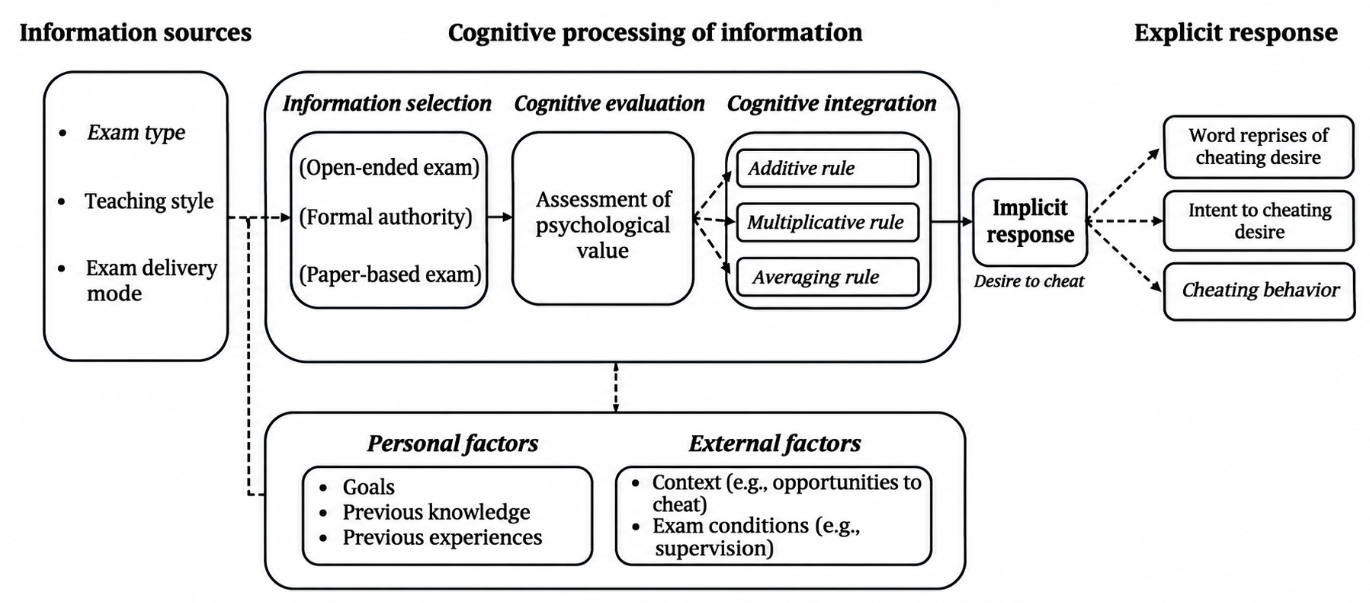
Note. Original conceptual illustration based on the theoretical framework of Anderson (1996) and the application of IIT to academic cheating by Morales-Martinez et al. (2019).
The figure shows how students' minds assign psychological values to stimuli related to their academic assessment experience. They then organize these values into cognitive schemas understood as algebraic patterns or rules, which can manifest as cognitive operations that are summative, multiplicative, or averaging. Cognitive addition means that a person's response (e.g., attitude, judgment) is a function of the sum of the psychological values assigned to the stimuli; that is, each factor contributes independently and linearly to the formation of the judgment. The cognitive rule of averaging holds that people's responses result from a weighted average of the psychological values assigned to stimuli and their relative importance. In cognitive multiplication, the psychological value of one factor's level interacts with that of another; that is, the effect of one factor's level depends on another factor's level.
The IIT proposes using factorial experimental designs to examine these cognitive patterns, meaning how the factors operate individually and jointly through these cognitive rules in people's minds when faced with different situations (Morales-Martínez et al., 2025). In this respect, in the field of education, there are studies on these cognitive mechanisms or functions to account for the formation of judgments in academic motivation (Villarreal-Lozano et al., 2022), mathematical self-efficacy (Villarreal-Treviño et al., 2017), exam anxiety (Hedlefs-Aguilar et al., 2021; Morales-Martínez et al., 2021), and school inclusion (Morales et al., 2014), among others.
Considering the flexibility of cognitive algebra for exploring diverse phenomena, Morales-Martinez et al. (2019) explored the cognitive functions underlying the desire to cheat during exams in 327 engineering students by using 12 hypothetical assessment scenarios combining teaching style, exam type, and exam delivery mode. Participants rated their likelihood of cheating in each scenario. The findings identified four cognitive styles based on their level of desire to cheat: very low, low, moderate, or high. The cluster with no desire to cheat and the group with low desire both selected the exam type and delivery method as the most relevant factors. The cluster with moderate desire considered only the delivery method when forming their judgment. In contrast, the last group, with the highest desire to cheat, gave greater importance to teaching style, test type, and delivery method.
Although the findings of this study provide experimental evidence that the desire to cheat on exams is not necessarily a matter of chance—but rather that students evaluate and integrate certain environmental factors in a seemingly systematic way when considering their academic cheating desire—there remain key aspects yet to be explored. Specifically, this study identified a cognitive rule for information integration that is common across four distinct cognitive response profiles regarding factors associated with the desire to cheat (three of which are context-dependent, while the other one is independent of the specific evaluative circumstances). Notably, the mode of exam administration emerged as the most statistically significant factor in three of the four groups. However, this study did not investigate whether these response patterns persist across different contextual settings and academic disciplines, nor did it utilize a more balanced and diverse sample. Furthermore, the results indicated a higher average desire to cheat among men (M = 3.5) than among women (M = 2.48). However, the disparity in group sizes could have influenced the findings. Consequently, further research is needed to determine whether these gender-based differences in the desire to cheat remain consistent when the number of male participants in the sample is increased.
Given this, the present study explores how the cognitive functions underlying the desire to cheat during exams vary across three distinct groups of university students, assessed during three different periods: before, during, and after the COVID-19 pandemic. To this end, the authors examined the three cognitive functions proposed by Information Integration Theory (IIT)—response, valuation, and information integration—based on students' judgments regarding their desire to cheat in hypothetical assessment scenarios. These scenarios combined information derived from three contextual factors: the mode of exam administration, the type of exam, and the teaching style, following the research design established by Morales-Martinez et al. (2019).
Methodology
Research Design
This study employed the cognitive algebra experimental design of Morales-Martinez et al. (2019), which involved the orthogonal combination of three factors: Teaching Style (Formal Authority vs. Delegator), Exam Type (Closed vs. Open), and Exam Delivery Mode (Face-to-face/Paper vs. Face-to-face/Digital vs. Distance/Digital). This combination yielded 12 experimental conditions, which the researchers used to create the experimental instrument.
Teaching style described the instructor's approach to handling the teaching-learning process. The teacher could direct the learning process (Formal authority) or students assumed greater responsibility for their learning (Delegator). Exam type concerned the kind of questions included in the evaluation. Closed exams consisted of closed-ended questions, while Open exams involved open-ended questions. Exam delivery mode referred to the conditions of information access during examination. Students could take the exam in person using paper (Face-to-face/Paper), in person using digital devices (Face-to-face/Digital), or complete the exam remotely using digital devices.
Materials
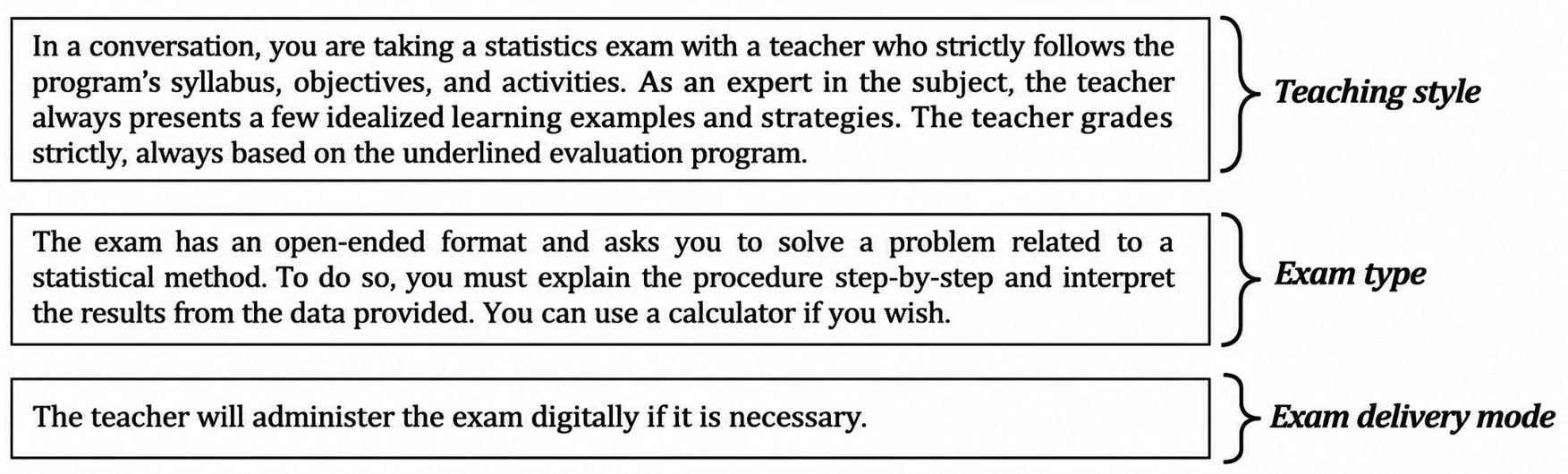
The authors used Morales-Martinez et al.'s (2019) instrument to explore judgments about cheating in school. The instrument comprised 12 experimental scenarios, each narrating a story related to an academic assessment situation constructed from the combinations resulting from the experimental design. Figure 2 illustrates the structure of the experimental scenarios, the content of each situation, and how the combination of experimental factors shaped the narratives.
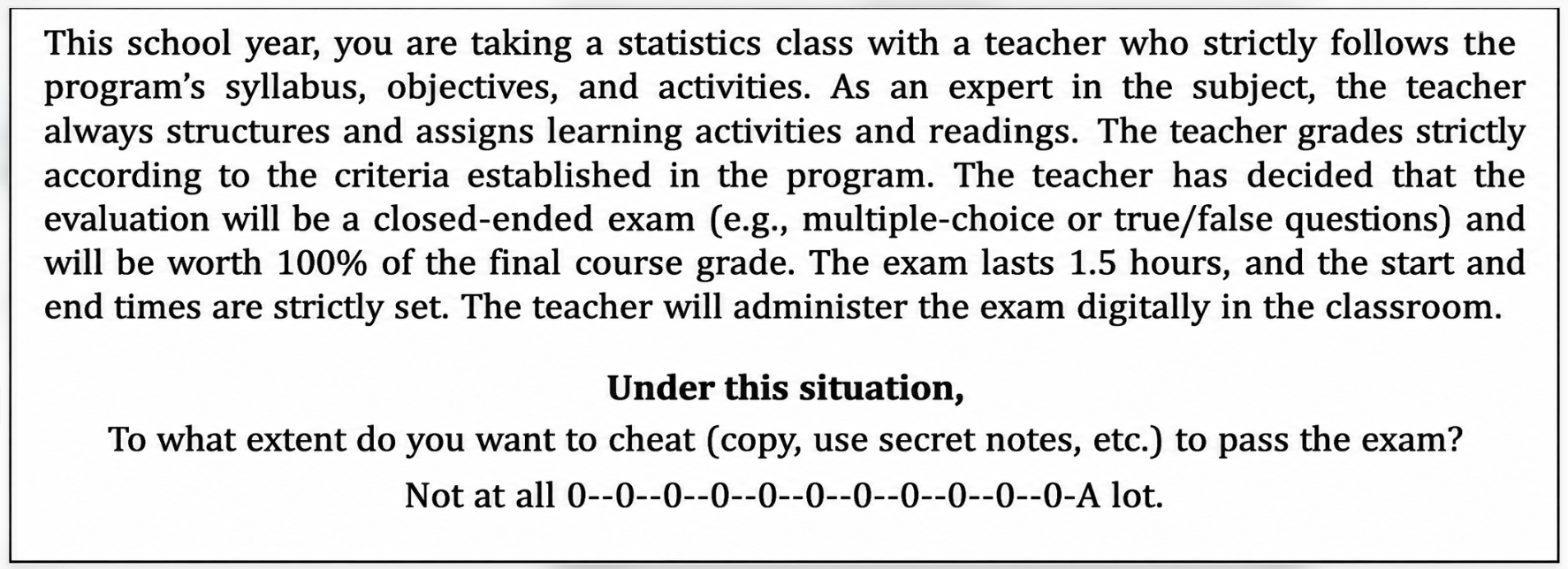
Each scenario had a question about the level of desire to cheat in that situation, along with an eleven-point response scale ranging from "None" to "A lot" (Figure 3). Each point on the scale was represented by an unnumbered circle, allowing participants to divide the perceptual continuum according to their own judgment and to select only one circle, the one that best represented their judgment relative to the scale's anchors.
Morales-Martinez et al. (2019) did not report information regarding the validity of their instrument; however, the information provided in their article indicates that the theoretical grounding of the factors—as established by the authors—supports several aspects of the content validity of the scenarios. First, they cited studies that provide evidence for the theoretical and empirical relevance of the selected factors and their respective levels. Furthermore, the systematic manipulation of these three factors within a factorial design contributes to internal validity by allowing the effects of these factors on participants' judgments to be explored under controlled conditions. Additionally, the scenarios possess ecological validity, as the situations presented are plausible and recognizable as part of the students' everyday academic life. The authors also did not provide evidence regarding the consistency of participants' judgments or the reproducibility of their experimental findings, as their study involved only a single administration of the instrument. Nevertheless, the present study provides evidence for the experimental reproducibility of some of these findings, which is briefly discussed in the final section.
Sample and Data Collection
The study followed a non-probability convenience sampling approach, with 262 university students responding to an open invitation to participate voluntarily. The sample comprised three independent cohorts corresponding to pre-pandemic (2019; n =99, 38%), pandemic (2021; n=65, 25%), and post-pandemic (2024; n =98, 37%) periods. All students were enrolled at public universities; Table 1 presents the demographic and academic characteristics of participants in each cohort.
Table 1. Demographic and academic characteristics of participants by cohort
| Characteristic | Pre-pandemic 2019 (n=99) | Pandemic 2021 (n=65) | Post-pandemic 2024 (n=98) |
| Age, M (SD) | 18.68 (1.79) | 21.15 (2.13) | 20.17 (3.10) |
| Gender, n (%) | |||
| Female | 82 (82.8) | 43 (66.2) | 35 (35.7) |
| Male | 17 (17.2) | 22 (33.8) | 63 (64.3) |
| Geographic region, n (%) | |||
| Southern Mexico | 0 (0.0) | 65 (100.0) | 98 (100.0) |
| Northern Mexico | 55 (55.6) | 0 (0.0) | 0 (0.0) |
| Central Mexico | 44 (44.4) | 0 (0.0) | 0 (0.0) |
| Academic field, n (%) | |||
| Humanities and social sciences | 99 (100.0) | 65 (100.0) | 7 (7.1) |
| Psychology | 99 (100.0) | 65 (100.0) | 0 (0.0) |
| Business administration | 0 (0.0) | 0 (0.0) | 7 (7.1) |
| Science and technology | 0 (0.0) | 0 (0.0) | 91 (92.9) |
| Civil engineering | 0 (0.0) | 0 (0.0) | 53 (54.1) |
| Biomedical engineering | 0 (0.0) | 0 (0.0) | 38 (38.8) |
| Academic semester, n (%) | |||
| First–third | 55 (55.6) | 19 (29.2) | 53 (54.1) |
| Fourth–sixth | 44 (44.4) | 36 (55.4) | 20 (20.4) |
| Seventh–tenth | 0 (0.0) | 10 (15.4) | 21 (21.4) |
| Third semester–master’s degree | 0 (0.0) | 0 (0.0) | 4 (4.1) |
Note. n (%) = number and percentage of subjects. M = mean; SD = standard deviation. Percentages use each cohort's sample size as the denominator.
Procedure
The Study
Data collection took place at three time points, before the COVID-19 pandemic (2019), during the pandemic (2021), and after the pandemic (2024). At each time point, the study comprised three stages. In the first stage, experimenters conducted a virtual information session (during pandemic) or in-person session (before and after the pandemic) to explain the objectives and implications of the study, as well as participants' rights. Afterward, volunteers who agreed to participate provided verbal informed consent. During the second stage, researchers asked participants to practice the experimental task and ask questions to clarify any doubts. Finally, researchers administered the study in group sessions, presenting each experimental scenario in random order. The participants' experimental task was to read each scenario and answer a question about their level of desire to cheat during the exam. To do this, students marked their answers on an eleven-point scale by clicking the corresponding circle using the survey platform. Participants took approximately 20 to 30 minutes to read and respond to the experimental scenarios, depending on each participant's reading speed.
Analysis of Data
The present research codified the participants’ answers across the 12 experimental conditions on an 11-point scale of cheating desire ranging from 0 to 10. The data were saved directly from the survey platform in CSV format for subsequent statistical analysis using STATISTICA software (StatSoft, Inc., 2007). First, we applied a repeated-measures ANOVA using IIT and cognitive algebra as the framework to identify cognitive rules (Function I) through interaction patterns among factors. Afterward, we conducted a mixed ANOVA to examine differences in cognitive behavior, accounting for gender and time of application. Finally, we used cluster analysis to explore cognitive patterns across the sample and applied a repeated-measures ANOVA for each cluster.
Findings/Results
The present authors applied a repeated-measures ANOVA to the participants' responses, with the following variables: 2 (Teaching Style: Formal Authority vs. Delegator), 2 (Exam Type: Closed vs. Open), and 3 (Exam Delivery Mode: Face-to-face/paper vs. Face-to-face/Digital vs. Distance-Digital). The significance level was p ≤ .001.
First, we examined the statistical assumptions underlying the repeated-measures ANOVA. To ensure the independence-of-observations assumption, participants completed the experimental conditions individually without interacting with one another. Furthermore, the experimental conditions were presented in a randomized order. Second, Shapiro-Wilk tests (W = .780-.898, all p<.001) and visual inspection of Q-Q plots for the 12 conditions showed departures from normality. The distributions exhibited positive skewness (.410-1.210) and kurtosis ranging from -1.200 to .506. Additionally, since Mauchly's test detected violations of the sphericity assumption for Exam delivery mode (W=.597, p<.001, ε = .713), Teaching style x Exam delivery mode (W=.972, p=.027, ε = .973), and Exam type x Exam delivery mode (W=.963, p=.008, ε = .965), we applied Greenhouse-Geisser corrections to these effects. Despite these findings, we retained the repeated-measures ANOVA, given evidence that the F test can be reasonably robust to departures from normality (Anderson, 2001). Also, the visual inspection of boxplots did not identify any outliers. Finally, after applying Greenhouse-Geisser corrections, the conclusion regarding statistical significance remained unchanged.
The results indicated that exam delivery mode (p2=.19) had the largest effect. In this regard, distance-digital exams showed the highest desire to cheat (M=3.75, SE= .17), followed by face-to-face-digital exams (M = 2.61, SE= .15), and face-to-face-paper exams (M=2.54, SE = .15). Regarding exam type (p2=.08), participants reported a higher desire to cheat in open exams (M = 3.16, SE = .15) than in closed exams (M = 2.78, SE = .15). Neither teaching style nor any interaction effects reached the significance threshold (Table 2).
Table 2. Overall ANOVA
| Source | df1 | MS Effect | df2 | MS Error | F | p | p2 |
| N=262, M=2.96, SD=2.3 | |||||||
| Teaching style (Ts) | 1 | 21.667 | 261 | 5.196 | 4.170 | .042 | .016 |
| Exam Type (E) | 1 | 115.652 | 261 | 4.668 | 24.774 | .000* | .087 |
| Mode (M)(GG) | 1.43 | 674.167 | 371.96 | 10.635 | 63.389 | .000* | .195 |
| Ts * E | 1 | 0.484 | 261 | 3.004 | 0.161 | .689 | .001 |
| Ts * M(GG) | 1.95 | 1.366 | 508.01 | 2.560 | 0.534 | .582 | .002 |
| E * M(GG) | 1.93 | 2.460 | 503.58 | 2.804 | 0.877 | .413 | .003 |
| Ts * E * M | 2 | 6.037 | 522 | 2.813 | 2.146 | .118 | .008 |
Note. n = number of subjects; M = mean; SD = standard deviation; df1 = numerator degrees of freedom; df2 = denominator degrees of freedom; p2 = partial eta squared; MS Effect = Mean Square for the Effect; MS Error = Mean Square for the Error; F = F statistic; p = p-value; GG = Greenhouse-Geisser correction; Significance level: *p ≤. 001.
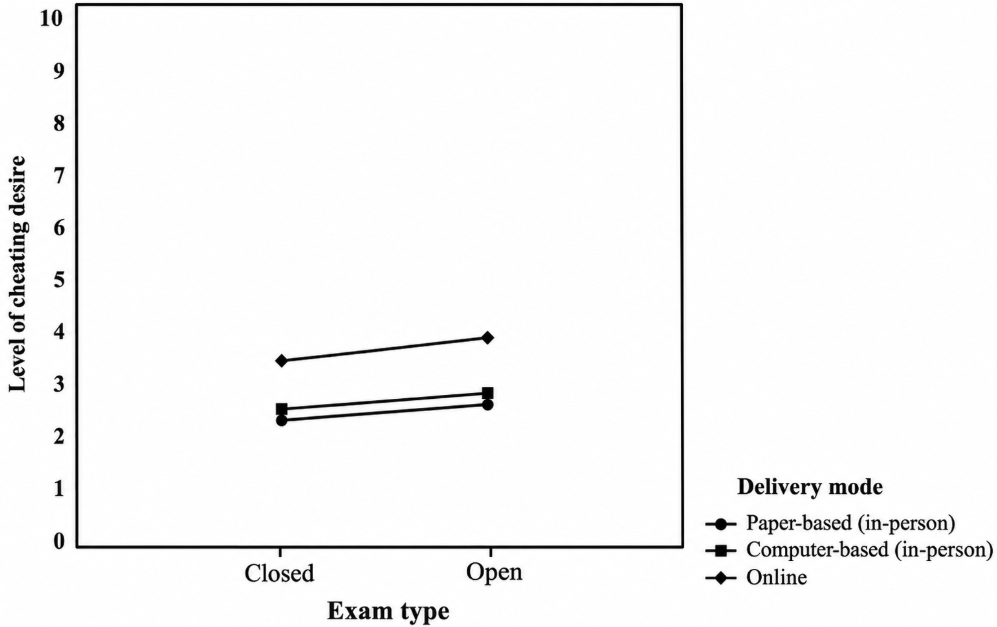
Figure 4 illustrates the cognitive integration pattern of the significant factors, exam delivery mode and exam type. The three lines show similar slopes, suggesting that changes in cheating desire between exam types were consistent across exam delivery modes. Together with the absence of statistically significant interaction between the factors (Table 2), this pattern aligns with the Anderson's (1996) parallelism theorem, which predicts parallel lines in factorial graphs when information is integrated through an additive psychological rule, assuming a linear response function.
The present researchers conducted several mixed-type ANOVAs to examine whether the integration mechanism (Function I) differed across participants by gender, application time or cognitive profile. First, the researchers examined the statistical assumption for the mixed ANOVA. Based on visual inspection of Q-Q plots and Shapiro-Wilk tests, there were departures from normality across the twelve experimental conditions for both men (W = .746-.874, all p <.001) and women (W = .800-.911, all p <.001). The distributions for men (.541-1.650) and women (.329-1.100) showed positive skewness, while kurtosis values ranged from -1.150 to 2.130, and -1.21 to .0746, respectively. Mauchly's test detected violations of sphericity for exam delivery mode (W = .595, p<.001, ε =.712), teaching style × exam delivery mode (W = .969, p= .016, ε =.970), and exam type × exam delivery mode (W = .967, p = .014, ε = .968). Therefore, we applied Greenhouse-Geisser corrections to these effects. Levene's test also indicated unequal variances among women and men in three of the twelve experimental conditions (p= .027, .007, and .004).
The mixed ANOVA indicated no significant differences [F(1, 260) = 1.110, p = .293, ηp² = .004] in the R function between men (M=2.77, SD=2.21) and women (M=3.09, SD =2.49). The factor with the most statistically significant effect was exam delivery mode [F(1.42, 370.04) = 59.930, p< .001, ηp² = .187]. Also, exam type had a significant main effect [F(1, 260) = 23.624, p< .001, ηp² = .083]. Analysis did not show a significant interaction between these factors. To explore the V and I cognitive functions within each gender, we applied a repeated-measures ANOVA for men and women (Table 3). Mauchly's test indicated violations of sphericity assumption for exam delivery mode in women (W = .595, p < .001, ε =.712) and men (W = .591, p < .001, ε =.710), teaching style x exam delivery mode in women (W = .952, p = .020, ε =.954), and exam type x exam delivery mode in women (W = .895, p < .001, ε =.905). Therefore, we applied Greenhouse-Geisser corrections to these effects.
Table 3. Repeated Measures ANOVA for Each Gender
Note. n= number of subjects; M = mean; SD = standard deviation; df1 = numerator degrees of freedom; df2 = denominator degrees of freedom; p2 = partial eta squared; MS Effect = Mean Square for the Effect; MS Error = Mean Square for the Error; F = F statistic; p = p-value; GG = Greenhouse-Geisser correction; Significance level: *p ≤.001.
Separate repeated-measures ANOVA revealed the largest effect size for exam delivery mode in both women (p2=.224) and men (p2=.163). Also, exam type had a significant main effect in women (p2=.082), whereas in men it did not reach the established significance level (p = .0016, p2=.094). Teaching style and all interactions were not statistically significant at p ≤.001 (Table 3). Figure 5 showed the relationship between exam type and exam delivery mode separately for women and men. The line patterns suggest both groups have a similar V-function. Although there is a crossover among men, the three-way interaction between exam type, exam delivery mode, and gender did not reach the predefined significance threshold after applying Greenhouse-Geisser correction [F(1.94, 503.58) = 3.499, p = .032, ηp² = .013]. Therefore, differences in Function I between genders do not appear to be statistically significant.
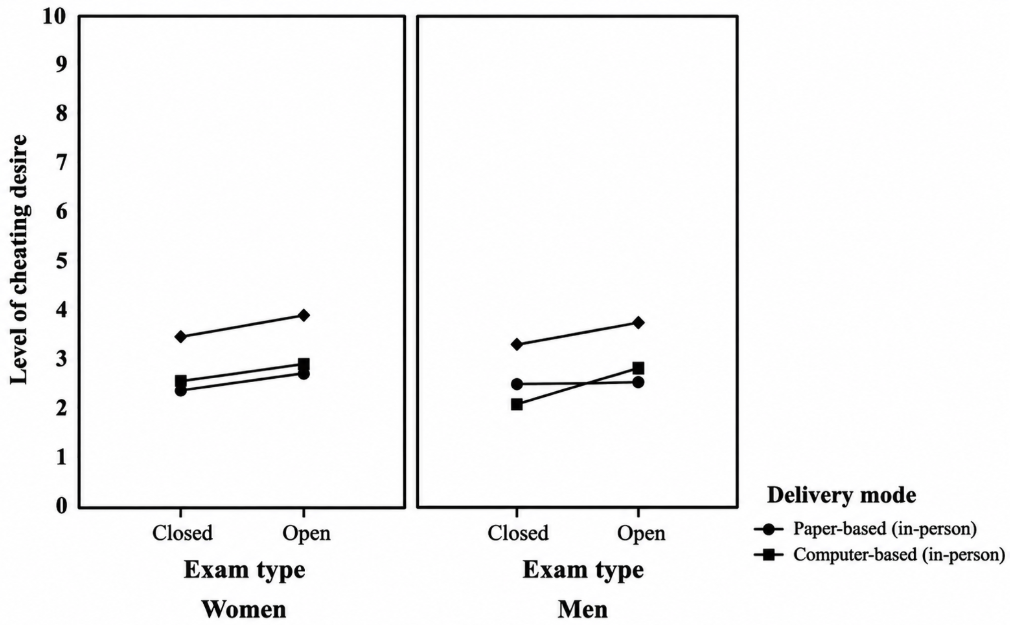
The interaction pattern suggests that for women, the information from the two selected pieces of information in the scenarios is systematically integrated, consistent with a summative cognitive rule. Furthermore, a mixed ANOVA was used to compare participants' responses across application time (pre-pandemic, pandemic, post-pandemic). The significance level was set at p≤ .001. First, we explored the statistical assumptions underlying the analysis. Shapiro-Wilk test (W = .724-.936, all p≤ .002) and visual inspection of Q-Q plots across the 36 experimental conditions revealed departures from normality. The distribution showed positive skewness, ranging from .0169 to 1.640, and kurtosis values ranging from -1.400 to 2.160. Levene's test indicated homogeneity of variance across the three time periods for 11 of the 12 experimental conditions (.185-3.983, all p≤ .073); the only exception was delegator teaching style, open exams × face-to-face paper delivery (F(2,259) = 3.983, p = .020). Mauchly's test detected violations of the sphericity assumption for exam delivery mode (W = .623, p<.001, ε =.726), teaching style × exam delivery mode (W = .972, p= .026, ε =.973), and exam type × exam delivery mode (W = .961, p<.006, ε =.962). We applied Greenhouse-Geisser correction to these effects and their interaction with time, and this did not change the conclusions of statistical significance.
The results indicated that there are no statistically significant differences in the R-Function [F(2, 259) = 1.795, p = .168, p2= .014] between the three moments. However, students showed slightly more desire to cheat during the pandemic (M= 3.22, SE= .296) and pre-pandemic (M=3.16, SE = .240) than during the post-pandemic period (M= 2.61, SE= .241). Exam delivery mode had the largest effect [F(1.45, 376.29) = 74.143, p ≤.001, p2= .223], students experienced more desire to cheat when exams were administered remotely in digital format (M = 3.83, SE = .178) compared with those carried on face-to-face and in a digital way (M = 2.62, SE = .155), or face-to-face and in a paper format (M = 2.53, SE = .162). Exam type also had a significant main effect [F(1, 259) = 24.887, p ≤.001, p2= .088], open exams produced a greater desire to cheat (M = 3.19, SE = .158) than closed exams (M = 2.80, SE = .152). Teaching style was not statistically significant [F(1, 259) = 2.179, p=.141, p2= .008].
Furthermore, none of the interactions between teaching style and time [F (2, 259) = 4.227, p =.016, p2= .032], exam type and time [F(2, 259) = .480, p =.619, p2= .004], exam type, exam delivery and time (Greenhouse-Geisser corrected) [F(3.85, 498.49) = 2.586, p = .038, p2= .020], or teaching style, exam delivery mode, and time (Greenhouse-Geisser corrected) [F (3.89, 503.89) = 1.906, p = .110, p2= .015] reached the predefined significance level. In contrast, after applying the Greenhouse-Geisser correction, the interaction between exam delivery mode and time was statistically significant [F(2.91, 376.29) = 7.997, p < .001, p2= .058]. This result suggests that the function R, the desire-to-cheat level, differed across delivery modes over the three periods.
Figure 6 is used to examine the integration cognitive mechanism of these factors and the interaction between exam delivery mode and time. Graph analysis is a conventional tool within the framework of integration theory (Anderson, 2001) to scrutinize the functional relationship among factors across the three application periods by observing response levels, slopes, and the curve parallelism. Note that the distance among lines suggests differences in Function V, pre-pandemic and pandemic sample distances in digital exams showed a higher willingness to cheat level than face-to-face delivery modes. In contrast, the post-pandemic group had smaller differences in the cheating desire ratings across delivery modes. Regarding Function I, there seems to be a tendency toward parallelism in the curve patterns, which suggests compatibility with summative cognitive integration.
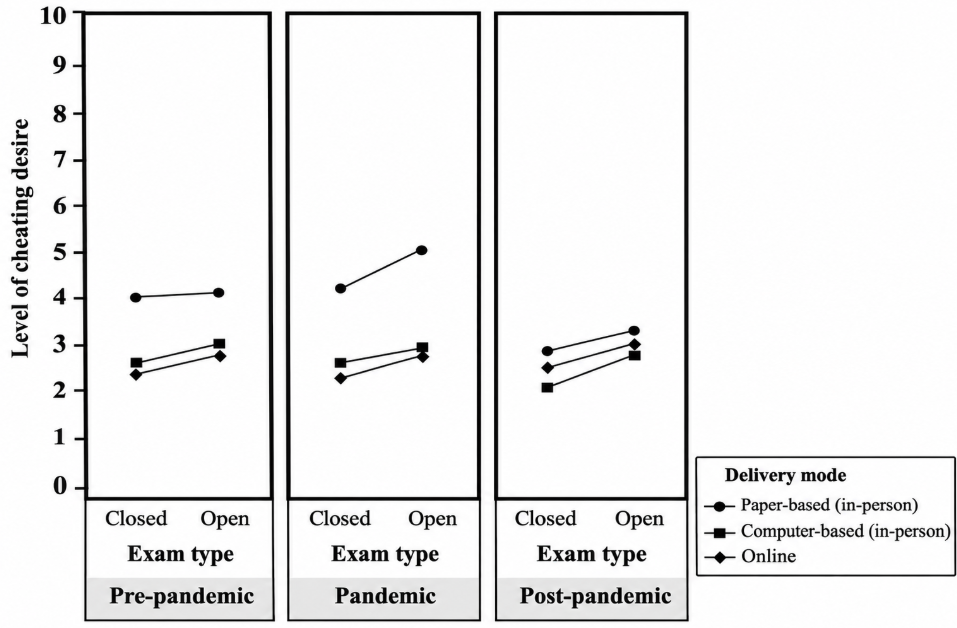
The present authors conducted separate repeated-measures ANOVAs on participants’ data for each application period (pre-pandemic, pandemic, and post-pandemic) to examine the effects of experimental factors within each period, using a significance threshold of p ≤.001. First, we explored statistical assumptions, including visual inspection of Q-Q plots and the Shapiro-Wilk test, and noted departures from normality in all twelve experimental conditions in the pre-pandemic (W =.805-.925, all p≤ .001) and post-pandemic groups (W =.742-.848, all p≤ .001). In the pandemic sample, only one condition showed normality (W =.785-.936, p≤ .001 to p≤ .002). The skewness coefficients were positive across all three periods (pre-pandemic, pandemic, post-pandemic) with values of 0.340–1.12, 0.016–1.35, and 0.741–1.64, respectively. Similarly, the kurtosis ranged from -1.26 to 0.142, -1.40 to 1.11, and -0.895 to 2.16, respectively. Taken together, the results indicate that the distributions evaluated did not meet the assumption of normality in any of the three periods. Mauchly's test indicated violations of sphericity for exam delivery mode (all p<.001) in pre-pandemic (W = .490, p<.001, ε =.662), pandemic (W = .411, p<.001, ε =.629), and post-pandemic (W = .761, p<.001, ε =.807), teaching style by exam delivery mode interaction in the pre-pandemic (W = .890, p=.004, ε =.901), pandemic (W = .846, p=.005, ε =.866), and post-pandemic (W = .918, p=.017, ε =.990). We then applied Greenhouse-Geisser corrections to these effects.
The results showed different answer patterns across three samples (Table 4). The exam delivery mode was the only factor statistically significant for the pre-pandemic (p2= .225) and pandemic groups (p2= .39), while during the post-pandemic period, exam type (p2= .105) was the only one that reached the pre-established significance level. Teaching style and all interactions among the factors were not statistically significant.
Table 4. Repeated Repeated Measures ANOVA for Each Application Time
Note. n = number of subjects; M = mean; SD = standard deviation; df1 = numerator degrees of freedom; df2 = denominator degrees of freedom; p2 = partial eta squared; MS Effect = Mean Square for the Effect; MS Error = Mean Square for the Error; F = F statistic; p = p-value; GG = Greenhouse-Geisser correction; Significance level: *p ≤.001.
Finally, to complement the analysis and examine heterogeneity in the students’ cheating desire judgments across experimental conditions, we applied a cluster analysis (K-means). We identified distinct cognitive profiles of academic cheating propensity. The present researchers determined the number of clusters using the Elbow method (Figure 7, Panel A), examining solutions ranging from K = 2 to K = 8. The within-cluster sum of squares (WSS) fell from 16,090 at K=2 to 13,244.05 at K = 3, representing a reduction of 2,846.36 units. The K =4 solution further reduced the WSS by 1,402.70 units, reaching 11,841.35. After K = 4, additional reductions were smaller (Figure 7, Panel A). Furthermore, the Gap statistical analysis indicated a four-cluster solution (Figure 7, Panel B) supporting this choice. The four-cluster structure was consistent across two statistical implementations, one with STATISTIC and another with jamovi (The jamovi project, 2025); the adjusted Rand index (ARI = 0.966) showed high agreement between both analyses, and 98.1% of participants were assigned to their corresponding cluster.
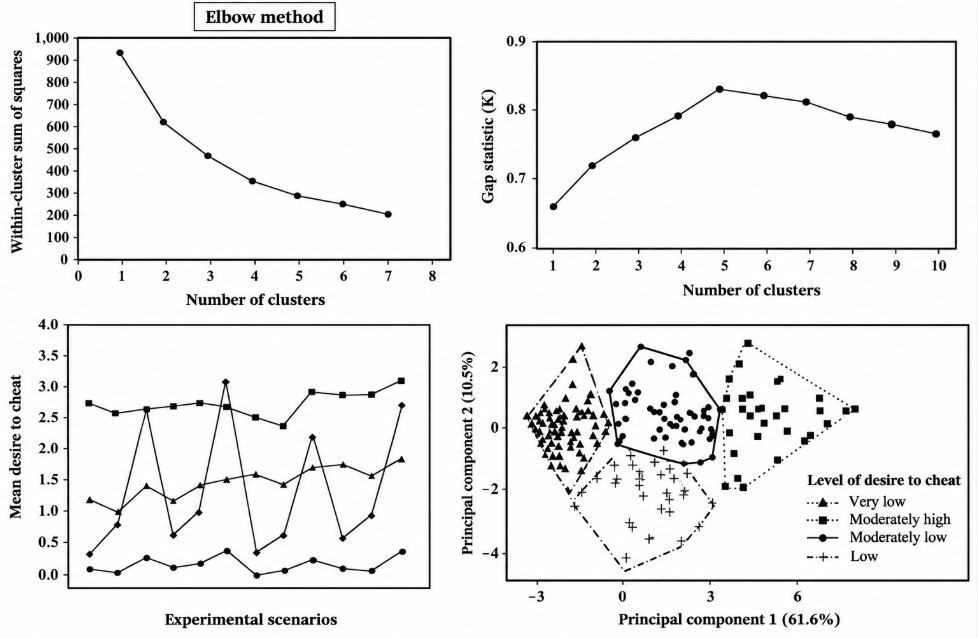
The cluster centroids showed that the level of desire to cheat differed across four groups, and their responses across 12 experimental scenarios (Figure 7, Panel C; Table 5). The patterns of desire to cheat ranged from very low (n=123, 46.9%) to moderately high (n=33, 12.6%), moderately low (n=69, 26.3%), and low and context-dependent (N =37, 14.1%). We then retained the four-cluster solution based on the additional reduction in within-cluster variability and its interpretability, given that Morales-Martinez et al. (2019) identified four distinct profiles of academic cheating propensity.
Table 5. Cluster centroid across the twelve experimental scenarios or conditions
| Experimental scenario | Cluster 1 Very low | Cluster 2 Moderately high | Cluster 3 Moderately low | Cluster 4 Low |
| n=123, M=.86, SD =.66 | n=33, M=7.32, SD =1.11 | n=69, M=4.21, SD =.97 | n=37, M=3.76, SD =.99 | |
| 1. | .70 | 7.39 | 4.54 | 1.27 |
| 2. | .50 | 6.97 | 3.03 | 2.46 |
| 3. | 1.11 | 7.15 | 4.06 | 7.05 |
| 4. | .72 | 7.24 | 3.52 | 2.08 |
| 5. | .87 | 7.39 | 4.12 | 7.95 |
| 6. | 1.46 | 7.24 | 4.35 | 1.30 |
| 7. | .44 | 6.85 | 4.49 | 2.05 |
| 8. | .63 | 6.45 | 4.13 | 6.03 |
| 9. | 1.11 | 7.76 | 4.80 | 1.95 |
| 10. | .78 | 7.64 | 4.91 | 2.73 |
| 11. | .61 | 8.12 | 4.57 | 7.27 |
| 12. | 1.41 | 7.32 | 5.01 | 3.77 |
Note. n = number of subjects; M = mean or average across the 12 experimental scenarios; SD= standard deviation.
The PCA graph showed distinguishable patterns in the distribution of participants (Figure 7, Panel D). Very low and moderately high desire-to-cheat clusters occupied different regions of the first principal component. In contrast, the moderately low and low groups were in central regions and overlapped. After identifying these clusters, we analyzed the demographic composition of each one (Table 6).
Table 6. Distribution of Participants Across the Four Clusters
| Characteristic | Cluster 1 (n=123) | Cluster 2 (n=33) | Cluster 3 (n=69) | Cluster 4 (n=37) |
| Age, M(SD) | 20.1(3.02) | 19.2(1.70) | 19.5(2.29) | 20.1(2.38) |
| Gender, n (%) | ||||
| Female | 75(61.0) | 24(72.7) | 39(56.5) | 22(59.5) |
| Male | 48(39.0) | 9(27.3) | 30(43.5) | 15(40.5) |
| Assessment period, n(%) | ||||
| Pre-pandemic | 45(36.6) | 15(45.5) | 27(39.1) | 12(32.4) |
| Pandemic | 25(20.3) | 8(24.2) | 16(23.2) | 16(43.2) |
| Post-pandemic | 53(43.1) | 10(30.3) | 26(37.7) | 9(24.3) |
| Geographic region, n (%) | ||||
| Southern Mexico | 78(63.4) | 18(54.5) | 42(60.9) | 25(67.6) |
| Northern Mexico | 22(17.9) | 10(30.3) | 17(24.6) | 6(16.2) |
| Central Mexico | 23(18.7) | 5(15.2) | 10(14.5) | 6(16.2) |
| Academic field, n (%) | ||||
| Humanities and social sciences | 75(61.0) | 24(72.7) | 43(62.3) | 29(78.4) |
| Psychology | 70(56.9) | 23(69.7) | 43(62.3) | 28(75.7) |
| Business administration | 5(4.1) | 1(3.0) | 0(0.0) | 1(2.7) |
| Science and technology | 48(39.0) | 9(27.3) | 26(37.7) | 8(21.6) |
| Civil engineering | 27(22.0) | 6(18.2) | 15(21.7) | 5(13.5) |
| Biomedical engineering | 21(17.1) | 3(9.1) | 11(15.9) | 3(8.1) |
| Academic semester, n (%) | ||||
| First-Third | 56(45.5) | 17(51.5) | 40(58.0) | 14(37.8) |
| Fourth-sixth | 47(38.2) | 13(39.4) | 22(31.9) | 18(48.6) |
| Seventh-Tenth | 17(13.8) | 3(9.1) | 7(10.1) | 4(10.8) |
| Third semester-master’s degree | 3(2.4) | 0(0.0) | 0(0.0) | 1(2.7) |
Note. n (%) = number and percentage of subjects. M = mean; SD = standard deviation. Percentages use each cluster's sample size as the denominator.
The sociodemographic characteristics provide a descriptive overview of the composition of the four clusters. In addition to characterizing differences in participants’ judgment patterns, we examined how participants within each cluster responded to the different experimental conditions using repeated-measures ANOVAs. First, we analyzed the statistical assumptions. The Shapiro-Wilk test indicated departures from normality in all twelve experimental conditions in clusters 1 and 4, ten of twelve conditions in Cluster 2, and eleven of twelve conditions in Cluster 3 (p<.05). The Mauchly’s test results revealed that there were violations of the sphericity assumption in Cluster 1 for exam delivery mode and all its interactions (W = .728-.949, p ≤.001 to p ≤.042), in Cluster 2 the exam type x exam delivery mode (W=.720, p= .006, ε =.781); in Cluster 3 for exam delivery mode (W = .828, p =.002, ε =.853) and the three-way interaction (W = .882, p = .015, ε =.895), and in Cluster 4 for exam delivery mode (W = .826, p =.035, ε =.852). Then Greenhouse-Geisser corrections were applied to these effects.
The results revealed differences in cognitive patterns across the four clusters (Table 7). Exam type (p2= .08) and exam delivery mode (p2= .17) were significant effects in Cluster 1. The desire to cheat was stronger for open exams (M= .974, SE = .073) than for closed exams (M= .749, SE = .065). Regarding delivery mode, students reported the highest willingness to cheat during distance-digital exams (M= 1.270, SE = .1014) compared with face-to-face paper-based (M= .661, SE = .080) and face-to-face digital exams (M= .654, SE = .065). In Cluster 2, none of the main effects or interactions reached the established significance level (p ≤.001). In Cluster 3, teaching style was the only significant factor (p2= .197). Students reported a higher level of cheating desire when teacher style was delegator (M= 4.65, SE = .166) compared with formal authority style (M= 3.77, SE = .153). In Cluster 4, the most statistically significant factors were Exam type (p2= .280) and exam delivery mode (p2= .821); cheating desire scores were higher with open exams (M= 4.17, SE = .22) than closed exams (M= 3.36, SE = .176). Distance-digital exams elicited the highest cheating desire scores (M= 7.07, SE = .274) followed by face-to-face paper-based (M= 2.57, SE = .247) and face-to-face digital exams (M= 1.65, SE = .214). None of the interaction effects were statistically significant in any of the four clusters.
Table 7. Repeated measures ANOVA for each grouping
ote. n = number of subjects; M = mean; SD = standard deviation; df1 = numerator degrees of freedom; df2 = denominator degrees of freedom; p2 = partial eta squared; MS Effect = Mean Square for the Effect; MS Error = Mean Square for the Error; F = F statistic; p = p-value; GG = Greenhouse-Geisser correction; Significance level: *p ≤.001.
The interaction plots (Figure 8) illustrate the cognitive patterns of Clusters 1 and 4, both of which showed significant main effects for exam type and exam delivery mode. The plots allow us to examine the valuation (V-function) and integration (I-function) of these factors. Regarding the V-function, the vertical separation among the three curves suggests differences in the relative valuation of exam delivery modes within each cluster. These differences appear more pronounced in Cluster 4 than Cluster 1.
Regarding the I-function, both clusters showed parallel curves, consistent with a summative cognitive integration rule. This result suggests that the contribution of exam type to cheating-desire judgments remains constant across the three exam delivery modes.
Discussion
Few studies examine the cognitive functions (R, V, I) that underlie the reported desire to cheat in online and in-person exams. This study contributed to exploring, in light of the IIT, how these functions are expressed across different contexts (pre-pandemic, pandemic, and post-pandemic), gender, and cognitive profiles. To this end, the present authors examined the R function, which refers to the explicit desire to cheat; they found that the mean of this desire is relatively similar between genders (Table 3). These findings are consistent with previous research that found academic cheating is comparable between men and women (Aruğaslan, 2024; Ip et al., 2018). In contrast, Morales-Martinez et al. (2019) obtained differences in the cheating desire level among men and women; however, the discrepancies in the sample size by gender could have affected this result.
However, the results suggest heterogeneity in the R Function across participants. Regarding this, the cluster analysis identified four levels of academic cheating desire (Tables 5 and 7); participants showed variation in their cheating desire from very low to medium-high. This result indicates different cognitive patterns for processing similar information about academic assessment situations. This finding is consistent with the results of Morales-Martinez et al.'s (2019) study in engineering students. From the IIT view (Anderson, 1996), different patterns in valuation and integration functions could lead to different response patterns. To explore this possibility, the present authors examined how contextual factors (teaching style, exam type, and exam delivery mode) contribute, alone or in combination, to the formation of reported desire to cheat.
First, the overall analysis indicated that participants selected exam delivery mode and exam type as the most relevant factors shaping their desire to cheat (Table 2, Figure 4). Morales-Martinez et al. (2019) found a similar result; however, those authors did not discuss the possible reasons for this finding. However, the present authors suppose that students pay more attention to these factors because they convey implicit information about their abilities and the implications of the circumstances under which they will take the exam. For example, the perceived complexity of the exam type may influence students' expectations of success, which in turn may affect their desire to cheat. This interpretation is consistent with previous findings showing that exam conditions and assessment formats are associated with differences in students' temptation to cheat (Henderson, Chung, Awdry, Ashford, et al., 2023; Novick et al., 2022). Furthermore, online testing seems to influence students' perception that there are more opportunities to cheat, since they know distance reduces the possibility of exam supervision (Alguacil et al., 2024; Johnson-Clements et al., 2025; Newton & Essex, 2024).
An interesting finding in the present study is that participants did not consider the teaching style factor relevant when judging their desire to cheat on the exam. This contrasts with previous research that highlights the importance of the student–teacher relationship in educational contexts (Bretag et al., 2019; Sonbuchner et al., 2022). However, Madriaga (2026) found a similar result; they reported that students said the teacher's style did not matter in engaging in academic cheating during examinations.
On the other hand, the mixed ANOVA by application time showed that the mean cheating desire was similar across the three times. However, there were differences in the statistically significant factors by application period (Table 4). For the pre-pandemic and pandemic groups, the most significant factor was the exam mode of delivery, while for the post-pandemic group it was the exam type (Table 4). It is possible that, in this last group, the students focused on task demand. In contrast, before and during the pandemic, they seemed to focus on exam administration conditions, which could relate to the familiarity students gained with the digital and distance-learning environment. However, this interpretation should be considered cautiously, as differences in cohort composition and data collection may also have contributed to the observed patterns.
Regarding cognitive profiles across the levels of desire to cheat: very low, low, moderately low, and moderately high (see Table 7), there were some differences related to the psychological relevance assigned to the experimental factors. In the present study, only students with very low and low cheating desire (clusters 1 and 4, respectively) showed statistically significant effects for two factors: exam delivery mode and exam type. Morales-Martinez et al. (2019) found that these factors were relevant in three clusters (very low, low, and high desire to cheat) of the four clusters. Despite this difference, the groups with very low and low cheating desire in both studies assigned similar relevance weight to these factors. They showed comparable cognitive patterns in the response (R), valuation (V), and integration (I) functions (Figure 8). These similarities suggest that certain cognitive processes underlying cheating desire may be observed across different student groups.
On the other hand, for the moderately high cheating desire group, none of the experimental factors were statistically relevant to their cheating desire judgments. This finding differs from Morales-Martinez et al. (2019), who reported that students with the highest cheating desire assigned relevance to all three assessment factors. This result could suggest that participants in this group are relatively context-independent, meaning their cheating desire judgments remain similar in magnitude regardless of the specific assessment conditions. However, future research should include additional contextual and individual variables to understand this cognitive pattern better.
The cluster with a moderately low desire to cheat selected teaching style as the only relevant factor in forming their judgment. This result suggests two possibilities: first, participants in this group considered teacher characteristics to evaluate the likelihood of negative consequences, depending on the degree of permissiveness associated with each teaching style. This interpretation could be consistent with Sonbuchner et al. (2022), who identified fear of being caught as an important factor discouraging academic dishonesty. Second, Sonbuchner also reported that students considered respect for the teacher a relevant factor in preventing dishonest behavior. Thus, the relevance of teacher style in this study may reflect different students' perceptions of the teacher, which affect their desire to cheat academically.
Regarding the systematic thinking patterns underlying the desire to deceive, the results indicate no differences between the cognitive pattern reported by Morales-Martinez et al. (2019) and that observed in the present study across the entire sample (Figures 4, 5, 6, and 8). At a general level, students integrated the information using a similar cognitive rule in both studies.
In sum, from the perspective of IIT, this study's findings highlight that variability in academic cheating desire depends not only on the individual and conjoint effects of the factors involved in the situation, but also on how students value these factors. Although the I-function appears relatively similar across conditions, the V-function varies depending on contextual information. Therefore, the desire to cheat (R) is not a uniform response to situations; rather, it results from how students value and make meaning of the information they receive from their environment.
Conclusion
In general, the study results indicated that the desire to cheat (R Function) varied considerably across students and examination conditions, with scores ranging from very low to moderately high. However, the overall level of cheating desire (R-Function) and the patterns associated with the cognitive integration mechanism (I-Function) exhibited a certain degree of consistency across demographic (gender) and contextual (pre-pandemic, pandemic, and post-pandemic) conditions. Nevertheless, the influence of the evaluation conditions varied across the three periods. These findings should be interpreted with caution, given the independent origin of the samples.
The level of desire to cheat varies across different examination circumstances. These variations appear to reflect differences in how students evaluate those circumstances (V Function) rather than reflecting changes in the cognitive mechanism that integrates the information (I Function). Therefore, these findings highlight the potential importance of examining the cognitive appraisal processes through which students evaluate assessment conditions to understand better their desire to engage in academic dishonesty.
The cluster analysis suggested different cognitive response profiles associated with the level of desire to engage in academic cheating; however, there is insufficient information to interpret the cognitive nature of these profiles clearly. This points to the need for further research into the systematic processing of factors related to the desire to commit acts of dishonesty, which would help clarify the relationship between cheating desire and cognitive profiles.
Finally, the results suggest that students may evaluate the same examination circumstances differently, even when their patterns of information integration are relatively similar. These findings illustrate the potential usefulness of the cognitive algebra paradigm for identifying different patterns of cognitive judgment. This paradigm is useful for exploring variations in functions I and V, providing insight into how students assign psychological value to examination conditions and combine this information into cognitive algebraic schemas when judging their desire to cheat. This contribution highlights the potential value of IIT and cognitive algebra for advancing the theoretical understanding of the desire to engage in academic dishonesty behavior. Thus, this theoretical and methodological approach may inform the future development and empirical evaluation of programs designed to address students' cognitive processes related to academic dishonesty and promote integrity.
Recommendations
The findings of this research invite new lines of investigation to deepen understanding of the cognitive nature of the desire to cheat. First, explore whether the stability of the desire to cheat academically at a given level is robust across generations and population groups, and whether the R function varies under certain sociocultural or age-related conditions. It would also be beneficial to conduct longitudinal studies of specific groups to examine whether the index of the desire to cheat is consistent, and whether the valuation and integration mechanisms that regulate its emergence and maintenance remain stable within the same group. It would either support or refute the findings of this study regarding the dynamic nature of the V function and the stability of the integration mechanism.
In this regard, it would be insightful to explore how the process of evaluating and integrating factors related to the desire to cheat on examinations may vary based on a student’s specific psychological characteristics—such as academic self-concept, resilience to academic pressure, learning style (field-independent or field-dependent), sense of justice, and the degree of reliance on AI tools. These and other factors can modulate or influence the level of temptation to cheat that students experience before and during their academic assessments. Such analysis would shed light on how psychological variables—rooted in a student's identity or personality—not only affect their desire to engage in academic dishonesty but also shape how they perceive various contextual and situational factors during examinations, and how these perceptions ultimately combine to influence their inclination to cheat. Including new variables in studies on cheating desire will broaden the explanatory scope of the IIT model and strengthen its empirical evidence, enhancing our understanding of this topic.
Finally, from an educational perspective, the study's findings suggest that institutions should pay close attention to the design and administration of examinations. Overseeing exam formats and the procedures used for remote testing would help create an assessment environment that accounts for how the human mind perceives opportunities for academic dishonesty, thereby reducing the desire or inclination to engage in such behavior. These measures, when combined with education on academic integrity, would foster the application of best practices during assessments, ultimately ensuring that evaluations fulfill their true purpose: providing useful information to improve teaching and learning processes.
Limitations
The findings of this study are interesting, but their interpretation should consider certain limitations, such as the relatively small sample size and convenience sampling, which limit the sample's representativeness and make it difficult to generalize the findings to other contexts and populations. Furthermore, the use of independent cohorts prevents attributing the observed variations exclusively to the specific evaluation period, since they were not equivalent in terms of geographic origin or academic field of study. Differences in response patterns could also reflect cultural or disciplinary factors.
Additionally, although the experimental instrument was administered in the same digital format—using identical instructions and procedures across all three periods—the invitation and instruction communication during the pandemic period took place virtually. Therefore, one cannot rule out the possibility that this mode of communication may have influenced the participants' responses. Furthermore, this was an exceptional situation, making it difficult to replicate the study under those specific conditions.
On the other hand, the factorial nature of the study allowed the exploration of only a limited number of factors simultaneously. Therefore, the factors explored do not encompass the full range of variables that may influence the desire to cheat. Furthermore, although the scenarios presented plausible situations that might arise in an educational setting, the participants' self-reported desire to cheat on exams does not necessarily correspond to their actual dishonest behavior.
These limitations invite researchers to broaden the scope of studies like this one by increasing sample size, exploring new contexts, and conducting complementary studies that allow exploration of more factors.
Ethics Statements
This study was conducted as part of research project No. 117191, registered at the Institute for Research on University and Education of UNAM. The study involved non-invasive educational research procedures and was conducted in accordance with the Ethical Principles of Psychologists and Code of Conduct of the American Psychological Association (APA). All participants provided informed verbal consent before participation, ensuring voluntary participation, confidentiality, anonymity, and the right to withdraw at any time.
Conflict of Interest
The authors declare no conflicts of interest regarding the authorship or publication of this article.
Funding
The DGAPA-UNAM's Program for Support of Research and Technological Innovation Projects supported this research project (PAPIIT) <
Generative AI Statement
As the authors of this work, we used ChatGPT to assist in correcting spelling and grammar, improving writing style, checking label consistency, and improving figures. We independently verified the bibliographic information against the original publications and carefully reviewed the final manuscript. We take full responsibility for the content of this work.
Authorship Contribution Statement
Sanchez-Monroy: Data acquisition, critical revision of manuscript, final approval. Morales-Martinez: Concept and design, data analysis / interpretation, drafting manuscript, funding, supervision. Mezquita-Hoyos: Data acquisition, statistical analysis, critical revision of manuscript.