


Introduction
The four-day school week (4DSW) is no longer a peripheral practice confined to a small number of rural districts. By the 2024–2025 academic year, more than 2,100 schools in 26 states operated on a four-day schedule (Ordway, 2025). Adoption has grown particularly quickly in states such as Texas, where the number of schools using the 4DSW rose from 30 in 2020–2021 to 506 in 2024–2025 (Ordway, 2025). These trends reflect the growing prominence of the compressed calendar as a policy option in rural education.
Missouri reflects this broader national trend. The number of Missouri public school districts using a four-day calendar has grown from 34 in 2018–2019 to 192 of the state’s 516 districts—about 37%—in 2026–2027. Adoption is concentrated almost entirely in rural communities, where 183 of the 192 districts (95%) are located (Anglum & Park, 2021; Four-Day School Week Resource Center, 2026). This statewide trend differs from the sampling frame used in the present study, which was constructed earlier from the 146 districts operating a four-day calendar at the start of data collection (see Method). The growth of the 4DSW has intensified debates about its effects on student learning, teacher recruitment and retention, school finances, and the broader functioning of rural school systems.
Research on the four-day school week has focused primarily on student achievement. Studies from Oregon (Thompson, 2021), multi-state analyses (Morton et al., 2024), investigations of early elementary students (Thompson et al., 2023), and a recent scoping review of the literature (Grant et al., 2026) converge on a similar conclusion: achievement effects tend to be modest and vary across grade levels, subject areas, and local contexts. Morton et al. (2024) found that rural students generally experienced smaller declines than their non-rural peers. Other studies have produced mixed findings. Anderson and Walker (2015), for example, reported modest positive associations between 4DSW adoption and student achievement in Colorado elementary schools, whereas Thompson and Ward (2022) found that achievement outcomes depended largely on the amount of instructional time schools maintained under the compressed schedule.
Although student achievement remains important, it is rarely the sole factor shaping school calendar decisions in rural districts. School leaders must also contend with teacher recruitment and retention challenges, transportation costs, limited financial resources, and ongoing workforce shortages. Studies on the adoption of a four-day school week consistently identify these organizational and community factors as key influences on local decision-making (Griffith, 2023; Turner et al., 2018a, 2018b, 2019; Turner & Uribe-Zarain, 2024). As a result, decisions to adopt or maintain a four-day schedule often reflect broader concerns about staffing, financial sustainability, and rural schools’ ability to meet their communities’ needs.
This study examines how principals understand and make decisions about the four-day school week. Drawing on parallel cross-sectional surveys of Missouri principals in 4DSW districts and in geographically comparable 5DSW districts, the study describes the factors principals associate with adopting the schedule, how schools allocate professional time, and principals’ perceptions of stakeholder satisfaction. Because both groups were surveyed at a single point in time and all measures are based on principal reports, the study supports descriptive comparisons rather than causal inference. The focus on rural schools is deliberate, as nearly all Missouri districts operating on a four-day calendar are outside the state’s major metropolitan areas. Four research questions guide the study:
RQ1. How do principals in Missouri four-day-school-week (4DSW) and five-day-school-week (5DSW) districts differ in the importance they attach to teacher workforce issues, financial considerations, and instructional concerns when evaluating school schedules?
RQ2. How do principals in 4DSW and 5DSW districts differ in their reported use of professional time, including professional development, teacher planning, staff meetings, and mentoring?
RQ3. How do principals in 4DSW and 5DSW districts differ in their perceptions of satisfaction among students, parents, teachers, and themselves, and to what extent are principals in 4DSW districts willing to return to a traditional five-day school week?
RQ4. How do principals in 4DSW and 5DSW districts differ in the proportion who report any weekly time allocated to services for English Learners (ELs), gifted and talented (GT) students, and students receiving special education?
The final question addresses a recurring concern that compressed calendars may reduce the school-based time available to students whose educational needs require additional support. Because the survey asked only whether such time was allocated, this question addresses the reported presence of weekly service time rather than the amount, quality, or adequacy of services (see Method).
Literature Review
Research on the four-day school week (4DSW) has generally focused on four areas: the growth of compressed calendars, their effects on student achievement, the workforce and financial factors associated with adoption, and the broader implications for students, families, and rural communities. An important distinction runs through this body of work. Studies of student achievement are often designed to support causal inference, whereas evidence on adoption motivations and stakeholder perceptions is largely descriptive. Keeping this distinction in view helps clarify what is known about why districts adopt the 4DSW, as opposed to what the schedule demonstrably produces. The present study contributes to the descriptive strand by examining how principals perceive the motivations, professional time use, and stakeholder responses associated with the schedule.
This study is guided by a conceptual framework that treats rural school calendars as organizational rather than purely instructional decisions. Drawing on organizational adaptation and resource-dependence perspectives (Griffith, 2023; Kilburn et al., 2021), the framework holds that rural districts operating in constrained labor markets and fiscal environments may use calendar structure to compete for scarce personnel, manage limited resources, and sustain services. This framework yields three expectations that inform the survey measures and their interpretation: that principals in 4DSW districts will place greater importance on workforce and cost considerations (RQ1); that they will report using the compressed schedule to reallocate professional time to staff development and collaboration (RQ2); and that satisfaction and reversibility judgments will reflect the organizational fit of an already-adopted schedule rather than an independent evaluation of its effects (RQ3). The framework also situates the analysis of specialized services (RQ4) within concerns about the organizational capacity of rural schools.
Growth and Geography of the 4DSW
The four-day school week (4DSW) has been used in some rural districts for decades. Early adopters, particularly in western states, viewed the compressed calendar as a way to manage operating costs in small, geographically isolated school systems (Beesley & Anderson, 2007). Adoption expanded after the 2008–2009 recession, when transportation, utility, and staffing costs led some rural districts to consider compressed calendars as a cost-management strategy (Kilburn et al., 2021; Thompson et al., 2021).
The growth of the four-day school week has been especially pronounced in rural districts. Nationally, adoption increased substantially in the decade before 2020 and remained concentrated in states with small district enrollments and large geographic service areas (Thompson et al., 2021). Missouri exemplifies this trend. After a 2009 legislative change allowing local school boards to adopt a four-day calendar without voter approval, adoption spread through geographic and policy-related diffusion among rural districts (Anglum & Park, 2021). By 2026–2027, 192 of Missouri’s 516 public school districts—about 37%, up from 34 in 2018–2019—operated on a four-day schedule, with the vast majority in rural communities (Four-Day School Week Resource Center, 2026).
Achievement Effects in the Existing Evidence Base
Research on the relationship between the four-day school week and student achievement has yielded mixed findings. Thompson (2021), examining staggered adoption in Oregon, reported small to moderate declines in mathematics achievement and more variable effects in reading. Anderson and Walker (2015) found modest positive associations between 4DSW adoption and reading and mathematics performance among Colorado elementary students. Using data from multiple states, Morton et al. (2024) reported negative average effects in both subject areas, though the effects were smaller in rural districts than in non-rural districts. Grant et al. (2026), in a scoping review of the empirical literature, concluded that achievement effects vary across contexts and identified instructional time as a likely mechanism linking schedule changes to student outcomes. Thompson and Ward (2022) similarly found that achievement outcomes were closely related to the amount of instructional time maintained under a compressed calendar.
Research in rural districts has reached similar conclusions. Hewitt and Denny (2011) found that achievement outcomes generally favored five-day schools, although most differences were not statistically significant. They argued that decisions to adopt a four-day school week should be based on considerations other than expectations of academic gains. Kilburn et al. (2021) reached a comparable conclusion, reporting lower achievement in English language arts and mathematics among districts operating on a 4DSW, with effects that grew more pronounced over time.
Across studies, the most consistent achievement concerns have centered on mathematics, with effects more pronounced at higher grade levels. Hansen (2011), using variation in school-year length, found small declines associated with reduced instructional time, particularly in mathematics. Thompson (2021) reported similar findings in Oregon, where negative effects were most evident in mathematics and tended to be larger at upper grade levels. Thompson et al. (2023) found minimal average differences in early elementary achievement, although negative effects emerged for several student subgroups. More recent multi-state studies (Kilburn et al., 2021; Morton et al., 2024) likewise reported lower achievement in English language arts and mathematics among districts operating on a four-day schedule. Taken together, the evidence suggests that achievement effects associated with the 4DSW are generally modest but are most likely to emerge in mathematics and may become more pronounced over time.
Two observations emerge from this literature. First, several studies indicate that rural districts experience smaller achievement effects from the four-day school week than non-rural districts (Kilburn et al., 2021; Morton et al., 2024). Second, the motivations for adopting a four-day calendar do not always align with the outcomes most commonly examined in the research literature. Rural districts often turn to the 4DSW to address staffing, financial, and operational concerns, even though most studies evaluate the policy primarily through the lens of student achievement.
Workforce and Fiscal Motivations
Workforce considerations feature prominently in the literature on four-day school week adoption. Missouri studies have consistently identified teacher recruitment, retention, and job satisfaction as key factors in local decisions to adopt a compressed calendar. Turner et al. (2018b, 2019) reported strong support for the 4DSW among school staff and parents in rural Missouri districts, whereas community and business leaders expressed more divided views (Turner et al., 2018a). Similarly, Turner and Uribe-Zarain (2024) found that a Missouri district saw a substantial increase in employment applications after adopting a four-day schedule. Together, these findings suggest that districts often view the 4DSW as more than a scheduling change; it is also seen as a strategy for attracting and retaining personnel.
For many rural school leaders, the appeal of the four-day school week goes beyond potential cost savings. Irving (2023), reporting on Missouri districts operating on a 4DSW, quoted a superintendent who described time, not compensation, as the district’s most effective retention strategy. These perspectives help explain why compressed calendars continue to attract interest in rural communities, where districts often compete with larger, better-resourced neighboring systems for qualified teachers.
Findings on workforce outcomes are less consistent than those on adoption motivations. Thompson (2025) found no statistically significant overall retention advantage associated with the four-day school week, though beneficial effects were more common in rural settings. Manion and Varkey (2021) reported that rural 4DSW districts were more successful than comparable rural 5DSW districts at filling vacancies with qualified candidates. Kilburn et al. (2021) likewise found that district leaders often cited recruitment and cost savings as key reasons for adopting the schedule, while teachers viewed the additional day as a valued employment benefit. Although the financial savings associated with the 4DSW were generally modest, district leaders reported that those savings could help sustain staffing levels and instructional supports in rural schools.
Griffith (2023) identified teacher recruitment and retention, transportation and utility costs, and scheduling flexibility as key factors in adopting a four-day school week. In many rural districts, these concerns are compounded by workforce shortages, geographic isolation, and limited resources. As a result, decisions to adopt a four-day calendar often reflect efforts to address staffing and operational challenges rather than expectations of improved student achievement.
Outcomes Beyond Achievement
As research on the four-day school week has expanded, attention has increasingly focused on outcomes beyond academic achievement, including physical activity, food security, juvenile behavior, childcare, and family routines. The findings suggest that the consequences of compressed calendars are often shaped by local context and may affect rural families differently.
Research on outcomes beyond achievement has yielded mixed findings. Tomayko et al. (2020), comparing four- and five-day schools in Oregon, found that 4DSW schools offered slightly more weekly physical education than five-day schools and detected no statistically significant difference in childhood obesity prevalence between the two models. Fischer and Argyle (2018) reported increases in juvenile property crime after Colorado districts adopted the compressed schedule, which they attributed in part to reduced supervision on the fifth day. Morton (2023) found lower rates of reported bullying and fighting among high school students in Oklahoma 4DSW schools, while detecting no statistically significant effects on several other behavioral, attendance, and academic outcomes. Taken together, these findings suggest that the non-academic correlates of the four-day school week vary across contexts and outcomes.
Food security and student support services have also drawn attention in the literature. The Oklahoma State Department of Health (2017), in its health impact assessment of the four-day school week, identified the loss of school-provided meals as a particular concern for low-income families. The report recommended that districts adopting a 4DSW develop plans for meal access, supervised activities, and family support services on the fifth day.
Evidence from the RAND study suggests a more nuanced picture. Kilburn et al. (2021) reported that students and families generally valued the extra time created by the compressed schedule. Most students spent the fifth day at home on family activities, homework, or household responsibilities, and many parents preferred the four-day calendar.
Viewed collectively, the research suggests that the non-academic effects of the four-day school week are shaped by local context. Families may experience the schedule differently depending on their employment circumstances, access to community resources, childcare arrangements, and the availability of supports outside of school.
State Policy Context: Missouri SB 727
Missouri’s Senate Bill 727, signed into law in May 2024, marks an important policy development for districts operating on a four-day school week, and its provisions take effect on a staggered schedule. Beginning in the 2025–2026 school year, the statewide minimum teacher salary increased to $40,000. Beginning in the 2026–2027 school year, districts located wholly or partially within a charter county or a municipality with more than 30,000 residents must obtain voter approval before adopting a four-day school week. The legislation also establishes an additional state-aid supplement for qualifying districts that maintain at least 169 instructional days, with the funds designated for teacher salaries (Missouri General Assembly, 2024).
The legislation addresses several issues commonly associated with adopting a four-day school week, including teacher recruitment and retention, compensation, and instructional time. Given the continued growth of the 4DSW in Missouri, understanding why districts adopt and maintain compressed calendars remains an important policy and leadership question. This study contributes to that discussion by examining principals’ perceptions of schedule adoption, professional time use, and stakeholder satisfaction in a predominantly rural context.
Synthesis and Research Gap
The literature on the four-day school week points to three broad conclusions. First, evidence on academic outcomes remains mixed, though recent causal studies generally report modest, context-dependent effects, with the most consistent declines in mathematics achievement and at higher grade levels (Hansen, 2011; Kilburn et al., 2021; Morton et al., 2024; Thompson, 2021).
Second, districts often adopt a four-day calendar for reasons that go beyond academic performance. Teacher recruitment and retention, transportation and utility costs, budget flexibility, and family scheduling needs are among the factors most frequently cited in descriptive studies of adoption decisions (Griffith, 2023; Kilburn et al., 2021; Thompson et al., 2021; Turner et al., 2018a, 2018b, 2019; Turner & Uribe-Zarain, 2024).
Third, research has documented a range of non-academic consequences associated with the schedule, including effects on physical activity, food security, juvenile crime, and family routines. However, these consequences are not experienced uniformly across rural communities (Fischer & Argyle, 2018; Oklahoma State Department of Health, 2017; Tomayko et al., 2020).
What remains less well understood is how rural principals weigh competing considerations when evaluating their school calendars. Prior descriptive work has documented stakeholder perceptions, but comparatively little is known about how schools use the time made available through a compressed schedule, particularly the fifth day, or how principals’ perceptions of stakeholder satisfaction vary across schedule types within the same state policy environment. Principal reports are a useful source of evidence for these organizational questions because principals are positioned to observe how professional time is allocated and how schedules function day-to-day, even though their reports cannot substitute for direct measures of teacher, family, or student experience. The present study addresses this gap by comparing principals in 4DSW districts with those in geographically comparable 5DSW districts on schedule-related motivations, professional time use, perceptions of stakeholder satisfaction, and reported specialized-service time.
Methodology
Study Design
This study used a cross-sectional, parallel-survey design to compare rural Missouri principals in four-day school week (4DSW) districts with those in geographically comparable five-day school week (5DSW) districts. The two groups were assembled through geographic selection rather than formal statistical matching; no matching variables, matching ratios, or balance criteria were used, so the comparison should be understood as a cross-sectional comparison of geographically comparable rural samples rather than a matched design. Parallel survey instruments were used, with identical wording wherever possible to facilitate direct comparison across schedule types. Data were collected from K–12 public school principals in Missouri via the Qualtrics XM platform. Survey administration began in late 2022 and continued through the 2023–2024 academic year; because this window spans more than one academic period, respondents were classified according to their district’s calendar at the time they completed the survey. The extended collection window is acknowledged as a limitation, as local conditions and district calendars may have changed during this period.
The four-day school week (4DSW) sampling frame was constructed from district calendar records maintained by the Missouri Department of Elementary and Secondary Education (DESE). At the time the frame was constructed, 146 Missouri districts operated on a four-day calendar, and all were included in the survey frame. Eligible respondents were building principals in these districts. Principals in five-day school week (5DSW) districts were selected from the same counties or, whenever possible, from neighboring counties. Districts within or immediately surrounding the metropolitan areas of St. Louis, Kansas City, and Springfield were excluded from the comparison group to ensure both samples reflected rural Missouri.
Given the study’s focus on rural education, the sampling strategy was designed to maximize comparability across districts while minimizing metropolitan influences. Geographic selection reduced the likelihood that observed differences would reflect rural–urban variation rather than differences tied to school calendars. Consequently, both the 4DSW and 5DSW samples were drawn primarily from rural Missouri districts.
Of the 288 contactable principals in 4DSW districts, 125 completed the survey, yielding a response rate of 43%. Of the 413 contactable principals in 5DSW districts, 93 completed the survey, yielding a response rate of 23%. After excluding respondents who declined consent or did not complete the substantive portions of the survey, the final analytic sample comprised 94 principals from 4DSW districts and 70 from 5DSW districts (N = 164). The difference in response rates between the two groups is a notable feature of the design: differential nonresponse and self-selection cannot be ruled out, and the direction of any resulting bias is uncertain. Because the available records did not include district-level identifiers or nonrespondent characteristics that would support a formal respondent–nonrespondent comparison, this possibility is addressed as a limitation, and inferential claims are correspondingly tempered. Of those who began the survey, 40 principals in the 4DSW group and 23 in the 5DSW group were excluded as ineligible or incomplete (median progress 48%); because the sampling frame did not retain nonrespondent characteristics, a full respondent–nonrespondent comparison remained infeasible.
Participants could complete the survey online or by mail. The study received approval from the author’s institutional review board, and all responses were anonymized before analysis. No external funding supported the study. To protect participant confidentiality and comply with institutional review board requirements, individual districts are not identified. Because respondents were not asked to identify their districts, the number of principals from any single district could not be determined; the potential for within-district clustering is therefore addressed in the Analytic Approach and Limitations sections.
Instrument
Parallel survey instruments were used for principals in four-day school week (4DSW) and five-day school week (5DSW) districts. The instruments were designed to examine factors associated with schedule adoption, professional time use, and stakeholder satisfaction in rural Missouri schools. Items were informed by recurring themes in the literature on four-day school week adoption and implementation, including workforce considerations, financial pressures, instructional time, and stakeholder satisfaction. To facilitate comparisons across schedule types, the instruments shared a common structure and used identical item wording wherever possible. The instruments were developed by the research team based on this literature; no formal expert-panel review, cognitive interviewing, or pilot testing was conducted. Because most constructs were measured with single items rather than multi-item scales, internal-consistency reliability coefficients are not applicable. These features are acknowledged as limitations of measurement validity.
The survey consisted of five sections. The first collected demographic information about principals and their schools. The second asked principals to rate the importance of ten factors that may influence a district’s decision to adopt a four-day school week. Each factor was rated as major, minor, or not important. The third section focused on professional development and asked principals to report the total number of professional development hours planned for the academic year and to indicate when those activities were typically offered.
The fourth section examined how professional time was allocated by asking principals to report the number of minutes per week devoted to teacher planning, staff or team meetings, and teacher mentoring. Respondents reported time allocated during the school day, before or after school, and, where applicable, on the fifth day.
The final section assessed principals’ perceptions of stakeholder satisfaction using five Likert-type items, each rated from 1 (strongly disagree) to 4 (strongly agree). These items asked principals to estimate the satisfaction of students, parents, and teachers. Because these stakeholders were not surveyed directly, the resulting variables are described throughout as principals’ perceptions of stakeholder satisfaction rather than as stakeholder satisfaction itself. One item varied by schedule type. Principals in 4DSW districts were asked whether they would be happy to return to a five-day schedule, whereas those in 5DSW districts were asked whether they would be happy to adopt a four-day schedule. Because the two versions are not identical, this item is interpreted as willingness to change the current calendar rather than as a directly comparable preference measure.
Additional items asked principals to estimate the minimum and maximum weekly minutes allocated to services for English Learners (ELs), gifted and talented (GT) students, and students receiving special education. Because many respondents left these minute fields blank or entered non-numeric responses, the primary specialized-service analysis used a binary indicator of whether any weekly time was reported versus none. As a secondary sensitivity analysis, reported weekly minutes were compared among the smaller subgroup of respondents who reported positive service time; because these subgroups are small and rely on principal estimates, the minute-level results are interpreted cautiously.
Analytic Approach
The analysis compared responses from principals in four-day (4DSW) and five-day (5DSW) school-week districts. Because several survey variables were measured on ordinal scales and some continuous variables did not meet normality assumptions, group differences were assessed using the Mann–Whitney U test. Effect sizes are reported as rank-biserial correlations (r). To avoid the directional ambiguity noted by reviewers, a single convention is used throughout: positive r indicates a higher value or greater endorsement among principals in 4DSW districts, and negative r indicates a higher value among principals in 5DSW districts. The same convention governs the sign of the reported z statistics.
Differences in categorical variables, including professional development scheduling and the reported presence of specialized-service time, were assessed using Pearson’s chi-square test with Yates’ continuity correction, and the phi coefficient was reported as an effect size. Fisher’s exact test was used when expected cell counts were fewer than five. All statistical tests were two-tailed and evaluated at the .05 level. Because the study involved multiple comparisons across families of motivation, time-use, service, and satisfaction items, the Benjamini–Hochberg false-discovery-rate (FDR) procedure was applied within each research-question family, and the more conservative Holm correction was examined as a sensitivity check; both adjusted and unadjusted p values are reported so that readers can judge which differences are robust to correction. For the specialized-service items, the primary analysis compared the proportion of principals reporting any weekly time using the chi-square test described above; as a secondary analysis, reported weekly minutes were compared among respondents reporting positive time using the Mann–Whitney U test, with rank-biserial correlations and bootstrap 95% confidence intervals as effect sizes.
Medians and interquartile ranges are reported for continuous variables. For the four-category Likert perception items, distributions are summarized with the percentage in agreement and rank-biserial effect sizes rather than with means and standard deviations alone. The exact analytic n is reported for each comparison because item-level missingness varied across the survey. Analyses used all available responses for each item (pairwise deletion).
Six principals in the 4DSW group reported implausible professional-development values exceeding 2,000 annual hours (ranging from 2,200 to 33,600). Because these values are not plausible within an academic year, they were treated as data-entry errors and recoded as missing under a pre-specified rule. The professional-development analysis was rerun with these values removed, and the group medians were essentially unchanged (see Results). District affiliation was not collected directly but was approximated from respondents’ email domains, which showed that 26 domains contributed two to four principals each. A cluster (domain) bootstrap sensitivity analysis was therefore conducted for the principal professional-time comparison. To address observed group differences in principal experience and grade configuration, covariate-adjusted sensitivity analyses were also estimated (logistic regression for the recruitment-and-retention item and rank-based regression for professional-development time and perceived teacher satisfaction), each controlling for total principal experience and whether the school was a high school. Data management and analyses were conducted using Python 3.10.
Results
The two groups of principals were similar across most demographic characteristics (Table 1). Four-day-school-week (4DSW) principals were somewhat more likely than five-day-school-week (5DSW) principals to be male (45% vs. 34%), but the difference was not statistically significant, χ²(1) = 1.80, p = .179. The groups did not differ significantly in age, race/ethnicity, or highest degree earned. Approximately 79% of principals in 4DSW districts and 84% of those in 5DSW districts held a specialist or doctoral degree.
Differences emerged in principal experience. Principals in 4DSW districts reported fewer years of service in their current school (median = 4 years) and across all principal positions held (median = 6 years) than those in 5DSW districts (medians = 5 and 8 years, respectively). These differences were statistically significant for both current-school tenure (p = .013) and total principal experience (p = .003). Because principal experience and grade configuration differed between groups, these characteristics are treated as potential confounders when interpreting subsequent comparisons.
The two groups also differed in school-grade configuration, χ²(4) = 13.74, p = .008. Principals in 5DSW districts were more likely to work in elementary schools serving students through fourth grade, whereas those in 4DSW districts were more likely to work in schools extending through sixth or eighth grade. The distribution of respondents across the DESE regions was similar for both groups, with the Southwest region accounting for the largest share.
Table 1. Characteristics of Respondents by Sample (4-Day vs. 5-Day Principals)
| Characteristic | 4-day n (%) | 5-day n (%) | χ²(df), p |
| Gender | χ²(1) = 1.80, p = .179 | ||
| Female | 52 (55%) | 46 (66%) | |
| Male | 42 (45%) | 24 (34%) | |
| Age (years) | χ²(3) = 6.87, p = .076 | ||
| 30–39 | 29 (31%) | 12 (17%) | |
| 40–49 | 41 (44%) | 41 (59%) | |
| 50–59 | 23 (24%) | 14 (20%) | |
| 60+ | 1 (1%) | 3 (4%) | |
| Highest degree earned | χ²(2) = 0.86, p = .650 | ||
| Doctorate | 20 (21%) | 17 (24%) | |
| Master’s | 20 (21%) | 11 (16%) | |
| Specialist | 54 (57%) | 42 (60%) | |
| Building grade configuration | χ²(4) = 13.74, p = .008 | ||
| Through 4th | 3 (3%) | 9 (13%) | |
| Through 6th | 30 (32%) | 15 (21%) | |
| Through 8th | 29 (31%) | 19 (27%) | |
| Through 12th | 31 (33%) | 20 (29%) | |
| Other/Unknown | 1 (1%) | 7 (10%) | |
| Years as principal | |||
| At current school, Mdn (IQR) | 4 (2–7) | 5 (3–11) | U = 2548, p = .013 |
| At any school, Mdn (IQR) | 6 (2–9) | 8.5 (4–15) | U = 2384, p = .003 |
Note. n₄ = 94 four-day-school-week (4DSW) principals; n₅ = 70 five-day-school-week (5DSW) principals. Years-of-experience comparisons used the Mann–Whitney U test; medians are reported. Race/ethnicity is omitted because only two respondents identified as non-White (one in each group). Group differences in principal experience and grade configuration are treated as potential confounders when interpreting later comparisons.
RQ1: Motivations for Adopting a Four-Day School Week
Principals in four-day-school-week (4DSW) and five-day-school-week (5DSW) districts differed on several reported motivations for the four-day schedule (Table 2). Three workforce- and cost-related factors were rated as more important by principals in 4DSW districts. Recruiting and retaining high-quality teachers was identified as a major issue by 91% of 4DSW principals, compared with 70% of 5DSW principals (U = 3,945; z = +3.48; p < .001; r = +.21, 95% CI [.09, .33]). This difference remained significant after false-discovery-rate (FDR) correction. Principals in 4DSW districts were also more likely to rate lowering operating costs (31% vs. 16%; p = .010, FDR p = .020) and increasing time for students to assist with family responsibilities (13% vs. 4%; p = .007, FDR p = .018) as major considerations. The difference for lowering operating costs was robust to FDR correction but became nonsignificant under the more conservative Holm procedure, so it should be interpreted with caution.
In contrast, principals in 5DSW districts were more likely to identify attracting additional students to the district (p = .005, FDR p = .018) and improving student performance (p = .006, FDR p = .018) as major issues; both differences remained significant after correction. No statistically significant differences were observed for reducing substitute use, decreasing absenteeism, reducing staff stress, improving student discipline, or improving staff work-life balance. However, each of these factors was identified as a major issue by between one-quarter and three-fifths of principals across both groups.
The largest difference between the two groups concerned teacher recruitment and retention, with a 21-percentage-point gap between 4DSW and 5DSW principals, though the associated effect size was small to moderate. Differences were also evident in motivations related to student recruitment and academic performance, with both more frequently cited as major concerns by principals in 5DSW districts.
These motivation comparisons warrant caution in interpreting RQ1. Principals in 5DSW districts rated the importance of factors for a schedule their districts have not adopted, a prospective judgment about a change they have not made, whereas principals in 4DSW districts reported considerations associated with a calendar already in place. The RQ1 differences therefore reflect, in part, this prospective-versus-retrospective contrast rather than calendar type alone.
Table 2. Principal-Rated Motivations for the Four-Day School Week, by Sample
| Motivation | 4-day % Major | 5-day % Major | U | z | r [95% CI] | p | p (FDR) |
| Recruit/retain high-quality teachers | 91 | 70 | 3945 | +3.48 | +.21 [.09, .33] | <.001 | <.001 |
| Attract more students to the district/school | 4 | 11 | 2504 | −2.80 | −.22 [−.37, −.06] | .005 | .018 |
| Lower operating costs | 31 | 16 | 4010 | +2.59 | +.22 [.06, .38] | .010 | .020 |
| Reduce need for substitute teachers | 52 | 59 | 3054 | −0.76 | −.06 [−.22, .10] | .446 | .557 |
| Decrease student absenteeism | 60 | 47 | 3718 | +1.76 | +.14 [−.02, .30] | .078 | .130 |
| Increase time students help with family chores | 13 | 4 | 3978 | +2.70 | +.22 [.06, .38] | .007 | .018 |
| Decrease stress on staff | 59 | 57 | 3314 | +0.22 | +.02 [−.14, .18] | .823 | .914 |
| Improve student discipline | 26 | 29 | 3242 | −0.05 | +.00 [−.17, .16] | .963 | .963 |
| Improve staff work-life balance | 60 | 44 | 3690 | +1.63 | +.13 [−.03, .30] | .103 | .147 |
| Improve student performance | 28 | 44 | 2501 | −2.77 | −.23 [−.39, −.07] | .006 | .018 |
Note. n₄ = 94 (4DSW); n₅ = 70 (5DSW); analytic n varies slightly across items because of missing responses. “% Major” is the percentage identifying an item as a major issue. Group differences were assessed with the Mann–Whitney U test on the full three-category response distribution; z is the continuity-corrected normal approximation, and r is the rank-biserial correlation. Positive z and r indicate greater endorsement among 4DSW principals; negative values indicate greater endorsement among 5DSW principals. p (FDR) is the Benjamini–Hochberg adjusted p-value within the 10-item motivation family. Under the more conservative Holm correction, the effect on operating costs became nonsignificant; all other significant differences remained unchanged. All p-values are two-tailed. The complete three-category response distributions for these items are reported in Supplementary Table S1.
RQ2: Reallocation of Professional Time
After recoding six implausible values exceeding 2,000 annual hours (ranging from 2,200 to 33,600) as missing, principals in four-day-school-week (4DSW) districts reported more planned professional development (PD) time than those in five-day-school-week (5DSW) districts. The median annual PD hours were 70 in 4DSW schools (n = 88) and 48 in 5DSW schools (U = 4,048; z = +3.39; p < .001; r = +.31, 95% CI [.13, .49]); retaining the raw values yielded a very similar result (median 72; z = +3.92).
The scheduling of professional development also differed between the two groups (Table 3, Panel B). Most principals in 4DSW districts (86%) reported using the fifth day for professional development. By contrast, principals in 5DSW districts were more likely to rely on traditional professional development days (94% vs. 63%, p < .001) and on before- or after-school professional development sessions (30% vs. 11%, p = .003); both differences remained significant after FDR correction.
Differences were also observed in the reported allocation of time for professional collaboration (Table 3, Panel C). Among schools reporting time for these activities, principals in 4DSW districts reported a median of 230 minutes per week for planning and curriculum work, compared with 110 minutes in 5DSW districts (p = .002, FDR p = .005, r = +.29). The median weekly time allocated to staff or team meetings was 60 minutes in 4DSW districts and 50 minutes in 5DSW districts (p = .043, r = +.23), and teacher mentoring differed at 60 versus 30 minutes (p = .018, r = +.34). These differences were significant before correction but became nonsignificant under the conservative Holm procedure (staff meetings) or marginal (mentoring), and should therefore be interpreted with caution. Approximately 38% of principals in 4DSW districts reported using the fifth day for planning and staff meetings, and 26% reported using it for teacher mentoring.
Table 3. Reported Reallocation of Professional Time: PD, Planning, Staff Meetings, and Mentoring, by Sample
| Indicator | 4-day | 5-day | Statistic | p | Effect size |
| Panel A. Total PD hours planned (median, IQR) | |||||
| PD hours per year | 70 (50–97) | 48 (35–70) | U = 4048; z = +3.39 | <.001 | r = +.31 [.13, .49] |
| Panel B. Where PD occurs (% selecting) | |||||
| Before or after school | 11% | 30% | χ² = 8.59 | .003 | φ = .23 |
| On weekends | 4% | 4% | Fisher exact | 1.000 | — |
| On Professional Days | 63% | 94% | χ² = 20.29 | <.001 | φ = .35 |
| On the Fifth Day | 86% | n/a | — | — | — |
| Panel C. Minutes per week among schools reporting any (median, IQR) | |||||
| Planning time/curriculum | 230 (139–292) | 110 (50–250) | U = 3736; z = +3.04 | .002 | r = +.29 [.10, .46] |
| Staff/team meetings | 60 (30–142) | 50 (30–60) | U = 1744; z = +2.03 | .043 | r = +.23 [.02, .44] |
| Teacher mentoring | 60 (30–112) | 30 (30–56) | U = 834; z = +2.37 | .018 | r = +.34 [.09, .57] |
Note. PD = professional development. Mann–Whitney U tests were used for continuous variables (Panels A and C), with the rank-biserial r as the effect size; positive z and r indicate higher values among 4DSW principals. Pearson’s chi-square with Yates’ continuity correction (φ effect size) was used for the binary PD-scheduling variables in Panel B, with Fisher’s exact test when expected counts were fewer than five. Within the professional-time family, Benjamini–Hochberg FDR-adjusted p-values were .002 (PD hours), .005 (before/after school), .002 (Professional Days), .005 (planning), .050 (staff meetings), and .025 (mentoring); under the more conservative Holm correction, staff meetings and teacher mentoring were no longer significant. Six 4DSW respondents reported implausible PD values exceeding 2,000 annual hours (2,200–33,600); these were recoded as missing under a pre-specified rule (n = 88 for 4DSW PD hours), and Panel A reports the cleaned values (retaining the raw values gave a similar result: median 72, z = +3.92). The fifth-day PD option was not applicable to 5DSW principals.
RQ4: Reported Presence of Weekly Specialized-Service Time
Table 4 compares four-day-school-week (4DSW) and five-day-school-week (5DSW) schools on the proportion of principals reporting any weekly time for specialized services. Because minute-level responses were incomplete, the primary analysis focused on whether any weekly specialized-service time was reported; secondary analyses then compared reported weekly minutes among respondents who reported positive service time (Table 4, Panel B). The presence indicator speaks to whether service time was reported, not to the amount, intensity, access, quality, or adequacy of services. No statistically significant differences were detected between the two groups in the proportion reporting any weekly service time for any of the three service categories.
Among principals reporting any weekly time for English Learner (EL) services, 17% were in 4DSW schools and 23% in 5DSW schools (χ² = 0.54, p = .463, φ = .06). No significant difference was observed for gifted and talented (GT) services, reported by 32% of 4DSW and 26% of 5DSW principals (p = .490, φ = .05). The proportion reporting any weekly special-education service time also did not differ significantly (59% vs. 47%, p = .199, φ = .10). Across all three service areas, the effect sizes were small, and none of the differences were statistically significant. These results indicate no detectable difference in the reported presence of weekly service time and should not be interpreted as evidence of equal access, equal minutes, or equivalent service quality.
A minute-level analysis restricted to schools reporting any weekly time confirmed this pattern (Table 4, Panel B). Reported weekly minutes did not differ for English Learner services (medians 120 vs. 150; p = .395) or special-education services (544 vs. 395; p = .181). Among schools reporting gifted-and-talented services, principals in 4DSW districts reported significantly fewer weekly minutes than those in 5DSW districts (medians 120 vs. 190; z = −2.86; p = .004; r = −.50, 95% CI [−.76, −.19]). Because these subgroups are small and based on principal estimates, this difference should be interpreted cautiously; it nonetheless indicates that comparable service time does not guarantee comparable service intensity.
Table 4. Reported Presence of Any Weekly Specialized-Service Time for English Learners, Gifted/Talented, and Special-Education Students, by Sample
| Specialized service | 4-day | 5-day | Test | p | Effect size |
| Panel A. Reported presence of any weekly time — n (%) | |||||
| English Learners | 16 (17%) | 16 (23%) | χ² = 0.54 | .463 | φ = .06 |
| Gifted & Talented | 30 (32%) | 18 (26%) | χ² = 0.48 | .490 | φ = .05 |
| Special Education | 55 (59%) | 33 (47%) | χ² = 1.65 | .199 | φ = .10 |
| Panel B. Weekly minutes among schools reporting any (median, IQR) | |||||
| English Learners | 120 (60–220) | 150 (58–250) | z = −0.85 | .395 | r = −.18 [−.57, .24] |
| Gifted & Talented | 120 (94–189) | 190 (150–288) | z = −2.86 | .004 | r = −.50 [−.76, −.19] |
| Special Education | 544 (240–1541) | 395 (250–800) | z = +1.34 | .181 | r = +.17 [−.08, .41] |
Note. n₄ = 94 (4DSW); n₅ = 70 (5DSW). Panel A counts principals reporting any weekly time for each service; group differences used Pearson’s chi-square with Yates’ continuity correction (φ effect size), and the difference in the proportion reporting any time (4DSW − 5DSW), with a 95% CI, was EL −6% (95% CI [-18, 7]), GT 6% (95% CI [-8, 20]), and special education 11% (95% CI [-4, 27]). Panel B compares weekly minutes among only those reporting any time, using the Mann–Whitney U test (rank-biserial r with a bootstrap 95% CI; positive = higher among 4DSW principals). These subgroups are small (e.g., n = 30 vs. 18 for gifted and talented) and rely on principal estimates, so they should be read cautiously. The special-education value is reported consistently as 55 (59%).
RQ3: Perceived Satisfaction and Reversibility
Principals in four-day-school-week (4DSW) districts reported higher perceived stakeholder satisfaction than those in five-day-school-week (5DSW) districts across all four stakeholder groups examined (Figure 1; see Table 5 for supporting values). Nearly all principals in 4DSW districts agreed or strongly agreed that students and teachers were satisfied with the schedule, compared with 83% and 55% of principals in 5DSW districts, respectively. Principals in 4DSW districts also reported higher perceived parent satisfaction (99% vs. 85%) and their own satisfaction (96% vs. 79%). Because these items reflect principals’ perceptions rather than reports from students, parents, or teachers themselves, they should be interpreted as perceived satisfaction.
Differences between the two groups were statistically significant across all four stakeholder categories (p < .001) and remained significant after false-discovery-rate correction. Rank-biserial effect sizes ranged from |r| = .30 for perceived parent satisfaction to |r| = .88 for perceived teacher satisfaction. The very large effect size for teacher satisfaction reflects a ceiling effect, as 100% of 4DSW principals agreed or strongly agreed on this item.
The survey also included a schedule-preference item tailored to each group. Principals in 4DSW districts were asked whether they would be happy to return to a five-day schedule, whereas those in 5DSW districts were asked whether they would be happy to adopt a four-day schedule. Only 10% of 4DSW principals indicated they would be happy to return to a five-day week, while 62% of 5DSW principals indicated they would be happy to adopt a four-day week (p < .001; |r| = .60). Because the two versions of this item are not identical, the result is best interpreted as a difference in willingness to change the current calendar rather than as a directly comparable preference measure.
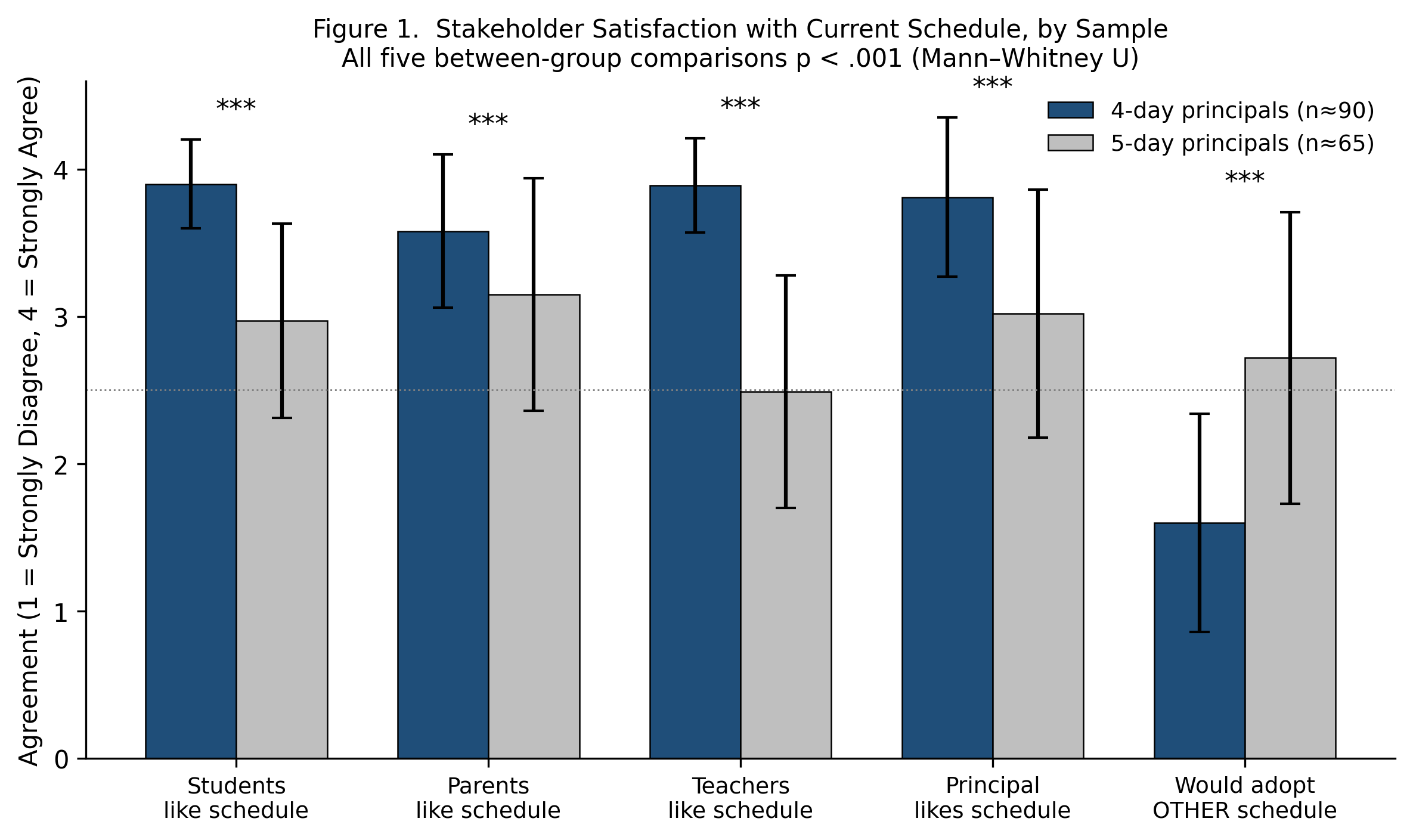
Note. Bars represent mean agreement ratings on a four-point scale (1 = strongly disagree, 4 = strongly agree); error bars indicate ±1 standard deviation. Analytic n ranged from 88–90 (4DSW) and 65–66 (5DSW) across the five items. The fifth item differed by group: 4DSW principals were asked about returning to a five-day schedule, whereas 5DSW principals were asked about adopting a four-day schedule. Group differences were examined using the Mann–Whitney U test; rank-biserial effect sizes ranged from |r| = .30 (perceived parent satisfaction) to |r| = .88 (perceived teacher satisfaction). Item-level means, standard deviations, medians, and interquartile ranges are provided in Table 5. *** p < .001.
Table 5. Supporting Values for Figure 1: Perceived Stakeholder Satisfaction and Schedule Preference, by Sample
| Item | n (4/5) | M (SD) 4-day | M (SD) 5-day | Mdn [IQR] 4-day | Mdn [IQR] 5-day | % Agree 4/5 | U | p | r [95% CI] |
| Perceived student satisfaction | 89/65 | 3.90 (0.30) | 2.97 (0.66) | 4.0 [4–4] | 3.0 [3–3] | 100/83 | 5,052 | <.001 | +.75 [.63, .85] |
| Perceived parent satisfaction | 90/66 | 3.58 (0.52) | 3.15 (0.79) | 4.0 [3–4] | 3.0 [3–4] | 99/85 | 3,849 | <.001 | +.30 [.14, .45] |
| Perceived teacher satisfaction | 90/65 | 3.89 (0.32) | 2.49 (0.79) | 4.0 [4–4] | 3.0 [2–3] | 100/55 | 5,490 | <.001 | +.88 [.80, .94] |
| Perceived principal satisfaction | 90/65 | 3.81 (0.54) | 3.02 (0.84) | 4.0 [4–4] | 3.0 [3–4] | 96/79 | 4,598 | <.001 | +.57 [.43, .71] |
| Willing to change current calendar | 88/65 | 1.60 (0.74) | 2.72 (0.99) | 1.0 [1–2] | 3.0 [2–3] | 10/62 | 1,141 | <.001 | −.60 [−.74, −.46] |
Note. M (SD) = mean (standard deviation) on a 1–4 agreement scale; Mdn [IQR] = median [interquartile range]; % Agree = percentage selecting agree or strongly agree. U = Mann–Whitney U; r = rank-biserial correlation with a bootstrap 95% CI (positive r = higher among 4DSW principals; for the final item, a negative r reflects greater willingness to change the current calendar among 5DSW principals). Complete category-by-category response distributions for these items are reported in Supplementary Table S2.
Discussion
Sensitivity Analyses
Several sensitivity analyses supported the main comparisons. First, the professional-development difference was robust to data cleaning: after recoding six implausible values (>2,000 annual hours) as missing, the 4DSW advantage remained (median 70 vs. 48; z = +3.39; p < .001). Second, the principal-group differences persisted after covariate adjustment for total experience and school level: the odds that a principal rated teacher recruitment and retention a major issue remained substantially higher in 4DSW districts (adjusted odds ratio ≈ 4.3; p = .001), as did professional-development time (p = .003) and perceived teacher satisfaction (p < .001). Third, although districts were not identified directly, email domains indicated that 26 domains contributed two to four principals each; a cluster (domain) bootstrap for professional-development hours produced an effect size whose 95% confidence interval excluded zero (|r| = .31, 95% CI [.14, .50]), indicating that within-district dependence is unlikely to account for this difference. Differences that were marginal or did not survive the Holm correction, such as those involving lowering operating costs and staff-meeting and mentoring minutes, should still be interpreted cautiously.
This study sought to broaden the conversation about the four-day school week (4DSW) by examining how rural principals perceive the motivations, time use, and stakeholder responses associated with compressed school calendars. The findings suggest that, in this sample, principals’ views of the four-day schedule in rural Missouri are shaped by considerations that extend beyond student achievement. For many principals, the four-day calendar is linked to teacher recruitment and retention, professional collaboration, organizational capacity, and the practical realities of operating schools in resource-constrained settings. Because the design is cross-sectional and relies on principal reports, these patterns describe associations rather than the calendar's effects. This interpretation aligns with prior descriptive research showing that workforce and organizational considerations often play a prominent role in the adoption of four-day school weeks (Griffith, 2023; Kilburn et al., 2021).
First, workforce concerns emerged as a central theme in principals’ reports on the four-day schedule. The largest difference between the two groups concerned teacher recruitment and retention, with principals in 4DSW districts substantially more likely to identify them as major factors. By contrast, 5DSW principals more often cited student recruitment and academic performance. These patterns suggest that principals in districts operating a 4DSW may face a different set of organizational challenges than those in districts maintaining a traditional schedule, although the cross-sectional design does not establish that the calendar produced these differences. This interpretation aligns with earlier Missouri studies identifying recruitment, retention, and workforce stability as considerations in local adoption (Turner et al., 2018b, 2019; Turner & Uribe-Zarain, 2024), and with evidence that rural 4DSW districts may have advantages in filling vacancies (Manion & Varkey, 2021), even as overall retention effects appear limited (Thompson, 2025).
Second, the findings indicate that the four-day calendar is associated with a different reported allocation of professional time. Principals in 4DSW districts reported more professional development, planning time, and mentoring than those in 5DSW districts, and they reported using the fifth day for adult collaboration and professional learning rather than leaving it unscheduled. This pattern is notable because much of the existing literature has emphasized instructional time and student achievement (e.g., Hansen, 2011; Morton et al., 2024; Thompson, 2021). However, the differences in staff meetings and mentoring were not robust to conservative correction for multiple comparisons, so these patterns warrant cautious interpretation.
This pattern builds on earlier work examining staff perceptions of the 4DSW. Turner et al. (2018b) found that staff in rural Missouri districts viewed the additional non-instructional time as a meaningful professional benefit, and Kilburn et al. (2021) reported that teachers often viewed the fifth day as an attractive employment incentive. The present findings add to this literature by describing how principals report using that time in practice: for many schools in this sample, the fifth day was used for professional development, collaborative planning, and teacher mentoring, activities that may be difficult to accommodate within a traditional school week.
Third, principals in 4DSW districts reported consistently higher perceived stakeholder satisfaction than those in 5DSW districts, across students, parents, teachers, and principals themselves. Relatively few principals in 4DSW districts expressed a desire to return to a traditional schedule, whereas a majority of 5DSW principals indicated willingness to adopt a four-day calendar. These patterns are broadly consistent with earlier research (Kilburn et al., 2021; Turner et al., 2018b, 2019). However, they should be interpreted with attention to the perceptual nature of the measures and selection: principals working in districts that already chose the schedule may report high satisfaction because of self-selection, organizational adaptation, or confirmation processes, rather than because the calendar independently produced satisfaction. High perceived satisfaction is therefore better read as consistent with, rather than as confirmation of, the value of the schedule.
Findings on specialized services provide important context. A common concern about compressed calendars is that reduced instructional time may disproportionately affect students who rely on specialized supports. The present study found no statistically significant differences between 4DSW and 5DSW schools in the proportion of principals who reported spending any time each week on services for English Learners (ELs), gifted and talented (GT) students, or students receiving special education.
This result must be interpreted in light of the measure’s limitations. The survey asked only whether any weekly time was allocated to each service; it did not capture the amount, quality, intensity, or adequacy of services. The finding therefore speaks only to the reported presence of service time and provides no basis for claims about equal access, equal minutes, or equivalent service quality across schedule types.
Within that limitation, the results indicate no observable difference between four- and five-day districts in the reporting of weekly time for student support services. This is relevant given concerns that compressed calendars may reduce students’ access to school-based supports, including meals, physical activity, supervised time, and related services (Oklahoma State Department of Health, 2017; Tomayko et al., 2020). The data reported here do not show a difference between schedule types in the reported presence of service time, but they cannot rule out differences in how services are delivered.
These results should not be taken as evidence that services are delivered uniformly across districts. As Thompson et al. (2021) observed, implementation of the four-day school week varies considerably across districts. Notably, a relatively small proportion of schools in both groups reported dedicated English Learner services. Rather than a calendar effect, this likely reflects a broader challenge for rural districts, regardless of calendar structure, in providing specialized services amid limited staffing and resources. A minute-level comparison added nuance: although the proportion reporting any weekly service time did not differ, among schools reporting gifted-and-talented services, 4DSW principals reported significantly fewer weekly minutes (medians 120 vs. 190; p = .004), suggesting that equal presence of service time need not imply equal intensity.
These findings align with the perception-versus-data pattern described by Kilburn et al. (2021) in the RAND multi-state study, in which stakeholders reported positive perceptions of the four-day schedule even when quantitative evidence on attendance, achievement, or other outcomes was mixed. The present results are consistent with that pattern and provide evidence on how schools report using time under a four-day calendar. Whereas RAND noted that schools rarely used the fifth day for student enrichment, principals in this sample frequently reported using that time for professional development, planning, mentoring, and other adult collaboration.
Alternative Explanations
Several alternative explanations should be weighed alongside the interpretations above. First, districts are not randomly assigned to calendars; districts that adopt a 4DSW may systematically differ from those that do not, so observed differences may reflect selection into calendar type rather than the calendar itself. Second, unequal response rates (43% vs. 23%) raise the possibility of differential nonresponse, and principals with strong views may have been more likely to respond. Third, the groups differed in principal experience and grade configuration, any of which could account for part of the observed differences; because district identifiers were unavailable, these could not be adjusted for in cluster-aware models and are addressed through cautious interpretation. Fourth, because all measures came from a single respondent group—principals—common-method and principal-report bias may inflate associations, particularly for perceived satisfaction. Finally, implementation of the 4DSW varies across districts, so aggregate comparisons may obscure meaningful local variation. Sensitivity analyses partially mitigated several of these concerns: differences in recruitment motivation, professional-development time, and perceived teacher satisfaction persisted after covariate adjustment for experience and school level, and a cluster (email-domain) bootstrap confirmed the professional-time difference. These considerations nonetheless reinforce a descriptive, association-focused reading of the findings.
Viewed together, these findings suggest that, for many rural principals, the four-day school week is understood as more than a scheduling change. Principals appear to view the calendar as linked to efforts to address workforce challenges and to create additional opportunities for professional collaboration and learning. However, confirming these associations will require designs better suited to causal inference.
Conclusion
This study examined how rural principals perceive the motivations, time use, and stakeholder responses related to the four-day school week. In this cross-sectional sample, principals’ views of the schedule were linked to factors that extend beyond student achievement. Although academic outcomes remain part of the conversation, principals consistently emphasized teacher recruitment and retention, professional collaboration, perceived stakeholder satisfaction, and the practical realities of operating rural schools.
The findings also indicate that principals in districts operating a four-day schedule report using professional time differently than their five-day counterparts, with greater reported investment in professional development, planning, and mentoring. This suggests that the fifth day is often used to support adult learning and collaboration. At the same time, the study detected no statistically significant difference between 4DSW and 5DSW schools in the proportion of principals reporting any weekly time for services to English Learners, gifted and talented students, and students receiving special education. This null result concerns only the reported presence of service time and should not be read as evidence of equal access, minutes, or quality.
These conclusions should be read as descriptive of the responding Missouri principals rather than as causal evidence for all rural districts. The cross-sectional design, unequal response rates across groups, non-random adoption of calendars, and the perceptual, single-respondent nature of the outcomes all limit generalizability. As Missouri implements Senate Bill 727 and other states consider compressed calendars, evaluations of the four-day school week should extend beyond student achievement to include workforce conditions, professional learning, service delivery, and stakeholder perceptions—while recognizing that establishing the calendar’s effects will require stronger designs. Continued research is needed to understand how districts balance these priorities amid the educational, organizational, and workforce challenges facing rural schools.
Recommendations
Implications for Rural School Leaders
Several implications emerge for rural school leaders considering or operating a four-day school week (4DSW). First, workforce considerations remain central to discussions of compressed calendars. Principals in 4DSW districts placed greater emphasis on teacher recruitment and retention and reported higher perceived stakeholder satisfaction and more time for professional development, planning, and mentoring. These are best understood as potential organizational advantages that require confirmation using staffing, vacancy, and longitudinal data, rather than as demonstrated effects of the calendar.
Second, the findings underscore the importance of how districts use the fifth day. Principals in 4DSW districts reported more time on professional development, collaborative planning, and teacher mentoring. As Missouri implements SB 727, rural leaders may benefit from treating the fifth day as a deliberate opportunity for professional learning and organizational improvement rather than merely non-instructional time.
Third, school leaders should continue to monitor access to services for students who rely on specialized supports. Although this study detected no significant difference between 4DSW and 5DSW schools in the proportion reporting any weekly service time, it did not address the amount, quality, intensity, or effectiveness of services. Ongoing attention to equitable access remains important, particularly in rural districts where specialized personnel and resources may already be limited.
Implications for State Policy
Missouri’s Senate Bill 727 provides an important policy context for districts operating a four-day school week (4DSW). The legislation combines new restrictions on 4DSW adoption in certain districts with measures to strengthen teacher compensation. When viewed alongside this study, the policy highlights issues that frequently arise in discussions of compressed calendars—particularly teacher recruitment, retention, and instructional time.
The findings suggest that workforce concerns are central to principals’ reasoning about the 4DSW, and that principals in districts already operating a four-day schedule report high perceived satisfaction and little interest in returning to a five-day calendar. These patterns suggest that changes in state policy may influence future adoption decisions more than the practices of districts that have already adopted the schedule, though this study cannot establish how districts will respond.
The results also underscore the value of a balanced local evaluation framework. Rather than treating principal-reported benefits as sufficient grounds for adoption, districts and the state would benefit from monitoring a broad set of indicators—teacher recruitment and retention, vacancy rates and applicant pools, professional development, instructional time and academic outcomes, attendance, access to specialized services, family needs, and fifth-day arrangements such as childcare, meals, and student supervision. Decisions about adopting or maintaining a four-day calendar are best grounded in local evaluation of these indicators rather than in blanket adoption or rejection.
Limitations
Several limitations should be considered when interpreting these findings. First, the study used a cross-sectional design and relied on principal self-reports; it therefore supports descriptive comparisons between four-day-school-week (4DSW) and five-day-school-week (5DSW) districts but does not permit causal conclusions about the effects of schedule type.
Second, response rates differed between the groups (43% for 4DSW principals and 23% for 5DSW principals). Although broadly comparable to rates in other administrator surveys, this difference raises the possibility of differential nonresponse and self-selection bias. Principals with strong views about their schedules may have been more likely to respond, and the available records did not permit a formal comparison of respondents and nonrespondents.
Third, districts were not identified directly. Using email domains as a district proxy, a cluster bootstrap indicated that within-district dependence did not overturn the main professional-time difference. However, this proxy is imperfect, and a full multilevel model was not possible, so standard errors from analyses treating principals as fully independent may still be somewhat optimistic, and marginal results should be read with caution. Covariate-adjusted analyses indicated that the principal-group differences persisted after accounting for experience and school level, although residual confounding cannot be excluded.
Fourth, all measures came from a single respondent group, so common-method and principal-report biases may inflate some associations, especially perceived stakeholder satisfaction, which reflects principals’ perceptions rather than direct reports from students, parents, or teachers. Fifth, the instrument was developed from the literature but was not subjected to formal expert review, cognitive interviewing, or pilot testing. Most constructs were single items, so measurement validity could not be established quantitatively. Sixth, the schedule-preference item was not identical across groups and is best interpreted as willingness to change the current calendar. Finally, the specialized-service items were analyzed as any reported weekly time versus none, which does not capture the amount or quality of services.
These limitations point to specific directions for future research. Stronger evidence would come from longitudinal and district-level panel designs that follow districts before and after adoption; linkage to administrative data on staffing, vacancies, teacher turnover, instructional time, and achievement; and direct surveys of teachers, families, and students rather than relying on principal proxies. Subgroup and equity analyses—particularly for English Learners and students receiving special education—and minute-level analyses of service time would clarify whether service time translates into comparable access. Mixed-methods implementation studies could illuminate how districts use the fifth day, and cluster-aware statistical designs that account for within-district dependence would strengthen inference. The open-ended survey item on improving student performance, not analyzed here, could also be examined qualitatively in future work.
Ethics Statement
All study procedures received approval from the author’s institutional review board prior to data collection. All respondents provided informed consent and were assured of anonymity.
Conflict of Interest
The author declares no conflict of interest.
Funding
The author received no financial support for the research, authorship, or publication of this article.