


Introduction
A great deal of resources have been invested in efforts to integrate ultra-Orthodox women into higher education and increase their participation in the workforce (Gado et al., 2023; Rubin et al., 2022). At the Strauss Campus, approximately 500 women are enrolled in undergraduate studies in a variety of fields, including management, medical laboratory technology, biotechnology, social work, and communication disorders. In light of the need for educational institutions in Israel and around the world to prove the value that their students can offer future employers, a variety of activities have been carried out within academic programs to expose students to the job market and bring them closer to the world of professional work. This study examined students’ developing professional identities and the relationship between professional identity and motivation for work. It examined how experiences over three years of academic studies influence professional identity and the motivation to work in one’s field of study. In doing so, this study broadens the understanding of the relationship between academia and work.
The process of choosing a career path and developing a professional identity has a developmental aspect that is characterized by self-examination and examination of occupational possibilities. This process occurs over the course of the period of academic studies, during which time individuals develop insights regarding their areas of interest, personal abilities, and opportunities in the job market. During their studies and before making decisions, students need to identify their areas of interest and analyze the existing opportunities in the job market as they relate to their professional futures (Bar Gal, 2009;Muradyan & Manukyan, 2023; Savickas, 1994, 2005). Academic studies have been described as the initial socialization for a profession and have an important impact on students (Pach et al., 2025). The range of courses taken and the encounter with instructors and experiences are the foundation for the development of a professional identity.
Based on this conceptualization, this study examined two core hypotheses: (a) the relationship between satisfaction with studies, professional identity, and motivation for work, and (b) the relationship between professional identity and motivation for work.Given that academic studies constitute a formative stage in professional development, clarifying how professional identity develops during this period is essential for understanding its role in shaping students’ motivation to engage in professional work.
Previous research has highlighted several complementary perspectives that help to contextualize students’ transition from academia to work (James & Yun, 2018; Schein, 2007;Wetstone& Rice, 202 3;Yurdakul Erol, 2022). Concepts such as future orientation, career anchors, work readiness, and construal-level theory have been used to explain how individuals envision their professional futures, evaluate career alternatives, and translate academic experiences into occupational intentions. These issues are not examined empirically in the current study. Instead, they serve as a broader conceptual backdrop for understanding the transition from education to work. Building on this framework, the current study focused on two key constructs, which it directly measured and analyzed: satisfaction with academic studies and professional identity. It also examined how those two constructs are each associated with motivation to work in one’s field of study.
Professional Identity
Professional identity is a belief in one’s chosen profession that helps people to understand their professional roles and provides a framework for activity and decision-making. Professional identity develops and changes over one’s lifetime and depends on social contexts and personal experiences (Erikson, 1968). Erikson’s traditional approach views identity as developing from childhood through adulthood and assumes that this development is chronological. Other researchers, such as Cooper and Olson (1996), have related identity to a complex, multifaceted phenomenon that includes sociological, historical, psychological, and cultural elements. Postmodern approaches to this issue are characterized by a holistic view of the concept and an emphasis on the unstable dynamic and changes that occur over the course of a lifetime (Akkerman & Meijer, 2011;Merseth et al., 2008).
Undergraduate studies form an initial basis for a chosen profession. This experience exposes students to professional concepts, key figures in the field, and interactions that require the application of skills related to the future profession. This process is accompanied by a reflective process that leads to the development of a professional self and a general, personal self (Gee, 2000; Kupferberg &Niderland, 2012). Within the process of developing a professional identity, we also find the question of how a person sees himself or herself and what he or she wants to be. Students’ experiences in this context include a range of actions and ways of coping: theoretical coursework, carrying out assignments, participation in practical courses, encounters with instructors and teaching assistants from the professional field, etc. All of these contribute to the formation of a professional identity and also affect general self-perceptions (Beijaard et al., 2004).
Professional identity is a significant component of a person’s self-identity. Flum and Blustein (2000) discussed the connection between self-identity and professional identity. The current study did not examine self-identity, but the connection between self-identity and professional identity underscores the importance of professional identity for self-identity. In the formation of professional development, three questions related to time are raised (Flum, 1995): Who am I as a professional person; how did I become a professional person; and what do I still want to be? Research has shown that a solid sense of professional identity decreases burnout, role-related conflict, and the likelihood of leaving one’s profession.
This study focused on the less-studied phenomenon of professional identity at the first stages of choosing a profession and motivation to work in the chosen profession. According to previous studies, initial motivation to find work in a particular field is an important factor for the rest of an individual’s professional life. In the context of research conducted among teachers, Kramer and Hoffman (1981) noted that professional identity involves a sense of belonging and identification with one’s profession. The process of developing a professional identity includes conflicts, dilemmas, and coping with complex situations. A strong professional identity can protect against the conflicts that exist between parties with different interests in the professional context (Shatz Oppenheimer & Dvir, 2010). To better understand how professional identity relates to motivation for work, it is necessary to examine students’ perceptions of their professional futures and career orientations.
Perceptions of a Professional Future and Career
Students’ thoughts and expectations regarding their professional futures can be understood in terms of the concept of future orientation. This orientation has been described as “a subjective, mental representation of the future picture of a person at a particular point in time in his life” and involves dilemmas and difficulties (Gati et al., 1996;Seginer, 2001).
This study focused on the period of academic studies. The question is: What characterizes this period of time relative to the future? According to the description of this concept, students’ future orientation refers to their thoughts regarding their future worlds of work. According to Seginer (2001), this orientation develops over time and is influenced by social and cultural expectations. Future orientation is learned through social interactions with different actors, primarily one’s parents and peer group, and serves as a basis for planning and aspirations. This study assumed that the college experience facilitates the development of an occupational future orientation among students, which is an important part of the development of their professional identities and influences their decisions regarding their future occupations. The relationship between attitudes toward one’s studies and perceptions about a professional future was described in a study recently conducted among Iranian students (Sharifi et al., 2020), which found a connection between occupation-related expectations and motivation for one’s studies, with perceptions about one’s professional future predicting motivation for one’s studies.
Perceptions regarding one’s professional future also depend on personal attitudes and aspirations. In this context, the concept of career anchors has been proposed. Career anchors (Schein, 2007) are the set of values according to which an individual chooses to direct himself or herself within the world of work. This set of values is relatively stable and serves as a source for growth and decisions about work-related issues. It is related to individuals’ fundamental beliefs about themselves and the professional futures that they have chosen for themselves. This study also examined the relationship between professional identity and career anchors.
Perceptions of one’s professional future provide a cognitive and emotional framework for career planning. However, these perceptions gain practical significance only when they translate into motivation for action. Motivation for work represents the mechanism through which future-oriented beliefs are expressed in intentions to enter a particular occupational field.
Motivation for Work
Motivation for work refers to the set of factors that cause individuals to invest effort and diligence in their work. This set of factors includes external forces, like economic pressure, as well as internal forces, such as a desire for personal development. Most of the studies in the field of motivation for work have analyzed the characteristics of work environments, such as relations between managers and workers, working conditions, how a given role is defined, etc.
Students’ perceptions of work have not received much research attention, possibly because the period of one’s studies is an early stage that is disconnected from the actual work experience. However, in one study,Grobelna and Marciszewska (2016) examined the motivation for work of students in the fields of tourism and health and found that potential for promotion and salary influenced the motivation of those students. The current study expanded upon that previous work by examining motivation for work while individuals were still studying, that is, before characteristics related to any particular organizational environment come into play.
Relatively few studies have addressed the transition from academic education to employment, particularly the initial choice of occupation and the dilemmas that accompany that decision.Smilansky (2013) wrote a book in which he collected recommendations for how to choose and advance in a career, but, in that work, he did not pay significant attention to one’s first job. Many studies have focused on the best ways to advance in one’s career (Oplatka, 2008;Shtauber & Shmueli, 2010). That is, many research findings have focused on considerations that go into these decisions and characteristics of individual workers, but less attention has been paid to the initial entry into the job market (James &Yun, 2018;Paulos et al., 2021). The small number of studies in this area may reflect the fact that it stands at the intersection of two different areas of knowledge and research: the study of education and the study of organizations and careers.
Over the course of studying and acquiring an education, many questions arise regarding motivation to succeed in one’s studies. The question regarding motivation to work in the studied field is related to planning for a future whose distance from the present depends on the student’s year of study. Liberman and Trope’s (2003) construal-level theory assumes that the distance between a person and an object or event will influence that person’s decision-making. Accordingly, the greater the distance between the person and the object/event, the more complex and abstract (i.e., higher level) the cognitive construal will be. In contrast, when the distance is small, the cognitive construal will be more concrete (i.e., at a lower cognitive level). The difference between the variables motivation for work and professional identity can also be explained by construal-level theory. Professional identity is seen as a variable that has abstract (less tangible) aspects and motivation for work is seen as a more concrete variable. (Levin et al., 2020) presented this approach in an explanation of career decisions and motivation for work.
A study by Yurdakul Erol (2022) found that students were worried about their professional futures and did not feel sure about their career. Those students expressed satisfaction with their studies, but did not feel sufficiently prepared for the job market. When practical experiences are integrated into the educational program (Okolie, 2022), readiness for work increases and motivation for work appears to increase as well.
Work Readiness
Students’ thoughts about and preparation for the job market can be viewed in terms of the relatively new concept of readiness to change, with regard to their readiness for their first jobs and their readiness for the change in status from student to worker. Work readiness includes the professional knowledge and skills possessed by a person who intends to begin to work. The current study aimed to determine the extent to which the educational experience actually prepares students for work and prepares them with the motivation to work in their respective fields of study. Students expect that, over the course of their studies, they will be exposed to content and connections and be able to examine their career horizons (Wetstone & Rice, 2023). Research has found a link between work readiness and motivation (Sojow et al., 2018). In a study of students,Indrawati et al. (2023) found that interpersonal connections and professional knowledge have positive influences on readiness and motivation for work.
Academic Studies and Practical Experience
Undergraduate study programs are made up of introductory and general courses in the first years of study and more profession-specific and applied courses in the later years. Studies have described how learning based on simulations has many advantages, including exposure to real-life situations and the ability to draw connections between theory and practice, which contribute to the development of professional identity (Badiee & Kaufman, 2015;Izadinia, 2013). Courses based on simulations and practical experiences are generally offered to students in their second and third years of study. The research assumption is that students in later years of their degree programs are exposed to more professional courses and that their professional identities are stronger. However, research has shown that the relationship between practical experience in the later years of a degree program and professional identity is not unidirectional or clear (Kaya, 2023; Zhao et al., 2024).
Higher Education for Ultra-Orthodox Women
Higher education is identified with modernity and raises questions related to career, personal actualization, and professional advancement (Shtadler, 2003;Teichler, 1999). The acquisition of higher education by women, in general, and by Ultra-Orthodox women, in particular, has become more common in recent decades (Charles, 2011; Klesment & Van Bavel, 2015; Mischau, 2001). This education is viewed as increasingly connected to women’s participation in and advancement within the workforce. This education is considered to be a determining factor in the increased number of women entering the workforce, the increased scope of their positions, and the quality of economic opportunities available to them. The trend of expanded education for Ultra-Orthodox women is based on an assumption that this education will help these women to advance economically, socially, and culturally (Bradley & Charles, 2003). Ultra-Orthodox women tend to acquire higher education before they direct their resources toward marriage and starting a family (Chassida, 2022). This means that they engage in academic studies at a relatively young age. Since they do not serve in the military, they generally arrive on campus straight from high school, without any work experience. This allows them to acquire a profession relatively early in life, which will provide a decent livelihood for their future families, for which they are often the main breadwinners (Friedman, 1991).
In this context, it is also important to emphasize the importance of the issue of these students dropping out of their study programs, as that dropping out eliminates the economic and social lever discussed above. Research has shown that only 47% of the Ultra-Orthodox women who begin academic studies and pre-college preparation programs actually earn a degree. For a variety of reasons, the drop-out rate among Ultra-Orthodox men is even higher (Bornstein, 2022; Rubin & Novis-Deutsch, 2018). The relationship between the experience in academia and the motivation to work in one’s field of study can serve as an anchor to discourage dropping out, as that relationship symbolizes the connection between academic studies and the job market.
Study Rationale
This study aimed to examine the construal of professional identity over the course of college studies. The assumption is that professional identity and college studies occur in tandem and feed off of one another, as studies toward a college degree are a significant stage in the development of a person’s identity (Pach et al., 2025). The decision to pursue a college degree is an initial step toward a professional future, employment, and career. According to the theory of career construction (Savickas, 2005),academic education is an important factor affecting professional identity and future motivation for work. During their academic studies, students get their first exposure to the theoretical and practical material related to their choice of occupation. Therefore, it is important to understand the characteristics of this period, in order to smooth their path to employment and a career.
Research Goals
This study examined the relationship between the student experience and the formation of professional identity and motivation for work among female Ultra-Orthodox college students. In the literature, there is a lack of material regarding occupational and career aspirations during the period of undergraduate studies. The experience of studying for a degree and the experience of work are generally addressed separately in the research literature for several reasons, including the fact that these experiences belong to the world of education and the world of work. We hypothesized that college studies have a gradual, ongoing effect on perceptions regarding one’s professional future. This led to the two main research hypotheses according to which the academic experience is related to perceptions regarding one’s professional future, which include both professional identity and motivation to work in the studied field.
Research Questions
What is the relationship between satisfaction with one’s studies, on the one hand, and professional identity and motivation for work, on the other?
How do demographic factors influence professional identity and motivation for work?
What is the relationship between professional career anchors, on the one hand, and professional identity and motivation for work, on the other?
Is a proposed mediation model in which there is a relationship between perceptions regarding one’s studies, professional identity, and motivation for work valid?
Research Hypotheses
1.There is a positive relationship between satisfaction with one’s studies, on the one hand, and professional identity and motivation for work, on the other.
2.There is a positive relationship between professional identity and motivation for work.
3.There is a positive relationship between professional career anchors and motivation for work.
4.Professional identity mediates the relationship between satisfaction with one’s studies and motivation to work in the studied field.
We will also examine the relationship between the year of study in a degree program and the development of professional identity.
Methodology
Research Method
This quantitative study was based on data from an anonymous survey completed by female, undergraduate Ultra-Orthodox students in their classrooms after they had received a detailed explanation of the study procedures and provided informed consent. The survey included questions regarding all variables and demographic characteristics.
Research Population and Description of the Sample
This study was conducted among female Ultra-Orthodox students on the Strauss Campus in Jerusalem, who were studying in different programs that each led to a bachelor’s degree.Ninety-three of these students participated in this study. The participants completed a series of self-report questionnaires at the end of the 2022–2023 academic year (between May and August of 2023).The sample was intended to include the majority of the female student population studying on campus. In reality, only a small portion (20%) of them attended face-to-face classes at the end of the semester and in the summer; therefore, the sample was smaller than expected.
Table 1. Description of the Study Participants
| Study Program | No. of Students | % |
| Human Resource Management | 36 | 39.1 |
| Information-Systems Management | 18 | 19.6 |
| Medical Laboratory Technology | 13 | 13.0 |
| Communication Disorders | 3 | 3.3 |
| Social Work | 5 | 5.4 |
| Optometry | 5 | 5.4 |
| BiotechnologyOther | 103 | 10.93.2 |
Most of the students (81 out of 93; 88%) defined themselves as Ultra-Orthodox. Twenty-eight percent were in their first year of studies, 31% were in their second year, and 35% were in their third year. The average age of the students was 21.7 (SD = 3.2). In terms of marital status, 61% were single (never married) and 35.9% were married. Twenty-three students (25%) had children. In terms of their parents’ education, 41% of the participants were the daughters of parents who did not have any higher education. Most of the students had not had any work experience; the average level of work experience was less than 1 year (0.7 years).
Research Tools
This study involved a series of questionnaires. Participants completed a questionnaire about professional identity (Fisherman, 2016; Fisherman & Weiss, 2011). They also completed a questionnaire about their satisfaction with their studies that was based on surveys of satisfaction with instruction that are conducted in the college every semester, as well as Neumann and Neumann’s (1980) questionnaire about satisfaction with instruction, which was modified for this research population. The measure of satisfaction with instruction was divided into two parts: Part A addressed satisfaction with instruction and the study program and interactions with the instructors, while Part B addressed satisfaction with the use of study aids. Participants also answered seven questions from a motivational questionnaire (Epstein, 1994) and questions about career anchors from Schein’s (2007) questionnaire for identifying career-related professional anchors.
The study questionnaire consisted of 65 questions. There were 20 questions about professional identity, which were each answered using a scale of 1 to 4. For example: "I think that the profession I have chosen is the best fit for me." There were also 13 questions about self-image, which were each answered using a scale of 1 to 4. For example, "Overall, I am satisfied with myself." There were seven questions about work motivation, which were each answered using a scale of 1 to 7. For example, "I will be energetic at work. " There were five questions about career anchors, which were each answered using a scale of 1 to 7. For example, "I want to reach a high level of expertise." Finally, there were 11 questions about satisfaction with one’s studies.For example, "The articles contribute to understanding the learning topic"
Reliability of the Research Tools
Cronbach’s reliability coefficients were used to evaluate the reliability of the different measures. The Cronbach’s reliability coefficients for the different variables were as follows: professional identity, α = 0.89; satisfaction with one’s studies, α = 0.90; satisfaction with the use of study aids, α = 0.79; motivation for work, α = 0.85; career anchors, α =0.78; and self-image, α = 0.67.
Ethical approval for the study was obtained from the college’s Ethics Committee prior to data collection. Potential participants were approached through department coordinators and English instructors. Prior to the collection of any data, the researchers provided a brief face-to-face explanation to potential participants in the classrooms, outlining the study’s aims, procedures, and the voluntary nature of participation. Students were given the opportunity to ask questions before completing the online questionnaire. All participants were informed about the purpose of the study, the voluntary nature of their participation, their right to withdraw at any time, and the confidentiality of their responses. Informed consent was obtained from all participants before their participation.
Data Analysis
The study hypotheses were tested using a series of statistical procedures, including correlation analyses, analyses of variance (ANOVA), regression analyses, and between-group comparison tests. All analyses were performed using the Statistical Package for the Social Sciences (SPSS)
Prior to any other analyses, key assumptions for parametric tests (i.e., normality, linearity, homoscedasticity, and multicollinearity) were checked and met. Only minimal missing data were handled using listwise deletion. Participants were divided into high- and low-professional-identity groups using a median split to provide a distinction between the main groups of identity while maintaining balanced group sizes.
Findings
Descriptive statistics were calculated for the study variables: professional identity, self-image, motivation for work, career anchors, satisfaction with one’s studies, and satisfaction with study aids (Table 2). The relationships between those variables were also examined (Table 3).
Table 2. Standard Deviations and Ranges of the Variables – Professional Identity, Self-Image, Motivation for Work, Career Anchors, Satisfaction With Studies, and Satisfaction With Study Aids
| Professional Identity | Self-Image | Motivation | Career Anchors | Satisfaction With Studies | Satisfaction With Study Aids | |
| Avg. | 2.99 | 3.10 | 6.07 | 5.55 | 3.52 | 3.36 |
| Median | 3.00 | 3.07 | 6.14 | 5.60 | 3.50 | 3.33 |
| SD | .44 | .46 | .788 | .89 | .65 | .85 |
| Min. | 1.80 | 2.08 | 3.71 | 3.60 | 1.00 | 1.00 |
| Max. | 3.85 | 4.00 | 7.00 | 7.00 | 4.86 | 5.00 |
Table 3. Relationships Between the Variables – Professional Identity, Self-Image, Motivation, Career Anchors, Satisfaction With Studies, and Satisfaction With Study Aids
| Professional Identity | Self-Image | Motivation | Career Anchors | Satisfaction With Studies | Satisfaction With Study Aids | |
| Self-Image | -.053 | |||||
| Motivation | .389** | -.08 | ||||
| Career Anchors | .379** | -.083 | .502** | |||
| Satisfaction With Studies | .322** | -.015 | .147 | .155 | ||
| Satisfaction With Study Aids | .236* | -.092 | .263* | .005 | .637** |
*p < 0.05. **p < 0.01.
Professional identity was moderately correlated with motivation (r = .389,p < .01) and career anchors (r = .379,p < .01) and weakly correlated with learning satisfaction (r = .322,p < .01) and satisfaction with teaching aids (r = .236,p < .05). Self-esteem was not significantly correlated with any of the other variables.
The study model is presented in Figure 1. The relationships between the study variables and demographic factors were also examined (Table 4).
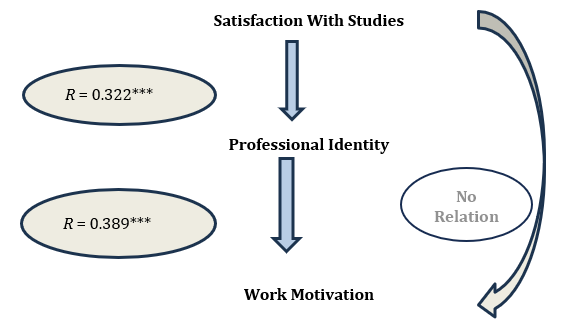
Figure 1. Study Model
Table 4. Relationships Between the Research Variables and Demographic Variables – Age, General Work Experience, Professional Work Experience, and Year of Study
| Work Experience | Professional Experience | Year of Study | Prof. Identity | Self-Image | Motivation | Career Anchors | Satisfaction With Studies | Satisfaction With Study Aids | |
| Age | .692** | .306** | .306** | -.047 | .087 | .112 | -.076 | -.092 | -.192 |
| Work Experience | 1 | .363** | .136 | -.062 | .226* | .169 | -.001 | -.003 | -.008 |
| Prof. Experience | 1 | .374** | -.151 | .169 | -.019 | .030 | -.135 | -.295** | |
| Year of Study | 1 | -.149 | -.111 | .006 | -.022 | -.076 | -.206* |
*p < 0.05. **p < 0.01.***p < 0.001.
Table 5. Professional Identity of the Students in the Different Programs
| Program | Mean | N | SD |
| Human Resource Management | 2.8514 | 36 | .44553 |
| Information Systems Management | 2.9194 | 18 | .34434 |
| Medical Laboratory Technology | 3.4115 | 13 | .29941 |
| Social Communication Disorders | 3.2833 | 3 | .18930 |
| Social Work | 3.3600 | 5 | .30903 |
| Optometry | 3.3600 | 5 | .28151 |
| Biotechnology | 2.8000 | 10 | .40000 |
| Other | 2.5167 | 3 | .55076 |
One-way ANOVA revealed that the program of study had a significant effect on overall professional identity [F (7, 59) = 5.07,p < .001] (Table 5). The effect size was large (η² ≈ .38), indicating that approximately 38% of the variance in professional identity was explained by the different programs of study. However, post-hoc Scheffé’s test did not reveal any statistically significant pairwise differences.
Table 6. Motivation for Work Among the Students in the Different Programs
| Program | Mean | N | SD |
| Human Resource Management | 6.0079 | 36 | .92579 |
| Information Systems Management | 6.2381 | 18 | .73336 |
| Medical Laboratory Technology | 6.1758 | 13 | .64458 |
| Social Communication Disorders | 6.2381 | 3 | .78680 |
| Social Work | 5.9714 | 5 | .85356 |
| Optometry | 6.2857 | 5 | 1.02020 |
| Biotechnology | 5.7857 | 10 | .47738 |
| Other | 6.0000 | 3 | .62270 |
One-way ANOVA was conducted to examine differences in motivation across the different programs (Table 6). No significant differences in motivation were found between the groups [F (7, 59) = 0.51,p = .821].
Table 7. Differences in Satisfaction With Studies, Professional Identity, Motivation for Work, Career Anchors, Self-Image, and Satisfaction With Study Aids Among Students in Different Years of Their Degree Programs
| Year of Study | Satisfaction, Studies | Professional Identity | Motivation | Career Anchors | Self-Image | Satisfaction, Study Aids |
| First (n = 27) | 3.53 | 3.04 | 5.98 | 5.59 | 3.20 | 3.64 |
| Second (n = 29) | 3.69 | 3.10 | 6.10 | 5.57 | 3.03 | 3.39 |
| Third (n = 33) | 3.30 | 2.85 | 6.13 | 5.49 | 3.08 | 3.10 |
| Fourth (n = 4) | 3.96 | 3.06 | 5.57 | 5.75 | 3.00 | 3.58 |
The findings presented in Table 7 show that the amount of time already spent studying was not positively associated with any of the examined variables. ANOVA revealed no significant differences between students of different academic years in terms of professional identity [F (3, 63) = 1.623,p = 0.193], self-image [F (3, 63) = 0.634,p = 0.596], or motivation [F (3, 63) = 1.241,p = 0.302]. Post hoc tests confirmed that there were no significant pairwise differences between students in different academic years.
The values of some variables (i.e., professional identity, satisfaction with study aids, career anchors, and self-image) even decreased over the years of study. These decreases were small and not statistically significant, but they did exist. The presented data show that being further along in one’s program of study was not associated with any improvement in professional identity, career anchors, or motivation to work in one’s field of study.
Differences in the relationships between the variables were also examined across years of study. The strongest relationship was observed in the first year between professional identity and motivation (r = .63,p < 0.001). Another significant relationship was found in the second year between professional identity and teaching satisfaction (r = .38,p = 0.041). Other correlations across years were generally weaker and not statistically significant.
The study participants were divided into two groups based on their levels of professional identity. Participants whose levels of professional identity were greater than the median level were put into the strong-professional-identity group and participants whose levels of professional identity were below the median level were put into the weak-professional-identity group.
Table 8. Relationships Between Variables, Categorized by Level of Professional Identity
| Motivation for Work | Career Anchors | Satisfaction With Studies | Satisfaction With Study Aids | ||
| Self-Image | Weak Professional Identity (n = 42) | -.222 | -.056 | -.150 | -.107 |
| Motivation for Work | .568*** | .126 | .098 | ||
| Career Anchors | .216 | .002 | |||
| Satisfaction With Studies | .622*** | ||||
| Self-Image | Strong Professional Identity (n = 51) | .056 | -.116 | .065 | -.086 |
| Motivation for Work | .352* | .056 | .393** | ||
| Career Anchor | .037 | .046 | |||
| Satisfaction With Studies | .631*** |
*p < 0.05. **p < 0.01. ***p < 0.001.
As shown in Table 8, a correlation between satisfaction with study aids and motivation for work was observed only among the participants who had strong professional identities. That is, a relationship between the learning experience and motivation to work in the field being studied was found only among participants who had strong professional identities. Among participants with weak professional identities, no relationship was observed between the learning experience and motivation to work in one’s field of study. This finding reinforces the understanding that students who have a strong sense of professional identity are different from those who have a weaker sense of professional identity. Among students with a strong professional identity, there is a relationship between the learning experience and motivation to work in the studied field.
Table 9. Differences in Satisfaction With Studies, Professional Identity, Motivation, and Career Anchors Among Students in Different Programs
| Program | Satisfaction With Studies | Professional Identity | Motivation for Work | Career Anchors |
| Human Resource Management | 2.8514 | 6.0079 | ||
| Information Systems Management | 2.9194 | 6.2381 | ||
| Medical Laboratory Technology | 3.4115 | 6.1758 | ||
| Social Communication Disorders | 3.2833 | 6.2381 | ||
| Social Work | 3.3600 | 5.9714 | ||
| Optometry | 3.3600 | 6.2857 | ||
| Biotechnology | 2.8000 | 5.7857 |
Significant differences in professional identity were found between students in programs at the end of which a professional license is issued and students in other programs. A comparison of students in management fields (i.e., human resource management and information systems management) with students in fields in which licenses are issued (i.e., medical laboratory technology, optometry, and social work) revealed that the professional identity of students studying in fields in which licenses are issued was significantly stronger (t = 0.94,p < 0.01). As shown in Table 9, for the management programs and the biotechnology program, the average professional-identity score ranged between 2.8 and 2.9. In contrast, for the programs in fields in which professional licenses are issued, the average professional-identity score ranged between 3.2 and 3.4.
A multiple linear regression analysis was conducted to examine whether satisfaction with one’s studies, professional identity, career anchors, and self-image predict students’ motivation to work in their studied field (Table 10). The overall model was significant [F (4, 88) = 9.42,p < 0.001], explaining 30% of the variance in motivation (R² = .30,adjusted R² = .27). Career anchors emerged as the strongest positive predictor of motivation (β = .41,p < 0.001), followed by professional identity (β = .23,p = 0.026). In contrast, self-image and satisfaction with one’s studies did not significantly predict motivation when we controlled for the other variables (p-values > 0.70). No multicollinearity issues were detected. A summary of the findings for each research hypothesis is presented in Table 11.
Table 10. Multiple Linear Regression Predicting Motivation (N = 93)
| Predictor | B | SE B | β | t | p |
| Professional identity | 0.4 | 0.18 | 0.23 | 2.27 | 0.026 |
| Self-Image | −0.06 | 0.15 | −.03 | −0.38 | 0.708 |
| Career Anchor | 0.36 | 0.09 | 0.41 | 4.26 | < .001 |
| Satisfaction With Studies | 0.11 | 0.01 | 0.1 | 0.92 |
Note. B = unstandardized coefficient; SE = standard error; β = standardized coefficient.R² = .30; adjusted R² = .27. The overall regression model was significant [F (4, 88) = 9.42,p < 0.001].
Table 11. Summary of Research Hypotheses and Empirical Support
| Hypothesis | Hypothesis Statement | Findings | Support |
| 1 | Satisfaction with studies is positively related to professional identity and motivation for work. | Satisfaction with studies was positively related to professional identity (r = .322, p < .01), but not to motivation for work. | Partially supported |
| 2 | Professional identity is positively related to motivation for work. | Professional identity was positively related to motivation for work (r = .389, p< .01). | Supported |
| 3 | Professional career anchors are positively related to motivation for work. | Career anchors were positively related to motivation for work (r = .502, p < .01). | Supported |
| 4 | Professional identity mediates the relationship between satisfaction with studies and motivation for work. | No direct relationship was found between satisfaction with studies and motivation for work; therefore, the mediation model was not supported. | Not supported |
| 5 | Professional identity increases across years of study. | Professional identity did not increase over the years of study and, in some cases, even decreased. | Not supported |
p < 0.05. **p < 0.01. ***p < 0.001.
Summary of the Results
There were significant, positive relationships between satisfaction with one’s studies and professional identity (0.322) and between professional identity and motivation to work in one’s field of study (0.389).
Contrary to the research hypothesis, no relationship was found between satisfaction with one’s studies and motivation to work in one’s field of study. That is, the proposed mediation model was not validated. Professional identity did not mediate the relationship between perception of one’s studies and occupation.
There were significant differences between the professional identities of students in different programs. The strongest professional identities were observed among students who were studying medical laboratory technology.
There was no relationship between year of study and professional identity. That is, professional identity was not stronger among students who were further along in their programs. An examination of differences in professional identity among students in different years of their programs revealed a significant difference in professional identity between second-year students and third-year students [t (62) = 3.56, p < .05)]. Professional identity was stronger among second-year students (3.1) than among third-year students (2.85). None of the other examined variables differed significantly among the students in different years of their programs. Contrary to the research hypothesis, professional identity did not get stronger over the years of studying, but rather the opposite.
As can be seen from Table 7, scores for career anchors, self-image, satisfaction with study aids, and satisfaction with studies were all higher among first-year students than they were among students who were further along in their study programs.
As can be seen from Table 9, differences in levels of professional identity and motivation to work in the field of study were observed between students in fields in which professional licenses are issued and students in other fields.
No differences were observed between the single students and the married students, in terms of professional identity, motivation to work in the studied field, or satisfaction with one’s studies. This indicates that marital status is not a significant factor for professional identity or motivation to work in the field studied. Similarly, no relationships were observed between family size (measured as the participant’s number of siblings) and professional identity or motivation to work. These findings lead to the conclusion that demographics and family background are not significant factors for the development of professional identity or motivation to work in the studied field.
Summary and Model
The findings indicate that satisfaction with studies does not directly predict motivation to work. Therefore, these findings challenge the career construction theory (Savickas, 2005), which assumes that higher education plays a major role in the process of career development. Consequently, the proposed mediation model was not supported. Instead, the findings supported the following model: Satisfaction with Studies → Professional Identity → Motivation to Work; Career Anchors → Motivation to Work. This pattern suggests that satisfaction with studies functions primarily as a contextual factor that facilitates identity formation rather than as a direct motivational driver.
Discussion
Academic studies toward a degree constitute a stage in the development of professional identity and integration into a profession. These studies expose students to theoretical and applied material related to their chosen field and, in doing so, constitute a continuation of socialization processes for the development of a professional identity. The study model assumed that the academic study experience is related to professional identity and that that relationship influences motivation to work in the studied field (i.e., a mediation model).
In line with the study hypotheses, positive relationships were found between perceptions regarding the academic study experience and professional identity, consistent with previous findings (Badiee & Kaufman, 2015;Izadinia, 2013;Pach et al., 2025). In addition, a positive relationship was observed between professional identity and motivation to work in the studied field, consistent with previous studies (Sharifi et al., 2020).
However, contrary to what was hypothesized, no relationship was found between perceptions regarding the academic study experience and motivation to work in the studied field. This lack of relationship may be explained by the fact that satisfaction with one’s studies may relate to short-term evaluation of the academic experience, whereas motivation for work may be related to future long-term orientation. An additional explanation relates to the characteristics of the Ultra-Orthodox students who took part in this study. These young students had not yet entered the labor market and, therefore, their future-oriented perceptions of work were not based on actual work experiences. Recent research (Zogopoulos & Raptis, 2024) has indicated that young students have incorrect perceptions of the labor market. The fact that data were collected at the end of the semester may also have affected the findings, as at that point in time, the students may have felt a sense of freedom from obligation. Shortly afterward, war broke out, and it was not possible to collect further data.
The conclusion is that perceptions regarding the academic study experience, which are not directly related to motivation to work in the studied field or to professional identity, do not mediate the relationship between academic studies and work. However, perceptions regarding the academic study experience may have some indirect effects. That is, professional identity may influence satisfaction with academic studies and, at the same time, be related to work motivation.
The most appropriate model to explain the relationships between the three variables could be an indirect-intervention model in which professional identity is the factor that is related to both the learning experience and motivation to work in the studied field. Support for this idea was provided by the analysis of strong vs. weak professional identity (Table 8). That analysis showed that there was a relationship between the learning experience and motivation for work only among the students who had strong professional identities (r = .393). Among the students with weak professional identities, the relationship was not significant. This finding supports the understanding that students with stronger professional identities enter college more ready for their studies and that, among those students, there is a relationship between the academic experience and work. This explanation assumes that professional identity may develop before the college experience.
Contrary to what was hypothesized, no positive relationship was found between year of study and professional identity. That is, the professional identities of students in the later years of their study programs were no stronger than those of students in the first year of their programs. In some cases, professional identity weakened over the years of study. One possible explanation for this is that the students’ professional identities were formed and solidified before they began their studies and are related to factors outside of their academic experience. An explanation for this can be found in the work of Shatz Oppenheimer and Dvir (2010), who argued that, during their academic studies, students are exposed to dilemmas and conflicts related to their chosen professions and this exposure can weaken their sense of connection with those professions.
An additional explanation relates to the specific population that was sampled for this study. Fifty percent of the participants in this study were first-generation college students. For these students, getting into and starting college may represent the heights of their sense of professional identity and satisfaction (Ball et al., 2002). Access to higher education is relatively new for the Ultra-Orthodox community, and therefore, by enrolling in college, these students may feel a greater connection to their chosen professions, which relate to their professional identities and do not change over the course of their studies.
An additional, unique feature of this population is the fact that over the course of their years of study, these students tend to get married and start families, which leads to a situation in which, in the later years of their study programs, some of them are already mothers responsible for families. The fact that they become mothers during their studies aligns with the values of the traditional society from which these students originate and may even reinforce their return to a more traditional role, in which family values are prioritized (Gado et al., 2023). The change in marital status may moderate the connection with an occupation or profession and create a situation in which, in the third year of studies, they are less focused on work. Support for this idea is provided by a study that found that college studies are indeed begun before women marry (Chassida, 2022). It is possible that motherhood encourages an old conflict between traditional and modern values.
A survey of studies on the development of professional identity in higher education reported that professional identity does not necessarily develop over the course of academic studies (Muradyan & Manukyan, 2023; Trede et al., 2012). Attention is also drawn to the influence of a person’s individual characteristics, that is, internal factors that provide a certain amount of subjectivity. The findings of that work are congruent with those of the current study and lead to an understanding of professional identity as a relatively stable factor that students bring with them as they begin their college studies.
The academic experience was not found to be related to motivation to work in one’s field of study. This surprising finding underscores the disconnect between experiences in academia and the desire to work in one’s field of study. It is possible that this lack of relationship may be explained by characteristics of the learning process, which includes many theoretical courses, which are relatively disconnected from the employment market, and little practical application of the learning. The fact that, in most of the programs, professional identity was stronger among first-year students than among students who were further along in their programs raises the possibility that the act of acquiring the status of a student creates positive feelings and a strong professional identity and that these feelings are balanced out or even decrease over the years of study. The academic learning experience may create a learner/student identity, but less of a professional identity. Future studies could compare the characteristics of student identity with those of professional identity.
The findings reveal a significant, positive relationship between professional career anchors and motivation to work in the studied field (Tables 3 and 8), meaning that professionalism is related to motivation for work. The literature on career anchors has noted that career anchors are fundamental values that develop between the ages of 20 and 30, as individuals engage in professional studies and enter the workforce (Schein, 2007). The fact that the sample used in the current study was made up of relatively young students (average age of 21) may explain the weak professional identities that were observed. Further support for this can be found in a study by Paulos et al. (2021), which found that older students have greater self-efficacy and a stronger sense of professional confidence.
The comparison of students in different fields revealed that students in fields with a practical orientation, like medical laboratory technology, social work, and optometry, and in which students earn a professional license when they have completed their studies, reported stronger professional identities than students in other fields. Professional identity appears to develop before the degree, with the aspiration to be accepted into the study program, and the actual learning experience does not strengthen that sense of identity. For students in programs that do not lead to professional licenses, such as management, professional identity and the motivation to work in the studied field may develop over the course of a career, as opposed to over the course of studies toward a degree.
Although the findings focused on Ultra-Orthodox women, they may also apply to other minority and first-generation students, including Arab minorities in Israel and immigrant students elsewhere. Despite cultural differences, the challenges observed—navigating higher education without prior work or familial academic experience—may be relevant across diverse groups facing similar social barriers.
Conclusions
The findings of the current study challenge the commonly held assumption that academic studies are a central stage in the formation of professional identity (Savickas, 2005). Instead, they suggest that professional identity may be largely shaped prior to entry into higher education, and that academic learning experiences do not necessarily strengthen this identity over time. In general, the proposed mediation model was not validated; whereas the identity-motivation link was supported.
While positive associations were found between academic experience and professional identity and between professional identity and motivation to work in the studied field, no direct link was found between academic experience and motivation for work. This implies that professional identity serves as the key mediating factor that links the academic experience with future career motivation. The most appropriate model to explain the observed relationships is an indirect-intervention model, in which professional identity both influences and is influenced by the academic experience and is directly associated with motivation to work in the field.
Interestingly, professional identity was not found to increase over the course of the academic program. In some cases, it even declined. This may reflect the fact that the study sample was made up of first-generation and Ultra-Orthodox students, for whom enrollment in higher education may represent a peak in professional identity, which then becomes more diffused over time due to competing life roles, such as marriage and parenthood, and exposure to professional dilemmas.
The study also found that students enrolled in applied, license-oriented programs (e.g., optometry, social work, medical laboratory sciences) reported stronger professional identities than those in general academic fields (e.g., management). This suggests that clarity of professional purpose and the promise of certification contribute to stronger identification with a profession, even before formal studies have been begun.
From a theoretical perspective, the findings challenge the assumption that professional identity is formed through academic socialization and suggest that students’ career orientations and work motivation may change according to academic experiences and progress and due to changes in family status. A better understanding of this developmental process may help us to explain shifts in occupational choices during academic studies and offer practical insights for reducing the gap between academic education and integration into the labor market.
Overall, this study highlights a need to reconsider the role of higher education in the development of professional identity. Strengthening the connection between academic learning and professional practice—through practical experiences, mentoring, and clearer professional pathways—may support students' motivation to work in their fields of study. Future research should further examine the distinction between student identity and professional identity and investigate how these identities interact and evolve across different populations and academic disciplines.
Recommendations
To make the academic learning experience more meaningful and more closely connected to professional and occupational identity, curricula (including specific courses and/or partnerships) should be developed to connect academia with the job market. Similarly, it would be worthwhile to consider integrating learning through practical, hands-on experience early on in degree programs. Such experiences could contribute to the learning experience and possibly even reduce drop-out rates during the first years of degree programs. Based on our findings, we recommend the development of a course or a program focused on student professional identity (Pach et al., 2025). The program should be accompanied by an expert from the labor market and operate during all of the years of study. Such a program could strengthen the relationship between academic studies and the labor market.
To expand upon the findings presented here, we recommend examining the factors examined in this study among students who are not Ultra-Orthodox, who may begin their college studies after having already acquired significant work experience. We also recommend conducting a longitudinal study in which professional identity and motivation to work in the studied field would be examined at at least four different points in time, at the beginning and end of each year of study.
In light of previous research regarding the influence of personality characteristics and social support (Wang et al., 2025), future studies should examine family social support and other components of self-esteem that can affect professional identity. We also recommend examining professional identity using a qualitative approach (Urrieta& Hatt, 2019), to allow for a deeper understanding of the professional identity concept. To that end, we have already begun facilitating focus groups in this area.
Limitations
Common method bias should be considered when interpreting the findings of this study. All variables were measured using self-report questionnaires collected at a single point in time and from the same source, which may increase the risk of inflated correlations due to shared method variance. Although no specific statistical test (e.g., Harman’s single-factor test) was conducted to formally assess common method bias, this limitation is acknowledged.
Data were collected at the end of the academic year and over the summer, which may have created some pressure or disconnection between the learning experience that had already finished and professional identity. In addition, the sample was comprised of relatively young students (average age of 21.7), most of whom did not have any experience in the workforce. The fact that these students were relatively young could be limiting in the context of professional identity.
The professional-identity dimension was examined using a self-report research tool, which has limitations. Various studies have indicated that adjustments need to be made to this research tool.
Personal identity and professional identity solidify between the ages of 20 and 30 and most of the students in this study were at the start of their professional paths. Research has emphasized that identity develops as individuals have different experiences, but most of the participants in this study had not had significant experience in the workforce. Choices of which field of study that are made at a young age may reflect family pressures and social pressures, as well as concerns about making a living. For this reason, there may be little correspondence between real values and professional identity at that point. In addition, the unbalanced distribution of the female students across different programs of study is a result of differences in faculty size and could create a bias in the findings. Another limitation is related to the timing of the collection of motivation data. The future perspective of this variable in the absence of substantial labor market experience may be problematic. Given that the respondents are students, most of whom are not currently employed, their responses may reflect a bias toward a student identity rather than an employee identity.
Ethics Statement
This study was based on an anonymous, voluntary, questionnaire-based survey. No identifying or sensitive personal data were collected. Participation was entirely voluntary and informed consent was obtained from all participants prior to their participation in the study. Participants were informed that they could withdraw at any time without any consequences. Ethical approval for the study was obtained from the Hadassah College Jerusalem Ethics Committee (Approval No. 231/2023).
Generative AI Statement
Generative artificial intelligence (AI) tools were used during the preparation of this manuscript for language refinement and organization of the text. The use of AI was limited to editorial assistance and did not involve data analysis, interpretation of results, or generation of original research findings. All substantive content, including the study design, data collection, analysis, interpretation, and conclusions, was developed and verified by the authors, who take full responsibility for the integrity and accuracy of this work.