


Introduction
The integration of artificial intelligence (AI) into special education has the potential to transform pedagogical practice, aiming to provide equitable learning opportunities for the estimated 240 million children living with disabilities globally (Chattopadhyay, 2025; Fitas, 2025). Historically, the field has evolved from basic assistive tools to sophisticated, adaptive systems that personalise learning and enhance accessibility (Irawan & Anwar, 2025). This technological evolution has generated considerable interest because the reviewed literature commonly describes AI-driven tools as supporting personalisation, accessibility, and engagement. However, much of this evidence is conceptual, secondary, or based on stakeholder perceptions rather than objective longitudinal measures of student achievement (Ergasheva & Mamatxanova, 2025; Kurnia et al., 2025).
Despite these advancements, the implementation of AI in inclusive settings faces a critical knowledge gap characterised by inadequate digital infrastructure, insufficient teacher training, and a lack of clear regulatory policies (Chanthiran et al., 2025; Irawan & Anwar, 2025; Silva & Endlich, 2025). While some scholars argue that AI offers scalable solutions for differentiated instruction, others emphasise that these tools risk exacerbating digital divides and systemic inequalities if not governed by robust ethical frameworks (Lockwood & Brown, 2026; Tsirantonaki & Vlachou, 2025). This tension between technological promise and implementation reality creates a significant barrier to equitable adoption (Jamaludin et al., 2025; Westover, 2025). Without addressing these structural and ethical deficits, the potential for AI to foster truly inclusive environments remains largely unrealised, threatening to marginalize the very students it aims to support (Ribeiro et al., 2024; Temirov et al., 2025).
The conceptual framework of this review centres on the intersection of inclusive education, AI-driven assistive technologies, and institutional governance (Pagliara et al., 2024). These concepts are linked through the necessity of human-centred design and pedagogical mediation, which can help technology serve as a catalyst for equity rather than a replacement for essential human interaction (Devadas, 2025; Silva & Endlich, 2025; Souza et al., 2026). By synthesising these relationships, this review aims to provide a comprehensive analysis of leadership frameworks and policy strategies required for responsible AI integration. The Universal Design for Learning (UDL) perspective is relevant because it emphasises multiple pathways for engagement, representation and expression; in this review, it is an interpretive framework for evaluating access rather than a claim that AI effectiveness has been experimentally demonstrated. Socio-constructivist theory likewise draws attention to educator mediation and participation. Examining leadership frameworks is necessary because principals decide how these pedagogical intentions are translated into procurement, privacy procedures, staff development and resource allocation.
Although research catalogues AI tools, barriers and possible benefits for diverse learners, it rarely tests the school-level decisions through which principals govern adoption in special education. Existing reviews often combine pedagogical applications, system design and broad inclusive-education contexts without isolating school-level leadership mechanisms or distinguishing policy aspirations from observed results. This review therefore synthesises the interaction of institutional capacity, teacher development, ethical oversight and accessibility, while identifying which propositions are empirical and which remain conceptual. These distinctions guide the three research questions.
To examine the topic in depth, the study seeks to answer three core research questions:
- Which leadership frameworks and practices support the ethical and equitable integration of artificial intelligence in special education settings, and how does school leadership influence the adoption of AI tools within inclusive classrooms?
- What impact do AI-driven assistive technologies have on learning outcomes and accessibility for students with diverse educational needs?
- Which barriers constrain AI implementation in special education, including digital infrastructure gaps, teacher training deficits, and policy limitations, and what role do institutional governance and data privacy policies play in addressing them?
Methodology
Research Design
This systematic review was reported in accordance with PRISMA 2020 (Page et al., 2021). The methodology was designed to ensure transparency, reproducibility, and alignment with the three research questions established in the Introduction. The review synthesised current research on how school principals and educational leaders support the integration of artificial intelligence in special and inclusive education settings, with particular attention to leadership frameworks, institutional governance, professional development, accessibility, and equity outcomes.
Data Sources and Search Strategy
A comprehensive multi-source search strategy was implemented to identify relevant literature. Scopus and Web of Science Core Collection served as the primary bibliographic databases. The database searches were conducted on 5 August 2026. Complementary keyword searches were conducted in Google Scholar and SciSpace. SciSpace Basic Search and SciSpace Full Text Search results were combined and reported as a single SciSpace source.
The search strategy was organised around three principal concept blocks: artificial intelligence technologies, special and inclusive education, and educational leadership and governance. Terms within each block were combined using OR, while the three concept blocks were connected using AND. The complete database-specific search strings were as follows.
Google Scholar and SciSpace were searched using shorter keyword combinations derived from the same three concept blocks to accommodate their platform-specific search functions. Google Scholar was used as a complementary source rather than as a substitute for conventional database searching, consistent with Haddaway et al. (2015). These complementary searches therefore broadened retrieval while the database searches remained the reproducible core of the strategy.
Searches were restricted to publications from 2023 to 2026. This threshold corresponds to the public availability of generative artificial intelligence systems from late 2022, after which school-level implementation studies became increasingly feasible. The review therefore characterises the generative artificial intelligence era rather than the longer history of assistive and adaptive technologies in special education, which is acknowledged as a scope limitation. No language restriction was applied.
Scopus Search String
TITLE-ABS-KEY(("artificial intelligence" OR "generative AI" OR ChatGPT OR "machine learning" OR "learning analytics" OR "adaptive learning" OR "large language model" OR "large language models" OR "intelligent tutoring system" OR "intelligent tutoring systems" OR "decision support system" OR "decision support systems") AND ("special education" OR "special educational needs" OR "inclusive education" OR "students with disabilities" OR "learners with disabilities" OR "learning disabilities" OR neurodiversity OR dyslexia OR "individualized education program" OR "individualized education programs" OR "individualised education programme" OR "individualised education programmes") AND ("instructional leadership" OR "educational leadership" OR "school leadership" OR "principal leadership" OR "school principals" OR "teacher leadership" OR "pedagogical leadership" OR "digital leadership" OR "school governance" OR "education policy" OR "professional development" OR "teacher training" OR "institutional readiness"))
Web of Science Core Collection Search String
TS=(("artificial intelligence" OR "generative AI" OR ChatGPT OR "machine learning" OR "learning analytics" OR "adaptive learning" OR "large language model" OR "large language models" OR "intelligent tutoring system" OR "intelligent tutoring systems" OR "decision support system" OR "decision support systems") AND ("special education" OR "special educational needs" OR "inclusive education" OR "students with disabilities" OR "learners with disabilities" OR "learning disabilities" OR neurodiversity OR dyslexia OR "individualized education program" OR "individualized education programs" OR "individualised education programme" OR "individualised education programmes") AND ("instructional leadership" OR "educational leadership" OR "school leadership" OR "principal leadership" OR "school principals" OR "teacher leadership" OR "pedagogical leadership" OR "digital leadership" OR "school governance" OR "education policy" OR "professional development" OR "teacher training" OR "institutional readiness"))
The strategy was refined iteratively during pilot testing. The abbreviation “SEND” was removed because it retrieved records containing the verb form rather than the intended acronym; the standalone term “autism” was removed because, in combination with machine-learning terminology, it retrieved a large biomedical literature unrelated to educational practice; and “assistive technology” was removed from the artificial intelligence block because assistive technologies do not necessarily incorporate artificial intelligence. These refinements were intended to improve topical precision without changing the three-concept structure of the search.
Eligibility Criteria
The criteria applied to the inclusion and exclusion of studies are summarised in Table 1. The criteria covered population, intervention, focus, study type, time frame, and language. They were applied during title-and-abstract screening and full-text assessment.
Table 1. Inclusion and Exclusion Criteria Used for Study Selection
| Criterion | Inclusion Criteria | Exclusion Criteria |
| Population | Students with disabilities or special educational needs in special or inclusive education settings; school principals and educational leaders. | General education populations without a special educational needs dimension; non-educational organisational settings. |
| Intervention | Artificial intelligence systems used in educational contexts, including adaptive learning platforms, generative AI tools, intelligent tutoring systems, and AI-supported assistive technologies. | Educational technology without an artificial intelligence component. |
| Focus | Studies explicitly examining school leadership, institutional governance, policy implementation, teacher capacity, accessibility, or equity outcomes in AI integration. | Studies focusing solely on algorithmic performance, system architecture, or classroom-level technical application without a leadership or governance dimension. |
| Study Type | Empirical studies, case studies, policy analyses, systematic reviews, conference papers, book chapters, and relevant preprints with sufficient methodological or analytical detail. | Editorials, opinion pieces, book reviews, product descriptions, methodologically insufficient preprints, and preprints with an available peer-reviewed version. |
| Time Frame | Studies published between 2023 and 2026. | Studies published outside the specified time frame. |
| Language | No language restriction; studies in any language for which full text was obtainable and evaluable. | Studies for which full text could not be obtained. |
Search Results and Study Selection
The searches identified 793 records before deduplication. Of these, 306 records were retrieved through the primary database searches, comprising 211 records from Scopus and 95 records from Web of Science Core Collection. A further 487 records were identified through the complementary Google Scholar and SciSpace searches.
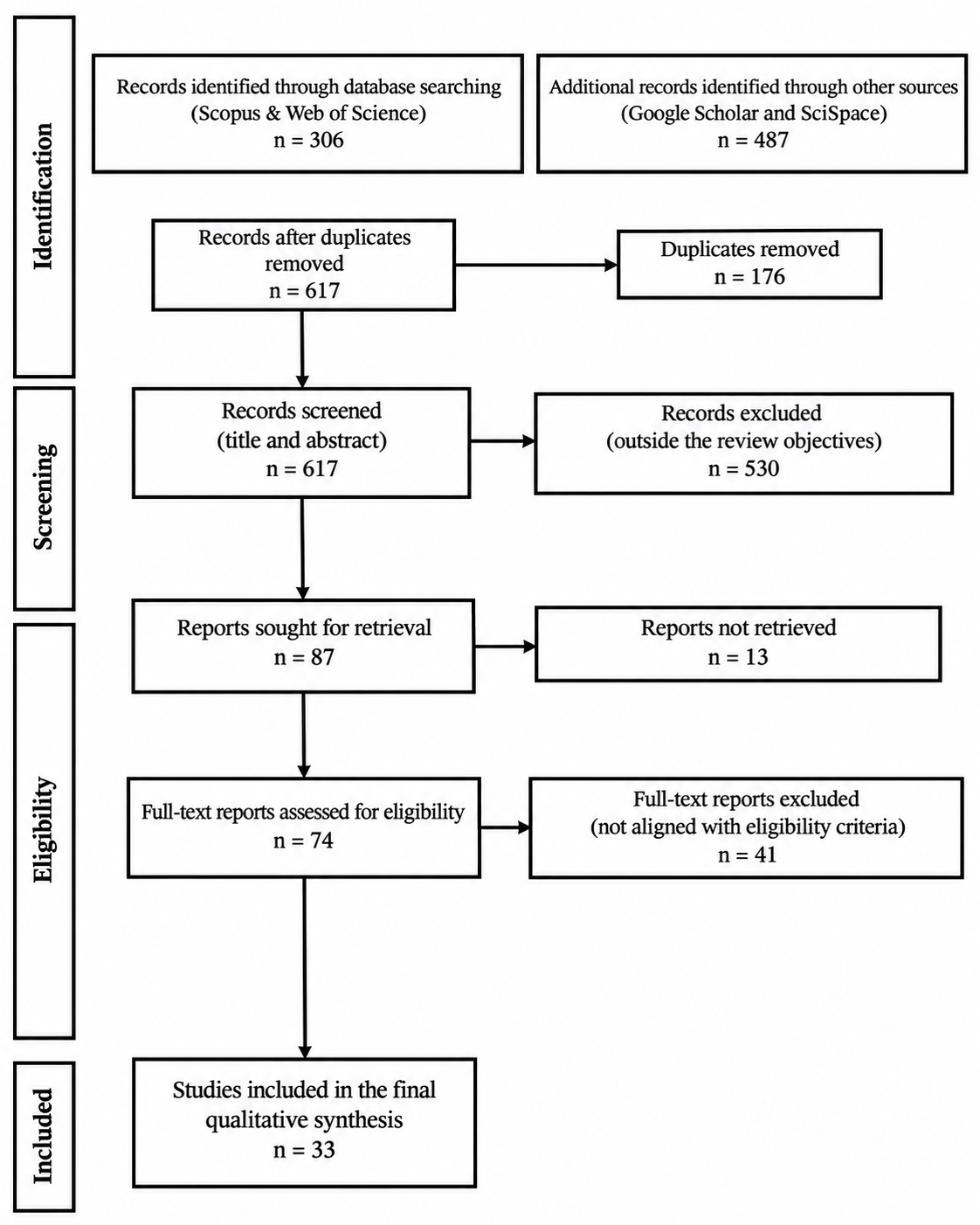
After deduplication across all information sources, 176 duplicate records were removed, leaving 617 unique records for title and abstract screening. At this stage, 530 records were excluded because they fell outside the aims and eligibility criteria, leaving 87 reports sought for full-text retrieval. Thirteen reports could not be obtained at this retrieval stage and were not assessed for eligibility. Of the 74 full-text reports evaluated, 41 were excluded because they were not sufficiently aligned with the research aims and eligibility criteria. Consequently, 33 publications were included in the final qualitative synthesis. Figure 1 summarises this process. Title-and-abstract screening, full-text eligibility assessment and data extraction were conducted by the sole author.
Data Extraction and Analysis
Data were systematically extracted from the included studies using a standardised framework covering publication characteristics, study design, educational context, participant or stakeholder groups, AI technologies, leadership and governance dimensions, accessibility and equity considerations, professional development needs, and principal findings. Data extraction was conducted by the sole author. The included studies were analysed through thematic synthesis. After full-text reading, the studies were classified under six thematic dimensions: personalised learning and accessibility, ethical governance and data privacy, professional development and teacher capacity, leadership and institutional support, infrastructure and resource disparities, and collaborative stakeholder ecosystems.
These dimensions were not determined entirely in advance. The research questions provided an initial high-level analytical framework, while the scope of the individual themes and the boundaries between them were clarified according to the patterns that became apparent during full-text reading. The classification therefore combined deductive and inductive approaches rather than applying a wholly predetermined framework or deriving categories purely inductively. The thematic classification was reviewed iteratively by the author for consistency with the research questions, the boundaries between themes, and the extent to which each study represented the dimension to which it had been assigned. Within each theme, studies were compared with respect to the points at which their findings converged and diverged, and each included study was assigned to at least one thematic dimension.
For transparency, each of the 33 included publications was entered into a study register with bibliographic details, publication design, educational setting, source or participant base, reported leadership or governance relevance, principal findings and limitations. Extracted material was first assigned deductively to domains derived from the research questions, and the domains were then refined inductively to reflect repeated patterns within the documents. The final codebook uses six non-exclusive categories: personalised access (PA), ethical governance (EG), professional development (PD), leadership and institutional support (LS), infrastructure and resources (IR), and stakeholder collaboration (CS). A report could receive several codes where its content addressed more than one domain. The accompanying evidence matrix and theme-frequency table provide an audit trail between references, source characteristics and analytic categories. These checks improve traceability within a single-author review but do not constitute independent duplicate screening or an inter-rater reliability test.
Evidence Appraisal and Interpretive Confidence
Evidence was appraised according to publication design rather than treated as an undifferentiated set of independent experiments. Empirical qualitative, quantitative and mixed-methods reports were examined against relevant methodological domains drawn from the Mixed Methods Appraisal Tool (MMAT; Hong et al., 2018); review and conceptual publications were assessed descriptively for clarity of scope, identification of sources, transparency of argument and relevance, informed by JBI approaches to non-empirical evidence (McArthur et al., 2025). The appraisal register records design, sample or source, strengths, limitations and the level of inference supportable for each publication. Where the information required for a formal checklist judgement was unavailable, no numerical quality or risk-of-bias score was inferred. Primary observations, cross-sectional associations, self-reported perceptions, literature syntheses and normative recommendations were distinguished in interpreting the six themes. Accordingly, convergence among conceptual sources is not presented as a measured intervention effect, and secondary reviews are not counted as additional independent participant samples.
Results
The literature reviewed in this section is organised around six thematic dimensions identified through a thematic synthesis of the included studies, reflecting recurring pedagogical, ethical, and organisational patterns in the integration of artificial intelligence into special education. Across the reviewed literature, studies of assistive technologies and personalisation appear alongside discussions of systemic governance and ethical implementation. Some publications foreground the potential utility of AI tools for accessibility, whereas others emphasise institutional frameworks, teacher capacity building and policy alignment. These six dimensions structure the analysis below.
Descriptive coding of the final included set shows 20 publications discussing personalised learning and accessibility, 20 addressing ethical governance and privacy, 15 discussing teacher capacity, nine discussing principal or institutional leadership, 18 addressing infrastructure and resources, and five examining stakeholder collaboration. Themes overlap; these figures therefore sum to more than 33. The counts indicate the extent of publication-level discussion, not independent outcome replications or evidence quality. Empirical case studies and surveys are distinguished from literature reviews, policy commentaries and conceptual reports in Supplementary Table S1.
Table 2. Publication-Level Coverage of Six Themes Among the 33 Publications Included in the Final Synthesis
| Theme | Publications, n |
| Personalised learning and accessibility | 20 |
| Ethical governance and data privacy | 20 |
| Professional development and teacher capacity | 15 |
| Leadership and institutional support | 9 |
| Infrastructure and resource disparities | 18 |
| Collaborative stakeholder ecosystems | 5 |
Note. The denominator is 33 included publications. Codes are not mutually exclusive; frequencies do not measure independent intervention effects.
Personalised Learning and Accessibility
Artificial intelligence technologies, including adaptive platforms and assistive tools, are frequently discussed across the reviewed literature as possible means of customising instruction and addressing accessibility gaps for students with diverse needs (Chanthiran et al., 2025; Devadas, 2025; Ergasheva & Mamatxanova, 2025; Fitas, 2025; Gayosso Mexia et al., 2024; Irawan & Anwar, 2025; Kontis et al., 2025; Kurnia et al., 2025; Main, 2025; Mohamed et al., 2025; Santos et al., 2024; Souza et al., 2026; Tsirantonaki & Vlachou, 2025). These publications frequently describe personalisation as potentially supporting engagement and access, but they do not collectively demonstrate independently measured academic gains (Irawan & Anwar, 2025; Waiganjo & Mutemaringa, 2025; Westover, 2025). This convergence is notable for its breadth. The reviewed literature covers a wide spectrum of applications, ranging from assistive technologies such as speech-to-text through to complex adaptive learning platforms and generative AI, which together illustrate the range of technologies discussed (Ahmed et al., 2025; Farooq et al., 2024; Irawan & Anwar, 2025). Across this spectrum many studies describe the potential of AI to support personalisation, engagement, and accessibility for learners with diverse needs, provided that implementation follows human-centred design principles (Ergasheva & Mamatxanova, 2025; Gayosso Mexia et al., 2024; Irawan & Anwar, 2025; Kurnia et al., 2025; Santos et al., 2024; Tsirantonaki & Vlachou, 2025).
However, the strength of this consensus should be interpreted alongside the evidentiary basis on which it rests. Much of the literature relies on qualitative case studies or theoretical reviews rather than large-scale, longitudinal empirical data, which constrains the ability to measure long-term academic outcomes and the sustained impact of AI on students with diverse learning needs (Harkins-Brown et al., 2025; Kontis et al., 2025; Kurnia et al., 2025). Studies also frequently draw on small-scale qualitative samples or on educators' self-reported perceptions, further limiting the generalisability of claims about student outcomes (Chanthiran et al., 2025; Irawan & Anwar, 2025; Waiganjo & Mutemaringa, 2025). Taken together, the reviewed literature identifies personalisation and accessibility among the most frequently discussed opportunities for AI in special education, while indicating that this benefit is at present better documented at the level of perceived potential than of measured longitudinal outcome.
Ethical Governance and Data Privacy
The reviewed literature emphasises an urgent need for robust and dynamic governance frameworks capable of mitigating risks such as algorithmic bias, data insecurity, and the potential for dehumanisation (Farooq et al., 2024; Krishna Kumari, 2025; Lockwood & Brown, 2026; Magdaleno Ramírez, 2026; Sangwa, 2025; Santos et al., 2024; Temirov et al., 2025; Ubbiev, 2026; Waiganjo & Mutemaringa, 2025). There is broad consensus on the necessity of ethical guidelines, data privacy protections, and transparency as preconditions for responsible AI use (Magdaleno Ramírez, 2026; Santos et al., 2024; Silva & Endlich, 2025), and the analysis of ethical risk offered in this literature is comparatively sophisticated (Lockwood & Brown, 2026; Magdaleno Ramírez, 2026; Santos et al., 2024). Despite this consensus, several studies describe a gap between articulated ethical principles and formal institutional guidance (Devadas, 2025; Irawan & Anwar, 2025; Sangwa, 2025; Silva & Endlich, 2025). The prevalence of comprehensive institutional AI policies cannot be quantified consistently from the included studies. This policy vacuum recurs throughout the reviewed studies as a limitation in its own right: concerns regarding data privacy, algorithmic bias, and transparency remain largely unaddressed within many institutional frameworks, which weakens the validity of implementation claims (Chanthiran et al., 2025; Devadas, 2025; Gayosso Mexia et al., 2024; Irawan & Anwar, 2025; Jamaludin et al., 2025; Krishna Kumari, 2025; Lockwood & Brown, 2026; Magdaleno Ramírez, 2026; Ribeiro et al., 2024; Sangwa, 2025; Santos et al., 2024; Sarmento, 2025; Silva & Endlich, 2025; Temirov et al., 2025; Tsirantonaki & Vlachou, 2025; Waiganjo & Mutemaringa, 2025).
The literature diverges on the form that governance should take. Studies vary on whether governance frameworks should be reactive and ad hoc or proactive and dynamic (Sangwa, 2025); a substantial body of work argues that governance must be dynamic and iterative in order to keep pace with rapid technological change in special education (Jamaludin et al., 2025; Sangwa, 2025; Silva & Endlich, 2025). These variations appear to reflect differences in scope, since comparisons drawn from early-adopter institutions yield different conclusions about governance maturity than those drawn from general school systems.
A further gap concerns evaluation. While ethical risks are well documented, there is little empirical evidence on the effectiveness of specific policy interventions or governance models in mitigating those risks within actual school settings (Krishna Kumari, 2025; Sangwa, 2025; Silva & Endlich, 2025). Governance in this field is therefore well theorised but weakly tested.
Professional Development and Teacher Capacity
Insufficient teacher training is identified throughout the reviewed literature as a primary barrier to effective AI integration, with research advocating structured and ongoing professional learning ecosystems (Barajas Motta et al., 2025; Braga et al., 2025; Chanthiran et al., 2025; Irawan & Anwar, 2025; Souza et al., 2026; Waiganjo & Mutemaringa, 2025). Studies converge on the view that pedagogical competence in AI is essential if educators are to move beyond basic tool usage towards meaningful, inclusive instructional mediation (Barajas Motta et al., 2025; Chanthiran et al., 2025; Kontis et al., 2025; Sarmento, 2025). The literature is correspondingly clear that professional development constitutes the cornerstone of effective integration, and advocates continuous, collaborative training models (Barajas Motta et al., 2025; Braga et al., 2025; Irawan & Anwar, 2025; Souza et al., 2026; Waiganjo & Mutemaringa, 2025). Professional learning ecosystems are further identified as a factor that may help translate AI implementation into improved student outcomes (Souza et al., 2026; Voicu, 2026; Waiganjo & Mutemaringa, 2025).
However, this recognition has not consistently translated into training provision. Many studies report that current teacher training programmes are insufficient or absent altogether, producing a significant gap between the availability of AI tools and the pedagogical competence required to deploy them effectively (Chanthiran et al., 2025; Irawan & Anwar, 2025; Kontis et al., 2025; Sarmento, 2025). This deficit also carries methodological consequences: because teachers frequently lack the skills to integrate these technologies pedagogically, findings concerning AI's potential are difficult to interpret, since observed outcomes may reflect implementation capacity rather than the tools themselves (Barajas Motta et al., 2025; Braga et al., 2025; Chanthiran et al., 2025; Irawan & Anwar, 2025; Kurnia et al., 2025; Santos et al., 2024; Sarmento, 2025; Souza et al., 2026; Tsirantonaki & Vlachou, 2025; Waiganjo & Mutemaringa, 2025). Teacher capacity therefore functions in this literature simultaneously as a barrier to implementation and as a source of implementation variation that complicates its evaluation.
Leadership and Institutional Support
School leadership is discussed across the reviewed literature as a potentially important institutional condition for AI adoption, and several publications recommend that principals foster stakeholder co-creation and institutional commitment (Sangwa, 2025; Voicu, 2026; Waiganjo & Mutemaringa, 2025; Westover, 2025). Several publications present leadership as important for fostering inclusive environments and managing adoption (Barajas Motta et al., 2025; Chanthiran et al., 2025; Westover, 2025), while identifying institutional commitment and stakeholder co-creation as proposed elements of inclusive ecosystems (Sangwa, 2025; Voicu, 2026; Westover, 2025). Leaders are further described as needing to actively foster trust and communication among stakeholders in order to mitigate resistance to change (Waiganjo & Mutemaringa, 2025), and to navigate cultural resistance and administrative hurdles so that technological innovation remains aligned with inclusive educational values (Chanthiran et al., 2025; Waiganjo & Mutemaringa, 2025).
The literature diverges, however, on the mechanism through which leadership exerts its effect. Some research suggests that leadership influence is mediated by the presence of professional learning ecosystems rather than by administrative support alone (Kontis et al., 2025; Voicu, 2026). These differences also reflect the various conceptual lenses used in the literature, ranging from equity-oriented implementation to broader organisational change perspectives; the mechanisms have not yet been compared systematically.
A practical gap also persists. The literature frequently identifies resistance to change and lack of institutional support as barriers, yet offers limited concrete guidance on how principals might navigate these cultural and administrative obstacles (Chanthiran et al., 2025; Waiganjo & Mutemaringa, 2025). Leadership is thus positioned as an important but insufficiently operationalised condition.
Infrastructure and Resource Disparities
Persistent gaps in digital infrastructure and funding remain significant obstacles to AI adoption, particularly in rural or underserved geographic regions (Chanthiran et al., 2025; Gayosso Mexia et al., 2024; Irawan & Anwar, 2025; Jamaludin et al., 2025; Kurnia et al., 2025; Temirov et al., 2025; Waiganjo & Mutemaringa, 2025). Infrastructure disparities in such settings are identified as a primary barrier to scaling AI beyond localised implementations (Irawan & Anwar, 2025; Jamaludin et al., 2025; Kurnia et al., 2025), and the reviewed studies indicate that successful deployment requires phased, scalable implementation strategies rather than ad hoc adoption (Chattopadhyay, 2025; Kontis et al., 2025). The equity implications of these disparities are contested. Research generally agrees that AI can promote equity by providing personalised support and dismantling accessibility barriers (Ergasheva & Mamatxanova, 2025; Irawan & Anwar, 2025). Other studies warn, however, that AI may exacerbate existing inequalities where algorithmic bias and the digital divide remain unaddressed (Lockwood & Brown, 2026; Tsirantonaki & Vlachou, 2025; Westover, 2025), and caution that without targeted investment and equitable resource distribution AI risks widening digital divides rather than closing them (Kurnia et al., 2025; Tsirantonaki & Vlachou, 2025; Westover, 2025). This divergence reflects the distinction between the theoretical potential of AI tools and the empirical reality of their deployment in resource-poor or underserved settings.
The composition of the evidence base compounds the problem. A notable geographic and socioeconomic bias runs through the literature, with many studies situated in resource-rich environments, leaving a gap in understanding how AI might be equitably deployed in rural or underserved regions (Kurnia et al., 2025; Voicu, 2026). Because findings from well-equipped environments may not be replicable in schools lacking basic technological access, infrastructure disparity constrains not only implementation but also the generalisability of the field's conclusions (Chanthiran et al., 2025; Gayosso Mexia et al., 2024; Irawan & Anwar, 2025; Jamaludin et al., 2025; Kurnia et al., 2025; Sarmento, 2025; Silva & Endlich, 2025; Temirov et al., 2025; Tsirantonaki & Vlachou, 2025; Waiganjo & Mutemaringa, 2025).
Collaborative Stakeholder Ecosystems
The reviewed literature increasingly proposes multi-stakeholder models involving teachers, parents, students, and technologists in the co-design process for AI implementation (Chattopadhyay, 2025; Ribeiro et al., 2024; Sangwa, 2025; Voicu, 2026). Studies advocate multi-stakeholder co-design specifically as a means of ensuring that AI tools remain aligned with educational values and student needs (Chattopadhyay, 2025; Sangwa, 2025; Voicu, 2026). This emerging theme emphasises that inclusive education is a collective responsibility requiring alignment between policy, practice, and community needs if outcomes are to be sustainable (Sangwa, 2025; Voicu, 2026). Considered against the other five dimensions, collaborative stakeholder engagement is the least developed theme in the current literature. Its comparative underrepresentation is itself informative: while leadership, teacher capacity, governance, and infrastructure are frequently discussed as implementation conditions, the participatory structures through which these determinants might be coordinated remain comparatively underexamined.
Discussion
The three research questions can be interpreted in relation to the six themes without treating all publication types as equivalent evidence. First, the governance, leadership, teacher-capacity and stakeholder findings suggest that a principal’s most plausible contribution is institutional coordination: selecting appropriate applications, ensuring accountability for data practices, involving educators and families, and aligning implementation with individual support needs. The Results show relatively few publications in the leadership-specific category (n = 9), and much of this material is conceptual or based on qualitative perceptions. Leadership is therefore an important proposed mechanism to investigate, not an established causal determinant of student attainment. The theoretical contribution is to connect the dispersed discussions of access, ethics and resources to a set of school-level decisions that can be observed and evaluated.
Second, the prominence of personalised access (n = 20) should not be mistaken for evidence that AI produces consistent academic improvement. Narrative reviews and design-oriented publications identify possibilities for communication support, adaptive presentation and differentiated materials; qualitative or cross-sectional studies commonly report educators’ attitudes or perceived usefulness. These outcomes cannot substitute for objective assessments of sustained learning or participation. Universal Design for Learning helps explain why alternatives in representation, engagement and expression matter for disability-related access. Socio-constructivist theory adds the role of teachers, peers and families in mediating the use of technology. Both frameworks support interpretation, but neither framework’s efficacy is established by this review.
Third, data protection, infrastructure, professional learning and stakeholder participation should be understood as interacting implementation conditions. Ethical governance and resource inequity appear in 20 and 18 publications respectively, whereas collaborative structures are addressed in only five. Principals can make this relationship operational by documenting accessibility and bias checks before procurement, assigning responsibilities for consent and sensitive-data handling, organising structured staff development, consulting parents and learners, and monitoring whether access differs across disability groups or resource-poor schools. Such a staged governance cycle distinguishes immediate safeguards from longer-term capacity building. The literature provides a rationale for these actions but does not yet compare their effects systematically. Prospective comparisons, intervention studies and school-level implementation audits are needed to test which leadership practices produce more equitable outcomes.
Confidence in this synthesis is constrained by heterogeneity. A cross-sectional staff survey, a small qualitative school study, a review of prior studies and a policy argument do not provide equivalent tests of effectiveness. Some secondary reports may cite overlapping primary work, and several studies provide limited details about sampling, outcome measurement or control for contextual factors. A design-sensitive appraisal was therefore used to identify what each publication can support, rather than combine them into a misleading numerical quality average. Findings supported mainly by concepts or perceptions are presented as hypotheses and contextual guidance, while directly observed practices are described only at the level of the source methods. This distinction is central to the review’s contribution and to its recommendations for more rigorous research.
Conclusion
Artificial intelligence is increasingly discussed as a means of supporting personalised learning and accessibility for students with diverse needs. Across the reviewed publications, AI-driven tools, such as adaptive learning platforms, speech-to-text technologies and intelligent tutoring systems, are discussed as possible supports for engagement, autonomy and learning; independent achievement effects remain insufficiently established. Their potential to facilitate individualised instruction aligns with the principles of Universal Design for Learning, offering a mechanism to bridge persistent accessibility gaps. However, the successful adoption of these innovations is not merely a technical challenge; it is a complex socio-technical endeavour that requires systemic leadership, institutional commitment, and collaborative ecosystems involving educators, parents, and policymakers.
At a theoretical level, the synthesis is consistent with socio-constructivist accounts of learning, in which adaptive technologies may function as mediators of student autonomy and engagement rather than as substitutes for pedagogical relationship. It also draws on Universal Design for Learning as an interpretive framework, since AI-driven personalisation converges with the objective of removing barriers to learning for students with diverse needs. Most consequentially, the synthesis is consistent with an ecosystemic perspective in which implementation may depend on interactions among infrastructure, governance and human agency rather than technological capability alone. Equity-oriented and adaptive-governance perspectives provide conceptual ways to understand AI adoption in special education as a socio-technical process requiring accountable, multi-stakeholder management; these perspectives still need direct empirical evaluation.
Despite the clear potential for fostering inclusive environments, the literature identifies significant barriers that impede effective implementation. Primary among these are persistent infrastructural disparities, particularly in rural and underserved regions, and a critical deficit in structured, ongoing professional development for teachers. The reviewed literature reports gaps in the pedagogical competence and algorithmic literacy educators need to integrate AI tools effectively, producing a gap between the availability of technology and its meaningful classroom application. Furthermore, several publications describe gaps between the pace of technological development and institutional guidance on data privacy, algorithmic bias and transparency. Such gaps may exacerbate existing inequalities rather than mitigate them. This finding directly challenges the assumption that technological adoption is inherently equitable: absent intentional design and governance, AI risks replicating systemic biases and widening educational disparities.
The synthesis identifies school leadership as a repeatedly proposed enabling condition for equitable AI implementation, rather than as a demonstrated cause of improved student outcomes. Principals must move beyond ad hoc adoption strategies toward proactive, dynamic governance frameworks that prioritise ethical oversight and stakeholder co-creation. While potential and perceived benefits of AI are widely discussed, the literature emphasises that technology should augment, not replace, the essential human and relational support provided by educators. Future research must transition from small-scale qualitative case studies to large-scale longitudinal empirical data in order to validate the long-term impact of AI on student achievement. The specific contribution of this review is to connect accessibility, privacy, professional capacity and resource equity to identifiable decisions for which school leaders may be accountable. Addressing the remaining evidence gaps requires tested ethical protocols, sustainable professional learning and school-level evaluation grounded in equity, transparency and student welfare.
Recommendations
To support equitable and sustainable AI integration in special education, stakeholders must adopt a multi-layered strategy that treats implementation as an institutional rather than a purely technological undertaking. As a short-term responsibility within the first school planning cycle, principals should assign clear accountability for AI procurement, obtain informed consent where relevant and implement accessibility and data-protection checks. First, regarding institutional governance, school leaders must prioritise the development of robust governance and data privacy policies that keep AI adoption ethical, transparent, and aligned with student welfare. Governance frameworks should be proactive and dynamic rather than reactive, capable of adapting as tools and practices evolve. At the system level, policymakers are encouraged to move beyond ad hoc measures by establishing structured regulatory frameworks that mandate equity, accessibility, and accountability in the deployment of AI within inclusive classrooms. Given the persistent gap between articulated ethical principles and classroom practice, standardised data protection and informed consent protocols tailored to K–12 special education settings are a particular priority.
Second, regarding professional capacity, professional development for educators should shift from basic technical training toward comprehensive capacity building that emphasises critical evaluation of AI tools, algorithmic literacy, and the maintenance of human-centred pedagogical practice. Because teacher capacity functions in this literature both as a barrier to implementation and as an interpretive limitation in its evaluation, sustained professional learning ecosystems should be treated as infrastructure rather than as supplementary provision. Practitioners, for their part, must maintain a critical stance, ensuring that technology augments rather than replaces the essential emotional and relational support provided by teachers.
Third, regarding equitable access and co-design, industry developers and educational institutions should engage in collaborative co-design processes with students, parents, and teachers, so that AI solutions are culturally and linguistically inclusive and responsive to the specific needs of marginalised learners. Attention to infrastructure is inseparable from this objective: solutions designed exclusively for resource-rich, high-connectivity environments cannot deliver equitable outcomes, and low-bandwidth or offline-capable assistive tools merit deliberate development and testing for schools with limited digital infrastructure. Over the medium to long term, school leaders should plan sustainable infrastructure expenditure, repeat professional-development cycles, audit equity outcomes and include families and students in review. Implementation should proceed through phased, scalable strategies rather than ad hoc adoption.
Finally, several research priorities follow directly from the gaps identified in this review. The most urgent is the need for multi-year, large-scale quantitative studies tracking the academic and social progress of students with disabilities within AI-integrated curricula, since establishing long-term efficacy is a precondition for moving beyond anecdotal evidence. Prospective comparative and intervention studies contrasting explicit principal-led procurement, privacy, teacher-coaching and stakeholder-engagement strategies against existing practice would provide the evidence base that governance discussion currently lacks, while evaluation of structured professional learning ecosystems would clarify their effect on teacher self-efficacy and student outcomes. Of secondary but substantial priority are the development of practical audit protocols enabling school leaders to evaluate AI software for bias against students with specific disabilities or cultural backgrounds, action research documenting how principals navigate cultural and administrative resistance, and participatory design work that involves students with diverse needs directly in the evaluation of emerging tools. Cross-national comparative research would further clarify how AI implementation adapts across differing cultural and linguistic settings.
Supplementary materials. Table S1 lists study characteristics and source-specific limitations for the 33 included publications. Table S2 records the 13 reports not obtained at full-text retrieval. Tables S3–S5 provide the coding definitions, non-exclusive theme assignments and design-sensitive evidence-appraisal domains.
Limitations
Several limitations should be considered when interpreting these findings. First, the search was restricted to Web of Science, Scopus, Google Scholar, and SciSpace; relevant work indexed elsewhere or not indexed at all may therefore have been missed. Second, the 2023–2026 date range excludes earlier research on assistive and intelligent tutoring technologies, so the review characterises the generative artificial intelligence period rather than the longer history of technology use in special education. Third, Google Scholar and SciSpace use platform-specific search functions that do not provide the same level of query reproducibility as Scopus and Web of Science; their use as complementary sources may therefore have limited the reproducibility of the search process. Fourth, although the corpus consists predominantly of peer-reviewed publications, it also includes one preprint (Westover, 2025) that had not undergone formal peer review at the time of the search. This source was retained because it directly addressed the review questions and provided sufficient methodological or analytical detail; nevertheless, its findings should be interpreted with appropriate caution. Fifth, studies for which full text could not be obtained were excluded, which may have introduced availability bias. Sixth, the included studies are heterogeneous in design, context, and educational level, and the synthesis was qualitative; no meta-analysis was conducted and no effect sizes can therefore be derived. Finally, screening, full-text eligibility assessment, data extraction and thematic classification were conducted by the sole author; no independent second-reviewer verification or formal inter-rater reliability coefficient was available. Differences in design quality and publication type also limit confidence: conceptual reports do not provide measured outcomes, small qualitative samples may not transfer widely, and survey associations cannot establish causality. The design-sensitive appraisal therefore guided interpretation but cannot replace an independently replicated study-level risk-of-bias assessment where reporting detail was incomplete.
Conflict of Interest
The author declares no conflict of interest.
Funding
This research received no external funding.
Generative AI Statement
ChatGPT (OpenAI) was used to support English-language editing and bibliographic checking.