


Introduction
Reading supports access to the curriculum and later educational participation, while persistent weaknesses in phonemic awareness, decoding, fluency, vocabulary, and comprehension can restrict pupils’ progress (Castles et al., 2018; Duke & Cartwright, 2021; Vaughn et al., 2022). These difficulties are especially consequential for pupils with dyslexia and other learning needs because weaknesses in word recognition and language comprehension can accumulate across the primary years (Snowling, 2019; Tunmer & Hoover, 2019).
Multisensory reading instruction coordinates visual, auditory, tactile, and kinesthetic activity—for example, seeing a grapheme, saying and hearing its phoneme, and manipulating or tracing a corresponding symbol. Such activities may offer additional routes for practising and retrieving print–sound associations, particularly for pupils who have not responded adequately to conventional instruction (Birsh & Carreker, 2018; Stevens et al., 2021). However, multisensory activity is commonly delivered together with explicit phonics, cumulative sequencing, repetition, feedback, and increased instructional intensity; consequently, outcomes cannot automatically be attributed to the sensory component alone (Stevens et al., 2021).
Evidence-based literacy practice has increased attention to structured programmes that combine explicit, systematic, and cumulative instruction with multisensory activities, including Orton–Gillingham-derived approaches and Structured Literacy (International Dyslexia Association, 2019; Moats, 2020; Stevens et al., 2021). These frameworks address phonological awareness, phonics, fluency, vocabulary, and comprehension, but the evidential status of the specifically multisensory component remains less certain than that of explicit and systematic instruction (Stevens et al., 2021). Recent primary-school studies have continued to examine structured multisensory phonics, digital tools, AAC-adapted instruction, and tactile or movement-based activities (de Oliveira et al., 2026; DeWine & Chai, 2024; Eryilmaz & Balcı, 2025; Ulriksen et al., 2024).
Contemporary reading research emphasises coordinated development of word recognition and language comprehension through explicit, systematic instruction (Castles et al., 2018; Duke & Cartwright, 2021). Meta-analytic evidence supports reading interventions for elementary pupils with or at risk of reading disabilities, but previous syntheses have typically examined broad multicomponent interventions or Orton–Gillingham programmes rather than isolating how recent multisensory interventions are implemented across primary-school populations (Hall et al., 2023; Stevens et al., 2021). This distinction is important because positive outcomes from a multicomponent programme cannot be attributed uniquely to tactile or kinesthetic activities.
A focused review of recent evidence is needed for three reasons. First, the most relevant prior meta-analyses cover earlier evidence bases and broader intervention categories (Hall et al., 2023; Stevens et al., 2021). Second, recent studies differ substantially in participants, intervention components, outcome measures, and research designs, ranging from large quasi-experiments to single-case and mixed-method studies. Third, previous conclusions may overstate effectiveness when feasibility, engagement, or outcomes from complete multicomponent programmes are treated as direct evidence for a multisensory mechanism. The present review therefore examines studies published from 2022 onwards to provide a current, scope-specific synthesis while distinguishing direct reading outcomes from motivational or feasibility findings and weighting interpretations by design and methodological quality.
Accordingly, this systematic literature review aims to describe the implementation and reported outcomes of multisensory approaches in primary-school reading interventions. The review uses the SPIDER framework (Cooke et al., 2012) to structure the review questions and eligibility criteria and PRISMA 2020 to report study identification and selection transparently (Page et al., 2021).
RQ1: What are the objectives, population and sample, methodology, and research findings reported in studies on multisensory approaches in primary school reading interventions?
RQ2: What reading, motivation, and engagement outcomes are reported following multisensory interventions among primary-school pupils?
Theoretical Framework
Multisensory Learning Theory
Multisensory learning proposes that coordinated information across visual, auditory, tactile, and kinesthetic channels can support attention, encoding, and retrieval (Shams & Seitz, 2008). In literacy instruction, pupils may simultaneously see a letter, articulate and hear its sound, and trace or manipulate the grapheme (Birsh & Carreker, 2018; de Oliveira et al., 2026). This theoretical possibility does not, by itself, establish that adding tactile or kinesthetic activity causes reading gains; effectiveness must be evaluated against the design and directness of empirical evidence (Stevens et al., 2021).
This perspective aligns with contemporary understandings of reading development, which involve phonological processing, orthographic recognition, and language comprehension (Castles et al., 2018). Recent studies have reported positive effects of multisensory instruction on phonological awareness, decoding, and early reading skills among primary school pupils (de Oliveira et al., 2026; Lane et al., 2025), supporting its use in reading interventions.
The Orton–Gillingham Approach and Structured Literacy
The Orton–Gillingham (OG) approach is one of the most influential foundations of multisensory reading instruction. Developed to support learners with dyslexia, the approach integrates visual, auditory, tactile, and kinesthetic learning experiences through explicit, systematic, cumulative, and multisensory instruction (Ritchey & Goeke, 2006). A key characteristic of the approach is its diagnostic and prescriptive nature, whereby instruction is adapted according to learners’ needs and delivered sequentially to ensure mastery of foundational literacy skills (International Dyslexia Association, 2019).
Structured Literacy emphasises explicit teaching of phonology, sound–symbol correspondence, morphology, vocabulary, syntax, and semantics through systematic and cumulative instruction (International Dyslexia Association, 2019; Moats, 2020). Programmes may incorporate visual demonstration, oral rehearsal, tactile manipulation, and movement, but these activities operate within a broader instructional package. Accordingly, findings from programmes such as structured phonics should be described as outcomes of multicomponent interventions that included multisensory activities unless the study design isolates the sensory component (de Oliveira et al., 2026; Stevens et al., 2021).
Phonemic Awareness and Reading Development
Phonemic awareness refers to the ability to identify and manipulate individual sounds within spoken words and is widely recognised as a critical predictor of reading success (Ehri et al., 2001). According to the Eunice Kennedy Shriver National Institute of Child Health and Human Development (2000), phonemic awareness supports learners in understanding the relationship between spoken language and written symbols, thereby facilitating decoding and word recognition.
Difficulties in phonemic awareness are frequently associated with dyslexia and other reading difficulties (Snowling, 2019). Consequently, phonemic-awareness instruction remains central to many reading interventions. Multisensory activities can coordinate hearing phonemes, viewing graphemes, articulating sounds, and manipulating or tracing symbols. Recent primary-school studies reported gains in phonological awareness, decoding, or related word-level outcomes within interventions that included these activities (de Oliveira et al., 2026; Eryilmaz & Balcı, 2025; Ulriksen et al., 2024). However, comprehension gains were less consistent, indicating the need for broader language and meaning-focused instruction.
Reading Acquisition and the Simple View of Reading
Reading acquisition is a complex process involving cognitive, linguistic, and environmental factors. One of the most influential frameworks explaining reading development is the Simple View of Reading proposed by Gough and Tunmer (1986), which suggests that reading comprehension is the product of decoding and language comprehension. More recent interpretations emphasise that both components are influenced by cognitive, linguistic, and instructional factors, highlighting the importance of evidence-based interventions in literacy development (Tunmer & Hoover, 2019).
The Simple View of Reading provides a useful framework for understanding multisensory reading interventions. Multisensory instruction primarily supports decoding through the development of phonological awareness, letter-sound correspondence, and word recognition skills. However, successful reading also depends on vocabulary knowledge and language comprehension (Castles et al., 2018). Recent studies indicate that multisensory approaches may contribute to reading achievement, fluency, motivation, and engagement (Hazaymeh & Khasawneh, 2025). Nevertheless, the extent of these effects varies across studies, highlighting the need for further synthesis of current evidence.
Collectively, Multisensory Learning Theory, the Orton–Gillingham approach, Structured Literacy, phonemic awareness theory, and the Simple View of Reading provide the conceptual foundation for understanding how multisensory approaches support reading development among primary school pupils.
Methodology
Research Design
This systematic literature review followed PRISMA 2020 and PRISMA-S to improve the transparency and completeness of reporting the search and study-selection process (Page et al., 2021; Rethlefsen et al., 2021). PRISMA was used as a reporting framework and was not treated as a mechanism that eliminates selection bias.
To guide the development of the review questions, search strategy, and inclusion criteria, this study adopted the SPIDER framework, which consists of Sample, Phenomenon of Interest, Design, Evaluation, and Research Type. The SPIDER framework was selected because it is particularly suitable for evidence synthesis involving qualitative, quantitative, and mixed-method studies, allowing for a comprehensive examination of multisensory approaches in primary school reading interventions.
Table 1. SPIDER Framework for Review Questions and Eligibility Criteria
| Element | Description |
| Sample (S) | Primary-school pupils, including struggling readers, pupils with dyslexia, pupils with disabilities, and early-grade readers enrolled in formal primary/elementary education |
| Phenomenon of Interest (PI) | Multisensory interventions that intentionally combine sensory modalities and directly teach or assess reading-related skills |
| Design (D) | Experimental, quasi-experimental, qualitative, mixed-method, case study, intervention, and design-based studies |
| Evaluation (E) | Direct reading outcomes (e.g., phonological awareness, decoding, word reading, fluency, comprehension, and spelling), with motivation and engagement analysed separately |
| Research Type (R) | Quantitative, qualitative, and mixed-method studies |
The review involved identification, title-and-abstract screening, full-text eligibility assessment, and inclusion. A multisensory reading intervention was operationally defined as an instructional programme for pupils enrolled in formal primary or elementary education that intentionally coordinated at least two sensory modalities, including a tactile or kinesthetic element, and directly taught or assessed reading-related skills. Studies with mixed kindergarten and primary samples were eligible only when primary-grade results were separately extractable. Preschool-only, kindergarten-only, secondary or vocational, adult, pre-Braille, perception-only, and non-reading studies were excluded. Quantitative, qualitative, mixed-method, and single-case intervention studies were eligible because the review examined both implementation and reported outcomes.
Databases and Data Collection
Scopus, Web of Science Core Collection, and ERIC were searched because together they cover multidisciplinary, citation-indexed, and education-specific literature. The final searches were conducted on 20 June 2026. The search covered January 2022 to 20 June 2026 to update earlier review evidence and capture recent intervention formats, including digital and technology-assisted delivery. Searches were limited to English-language journal articles. Records were exported to a reference-management file and deduplicated using bibliographic fields, followed by manual verification. Database filters identified records outside the date range and social-science or education scope; all automated exclusions were checked by a researcher before removal. The 11 reports not initially accessible were sought through institutional access and alternative scholarly sources but remained unobtainable.
Table 2. Search Strings Used for the SLR Process
| Database | Boolean Operator Used |
| Scopus, WoS, ERIC | ("multisensory" OR "multisensory learning" OR "multisensory approach" OR "sensory integration") AND ("reading" OR "literacy" OR "reading intervention" OR "reading skills") AND ("primary school" OR "elementary school" OR "early education" OR "children") AND ("effectiveness" OR "impact" OR "outcomes" OR "success") |
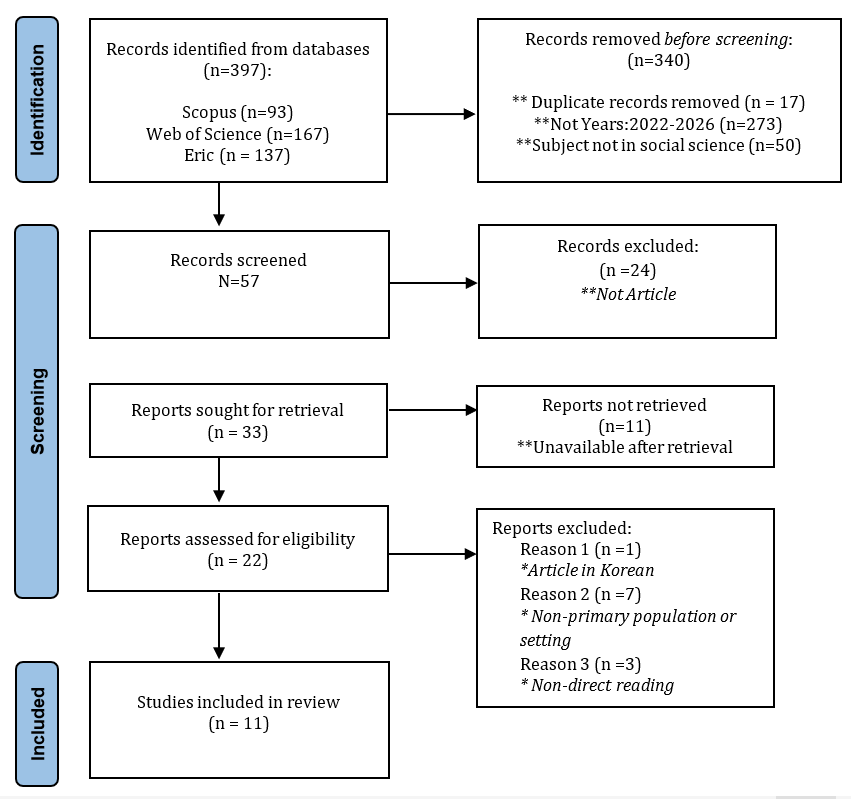
After the screening and analysis process based on the systematic literature review method adapted from Page et al. (2021), the findings of this study were summarised as presented in Figure 1.
Identification
The database searches identified 397 records: Scopus (n = 93), Web of Science (n = 167), and ERIC (n = 137). Before title-and-abstract screening, 340 records were removed: 17 duplicates, 273 outside the 2022–2026 period, and 50 outside the social-science or education scope. These exclusions were verified by a researcher.
Screening
Fifty-seven titles and abstracts were screened. Twenty-four non-article records were excluded, and 33 reports were sought. Eleven reports remained unavailable after institutional and alternative-source retrieval attempts, leaving 22 full texts for eligibility assessment.
Two researchers assessed 22 full texts against the operational definition and eligibility criteria. Eleven were excluded: seven involved a non-primary population or setting, three did not evaluate a direct reading intervention or outcome, and one lacked an eligible English full text. Eleven studies met all criteria and were included. Both researchers evaluated article scope and evidence; differences were discussed with reference to population, intervention, outcomes, and school level until consensus was reached.
Quality Appraisal
Methodological quality was appraised independently by two researchers using design-sensitive considerations, including the appropriateness of the design, sample and comparison conditions, control of confounding, completeness of outcome reporting, and the directness of the reading measures. Judgments were compared and disagreements were resolved through discussion and consensus. Quality was not used as an automatic exclusion threshold; instead, identified limitations informed the weight and caution assigned to each study in the narrative synthesis. Criterion-level MMAT ratings are not reported because completed, independently verifiable MMAT forms were not available for this integrity check.
The appraisal showed substantial variation in evidential strength. Lane et al. (2025) provided the largest grade-specific quasi-experimental comparison, while Eryilmaz and Balcı (2025) also used a large comparative sample. Other studies used non-randomised comparisons, small case series, single cases, or mixed-method classroom designs. Common concerns included unclear allocation procedures, limited control of confounding, absence of active comparison groups, uncertain assessor blinding, and small context-specific samples. Accordingly, larger comparative studies received greater interpretive weight, whereas case and mixed-method studies were used mainly to describe implementation, feasibility, engagement, and provisional outcome patterns. Study-specific limitations are reported in Table 2.
Data Analysis
Study objectives, design, participants, intervention components, comparison conditions, direct reading outcomes, motivation or engagement outcomes, and limitations were extracted using a structured form and checked against the full texts. Descriptive synthesis summarised study characteristics, while a framework-based thematic synthesis grouped direct reading outcomes into phonological awareness and decoding, word reading and fluency, spelling, and comprehension. Motivation and engagement were synthesised separately from reading attainment.
The synthesis distinguished statistically tested group differences from within-participant change, descriptive improvement, qualitative perceptions, and implementation evidence. Claims were then weighted by study design, sample size, methodological appraisal, and the directness with which the intervention assessed reading. No meta-analysis was undertaken because interventions, populations, designs, and outcome measures were too heterogeneous. Multicomponent programmes were described as interventions that included multisensory activities; effects were not attributed uniquely to a sensory component unless the study isolated that component.
Results
The results are organised by the two research questions.
- RQ1: What objectives, populations, methods, and findings are reported in primary-school multisensory reading-intervention studies?
- RQ2: How do multisensory approaches influence reading achievement, phonemic awareness, fluency, comprehension, motivation, and engagement among primary school pupils?
Therefore, the discussion presented in this section is structured based on these two research questions.
RQ1: What are the objectives, population and sample, methodology, and research findings used in studies related to multisensory approaches in primary school reading interventions?
Table 3 summarises all 11 eligible studies. The evidence base comprised six quantitative intervention studies, one qualitative explanatory case study, and four case, development, or mixed-method investigations. Samples ranged from one pupil (Tarjiah et al., 2023) and five pupils (Flaten Jarsve & Tsagari, 2022) to large first-grade and comparative samples (Eryilmaz & Balcı, 2025; Lane et al., 2025). Populations included mainstream pupils, struggling readers, pupils with dyslexia, deaf pupils, and pupils with intellectual disabilities who used AAC.
Table 3. Characteristics and Findings of Included Studies (RQ1)
| Study | Intervention focus | Design | Primary-School Sample | Reported Findings | Key Limitation |
| Ulriksen et al. (2024) | AAC-adapted systematic phonological instruction | Multiple single-case | 7 pupils aged 6–10 with intellectual disabilities using AAC | Gains in phonological awareness and decoding across cases | Small sample; single-case evidence |
| Eryilmaz and Balcı (2025) | Computer-assisted multisensory reading intervention | Comparative non-randomised | 170 pupils with dyslexia and 170 peers, Grades 1–4 | Differences favoured the intervention group for word reading and phonological awareness; comprehension remained weaker | Group allocation and causal attribution require caution |
| Gaitanidi et al. (2023) | Dyslexia Box phonological and literacy activities | Case study | 13 pupils in Grades 3–6 | Descriptive improvement in phonological-awareness and reading tasks | No comparison group; heterogeneous small sample |
| Lane et al. (2025) | UFLI Foundations multicomponent programme | Quasi-experimental historical comparison | First-grade results extracted (n = 1,338 below-median sample) | Large positive grade-specific gains in foundational reading measures | Historical control; effects cannot be assigned uniquely to multisensory activities |
| de Oliveira et al. (2026) | Structured multisensory phonics within RTI | Longitudinal quasi-experimental | 76 at-risk pupils aged 5–6 in early elementary classrooms; 76 matched comparison pupils at final assessment | Improvement across risk groups in early literacy and word-reading development | No randomisation or active intervention control |
| Hazaymeh and Khasawneh (2025) | Multisensory reading activities for dyslexic ELLs | Randomised/quasi-experimental | 60 male pupils aged 9–12 | Reported gains in fluency and comprehension relative to comparison instruction | Allocation and blinding details limited; context-specific |
| Daza Gonzalez et al. (2023) | Visual, kinesthetic, and vibrotactile phonological training | Comparative intervention | 40 deaf pupils aged 6–10; 28 hearing reference pupils | Improved phonological recoding and comprehension immediately after intervention; some effects were not maintained | Specialised population; maintenance was inconsistent |
| Tarjiah et al. (2023) | Remedial teaching including multisensory methods and family support | Explanatory qualitative case study | One Grade 3 pupil plus teacher and family participants | Triangulated descriptive improvement in reading performance and participation | Cannot isolate multisensory contribution; single case |
| Puspita et al. (2026) | Integrated 6C–multisensory and growth-mindset model | Mixed-method design and development | 70 Grade 1–2 pupils in four schools | Pre–post gains in reading–writing literacy and positive implementation evidence | No control group; multicomponent model |
| DeWine and Chai (2024) | Elkonin boxes combined with tactile and movement activities | Mixed-method classroom intervention | 8 first-grade struggling readers | Increased mastery of targeted decodable high-frequency words and high engagement | Small uncontrolled classroom sample |
| Flaten Jarsve and Tsagari (2022) | ICT-supported multisensory structured-language lessons | Mixed-method single-group intervention | 5 dyslexic pupils in Grades 5–6 | Descriptive spelling gains and positive motivation; individual variation | No comparison group; very small sample |
Research Trends and Objectives of Multisensory Reading Interventions
The objectives clustered around three areas. Six studies directly targeted foundational word-level skills such as phonological awareness, decoding, phonics, or target-word mastery (de Oliveira et al., 2026; DeWine & Chai, 2024; Eryilmaz & Balcı, 2025; Gaitanidi et al., 2023; Lane et al., 2025; Ulriksen et al., 2024). Three examined broader fluency, comprehension, or spelling outcomes (Daza Gonzalez et al., 2023; Hazaymeh & Khasawneh, 2025; Flaten Jarsve & Tsagari, 2022). Two evaluated multicomponent remedial or literacy models in which multisensory activity was one element among family support, growth-mindset, or broader pedagogical components (Puspita et al., 2026; Tarjiah et al., 2023).
Participant Characteristics and Educational Contexts
The included samples were restricted to formal primary or elementary settings. Five studies focused specifically on pupils with dyslexia or risk signs (de Oliveira et al., 2026; Eryilmaz & Balcı, 2025; Hazaymeh & Khasawneh, 2025; Flaten Jarsve & Tsagari, 2022; Tarjiah et al., 2023). Two addressed disability-specific access needs—AAC use among pupils with intellectual disabilities and multisensory phonological training for deaf pupils (Daza Gonzalez et al., 2023; Ulriksen et al., 2024). The remaining studies examined first-grade or early-primary literacy instruction and struggling readers (DeWine & Chai, 2024; Gaitanidi et al., 2023; Lane et al., 2025; Puspita et al., 2026).
Methodological Approaches in Multisensory Reading Research
Methodological strength varied substantially. Lane et al. (2025) analysed large, grade-specific quasi-experimental samples, and Eryilmaz and Balcı (2025) used a large comparative design. de Oliveira et al. (2026), Daza Gonzalez et al. (2023), and Hazaymeh and Khasawneh (2025) provided longitudinal or comparative evidence but retained limitations related to allocation, active controls, or reporting. Gaitanidi et al. (2023), Tarjiah et al. (2023), DeWine and Chai (2024), and Flaten Jarsve and Tsagari (2022) offered useful implementation detail but relied on small uncontrolled samples. Puspita et al. (2026) evaluated a broader development model without a comparison group. These differences were incorporated into the interpretation rather than collapsed into a single effectiveness score.
Reported Literacy Outcomes of Multisensory Interventions
Reported outcomes were generally positive but were not equally persuasive. The strongest comparative patterns concerned foundational skills and were reported in large or longitudinal studies of structured or computer-assisted programmes (de Oliveira et al., 2026; Eryilmaz & Balcı, 2025; Lane et al., 2025). Smaller studies reported improvement in phonological awareness, target-word mastery, spelling, fluency, comprehension, or reading participation (Daza Gonzalez et al., 2023; DeWine & Chai, 2024; Gaitanidi et al., 2023; Hazaymeh & Khasawneh, 2025; Flaten Jarsve & Tsagari, 2022; Tarjiah et al., 2023; Ulriksen et al., 2024). However, several interventions were multicomponent, so the findings support the complete instructional package rather than a uniquely multisensory mechanism.
Gaps and Limitations in Existing Research
The principal limitations were methodological heterogeneity, small or context-specific samples, limited active controls, uncertain fidelity or assessor blinding, and short follow-up. The evidence was particularly tentative in single-case and small mixed-method studies (DeWine & Chai, 2024; Gaitanidi et al., 2023; Flaten Jarsve & Tsagari, 2022; Tarjiah et al., 2023; Ulriksen et al., 2024). In addition, multicomponent programmes confounded multisensory activity with explicit phonics, repetition, feedback, technology, family support, or growth-mindset elements (de Oliveira et al., 2026; Lane et al., 2025; Puspita et al., 2026; Tarjiah et al., 2023).
In summary, the included studies show varied implementation of multisensory activities within primary-school reading instruction. Larger comparative studies provide encouraging evidence for multicomponent foundational-skills programmes, while smaller studies principally contribute information about feasibility, adaptation, and provisional outcomes. Table 2 therefore presents each study’s design and limitation alongside its findings.
RQ2: How do multisensory approaches influence reading achievement, phonemic awareness, fluency, comprehension, motivation, and engagement among primary school pupils?
Table 4 reports the direction and nature of findings rather than unsupported labels such as “highly effective”. Statistically tested comparative findings, longitudinal change, within-participant improvement, qualitative evidence, and engagement outcomes are distinguished so readers can judge the directness and strength of each result.
Table 4. Direction and Nature of Reported Findings (RQ2)
| Study | Outcomes | Intervention Activities | Reported Result | Direction and Nature of Findings |
| Ulriksen et al. (2024) | Phonological awareness; decoding | AAC-adapted explicit phonological lessons | Improvement across several single-case measures | Descriptive/single-case improvement |
| Eryilmaz and Balcı (2025) | Word reading; phonological awareness; comprehension | Computer-assisted multisensory reading activities | Comparative differences in word reading and phonological awareness; comprehension gap persisted | Comparative improvement with mixed outcomes |
| Gaitanidi et al. (2023) | Phonological awareness; reading performance | Dyslexia Box activities | Within-case descriptive improvement | Descriptive improvement |
| Lane et al. (2025) | Foundational reading skills | UFLI Foundations programme including multisensory routines | Large positive first-grade quasi-experimental effects | Statistically significant improvement in a multicomponent programme |
| de Oliveira et al. (2026) | Phonological awareness; decoding; word reading | Structured multisensory phonics and RTI cycles | Longitudinal progression across risk groups | Longitudinal improvement; no active control |
| Hazaymeh and Khasawneh (2025) | Fluency; comprehension | Multisensory ELL reading activities | Reported group gains in fluency and comprehension | Comparative improvement; reporting limitations |
| Daza Gonzalez et al. (2023) | Phonological recoding; comprehension | Visual, kinesthetic, and vibrotactile training | Immediate gains; incomplete maintenance at follow-up | Mixed immediate and maintenance findings |
| Tarjiah et al. (2023) | Reading ability; participation | Remedial and family-supported multicomponent intervention | Triangulated descriptive improvement | Qualitative case evidence |
| Puspita et al. (2026) | Reading–writing literacy | 6C–multisensory growth-mindset model | Pre–post improvement and favourable implementation feedback | Uncontrolled multicomponent improvement |
| DeWine and Chai (2024) | Target-word mastery; engagement | Elkonin boxes plus tactile and movement tasks | Target-word gains and high engagement | Descriptive classroom improvement |
| Flaten Jarsve and Tsagari (2022) | Spelling; motivation | ICT-supported multisensory lessons | Mean spelling increase and positive motivation with individual variation | Descriptive mixed-method improvement |
Influence of Multisensory Approaches on Phonemic Awareness and Decoding Skills
Foundational word-level outcomes were the most frequently reported. Large comparative and longitudinal studies reported gains in phonological awareness, decoding, word reading, or composite foundational-reading measures (de Oliveira et al., 2026; Eryilmaz & Balcı, 2025; Lane et al., 2025). Smaller studies reported improvement in phonological tasks or target-word mastery (DeWine & Chai, 2024; Gaitanidi et al., 2023; Ulriksen et al., 2024). These findings are consistent with interventions that provide repeated, explicit practice linking phonemes and graphemes across sensory modalities, although most studies did not isolate the added value of tactile or kinesthetic activity.
The evidence is therefore best interpreted as support for structured interventions that included multisensory practice, not proof that multisensory activity alone caused improvement. This distinction is clearest in UFLI Foundations and the RTI-based phonics protocol, both of which combined sensory activities with systematic sequencing, explicit instruction, cumulative practice, and feedback (de Oliveira et al., 2026; Lane et al., 2025).
Influence of Multisensory Approaches on Reading Achievement and Fluency
Word reading, fluency, and spelling outcomes varied by study design. Eryilmaz and Balcı (2025) reported comparative gains in word reading and phonological awareness; Hazaymeh and Khasawneh (2025) reported fluency gains among pupils aged 9–12; and Flaten Jarsve and Tsagari (2022) observed a mean spelling increase in five pupils. Puspita et al. (2026) also reported pre–post reading–writing gains within a broader literacy model. The latter two findings are descriptive and uncontrolled and therefore provide weaker causal evidence than the larger comparative studies.
Across studies, positive outcomes occurred when multisensory activities were embedded in explicit routines, repeated practice, corrective feedback, or structured progression. Because these instructional features co-occurred, the evidence supports the quality and coherence of the complete intervention package rather than demonstrating an independent sensory effect.
Influence of Multisensory Approaches on Reading Comprehension
Comprehension evidence was less consistent. Hazaymeh and Khasawneh (2025) reported improvement following a multisensory ELL intervention, and Daza Gonzalez et al. (2023) reported immediate comprehension-related gains among deaf pupils. By contrast, Eryilmaz and Balcı (2025) found that the comprehension gap remained despite improvement in word-level outcomes, while some gains in Daza Gonzalez et al. (2023) were not fully maintained at follow-up. Thus, comprehension findings were mixed and based on relatively few studies.
This pattern is theoretically plausible because comprehension depends on language knowledge and meaning construction in addition to accurate decoding (Duke & Cartwright, 2021; Tunmer & Hoover, 2019). Multisensory phonics practice may strengthen access to print, but broader vocabulary, syntax, background knowledge, and comprehension strategy instruction remain necessary.
Influence of Multisensory Approaches on Motivation and Engagement
Motivation and engagement were reported mainly in small mixed-method or classroom studies. DeWine and Chai (2024) observed high engagement during tactile and movement-based target-word practice; Flaten Jarsve and Tsagari (2022) reported favourable motivational responses to ICT-supported lessons; and Tarjiah et al. (2023) described improved participation within a family-supported remedial intervention. These findings indicate acceptability and participation, but they should not be treated as direct evidence of reading attainment.
Motivation and engagement may facilitate sustained practice, yet the included studies did not test them as mediators of reading growth. They are therefore reported as complementary implementation outcomes rather than proxies for effectiveness.
Effectiveness of Technology-Assisted Multisensory Interventions
Technology-assisted delivery appeared in computer-based reading activities and ICT-supported structured-language lessons (Eryilmaz & Balcı, 2025; Flaten Jarsve & Tsagari, 2022). In Eryilmaz and Balcı (2025), computer-assisted practice was associated with stronger word-reading and phonological-awareness outcomes, although comprehension remained weaker. In Flaten Jarsve and Tsagari, ICT supported repeated spelling practice and was accompanied by descriptive spelling gains and positive motivation in five pupils.
Technology enhanced practice by presenting visual and auditory cues, enabling repetition, supporting immediate interaction, and increasing pupil interest. The evidence does not show that novelty itself improved reading. Rather, digital tools appeared to reinforce established literacy activities, and conclusions remain limited by multicomponent designs and, in Flaten Jarsve and Tsagari (2022), a very small uncontrolled sample.
Challenges and Limitations of Multisensory Reading Interventions
The evidence base remains uneven. Lane et al. (2025) and Eryilmaz and Balcı (2025) provide greater statistical precision than the single-case or very small studies of Ulriksen et al. (2024), Tarjiah et al. (2023), DeWine and Chai (2024), and Flaten Jarsve and Tsagari (2022). Even the larger studies were not designed to isolate multisensory activity from explicit instruction, intensity, technology, or other programme components. Conclusions were therefore weighted by design and phrased as reported associations or programme outcomes rather than universal causal effects.
Intervention components and outcome measures were also inconsistent. Studies used phonological-awareness tasks, word reading, spelling, fluency, comprehension, composite early-literacy scores, interviews, and engagement observations. This heterogeneity precluded meta-analysis and prevents identification of a single optimal multisensory configuration. Future trials should specify sensory components, monitor fidelity, use active comparison groups, report effect estimates and uncertainty, and include maintenance measures.
Conclusion
This systematic literature review examined the implementation and reported outcomes of multisensory approaches in primary-school reading interventions. After full-text re-screening against a primary-school-only operational definition, 11 studies published from 2022 to 20 June 2026 were included. The evidence encompassed large quasi-experimental comparisons, longitudinal non-randomised studies, case investigations, and small mixed-method interventions.
The most consistent reported outcomes concerned foundational skills, including phonological awareness, decoding, word reading, and spelling. Larger comparative or longitudinal studies provided encouraging evidence for structured programmes that incorporated multisensory activities (de Oliveira et al., 2026; Eryilmaz & Balcı, 2025; Lane et al., 2025). Evidence for comprehension was mixed, while motivation and engagement findings came mainly from smaller descriptive studies.
These findings do not establish that multisensory activity alone causes reading improvement. Most interventions combined sensory activities with explicit instruction, systematic sequencing, repetition, feedback, technology, or additional support. The most defensible conclusion is therefore that multisensory activities may be useful components of coherent, structured reading interventions, particularly for foundational word-level practice and for adapting instruction to diverse learners.
Interpretation is constrained by design heterogeneity, limited active controls, small and context-specific samples, inconsistent fidelity reporting, and few maintenance assessments. The review itself was limited to three databases, English-language journal articles, and reports that could be retrieved despite additional access attempts. These limitations may have introduced language, database, and availability bias.
Future research should compare otherwise equivalent interventions with and without specified tactile or kinesthetic components, use validated direct reading measures, report effect sizes and confidence intervals, monitor fidelity, and include longer follow-up. Such designs are needed to determine whether multisensory elements add value beyond explicit, systematic, and intensive reading instruction.
Not applicable.
Conflict of Interest
The authors declare no conflict of interest.
Funding
This research received no external funding.
Generative AI Statement
As the authors of this work, we used the AI tool ChatGPT for language refinement, idea organisation, and writing support. We also used Grammarly for grammar and language editing, and Mendeley for reference management and citation formatting. After using these tools, we critically reviewed, revised, and verified the final version of the manuscript. We, as the authors, take full responsibility for the content, accuracy, and integrity of our published work.
Authorship Contribution Statement
Hasan: Conceptualization, drafting manuscript, data analysis, writing. Ali: Editing/reviewing, supervision, critical revision of the manuscript.