


Introduction
Mathematics learning not only focuses on numeracy skills, but also develops mathematical thinking, developing an understanding of mathematical concepts and constructions that will give students a foundation for solving problems (Szabo et al., 2020). Thus, it is essential for mathematics learning to develop students' mathematical problem-solving skills. The ability to solve mathematical problems is a person's effort to solve the mathematical problem faced by using methods, procedures, stages, and strategies that can be accounted for mathematically (Anam et al., 2020). Students' problem-solving abilities differ from one another according to their thinking abilities, the methods they use, and the strategies they employ. Previous research has found that students' mathematical problem-solving abilities are low, with a score of 41.72% (Annizar et al., 2020). Indonesia ranks low in reading, science, and mathematics literacy based on PISA results (OECD, 2023). The latest PISA results show a decline in mathematics literacy scores compared to previous PISA results. Based on the research results and PISA scores, there are problems with students implementing concepts in their daily lives. Low PISA scores are related to students' ability to solve mathematical problems, especially non-routine problems. Low mathematical problem-solving skills are caused by a learning process that lacks the development of higher-order thinking skills, is not relevant to students' lives, and focuses only on routine problems (Aminah et al., 2023; Asih& Ramdhani, 2019). Therefore, mathematics learning needs to focus on strengthening mathematical problem-solving skills.
Students involved in problem-solving tasks need to be able to manage their learning process adequately, especially during independent learning sessions where teachers do not directly guide the learning (van Gog et al., 2020). In the learning process, self-regulated learning will help students build knowledge and understanding of mathematical concepts independently (Ishartono et al., 2022). Self-regulated learning is a dynamic learning process in which students build knowledge that enables them to set goals, apply strategies, and reflect (Efriyadi & Nurhanurawati, 2021; Schunk et al., 2018). Self-regulated learning in mathematics is the ability of students to actively and constructively plan solutions, set goals for solving mathematical problems, and then strive to implement solutions, evaluate themselves, and make changes repeatedly. Based on the results of research (Lusiana et al., 2022) and (Kurniyawati et al., 2019), self-regulated learning is still low, as seen from the students' habit of often imitating their friends when doing assignments, lack of initiative in doing assignments, lack of enthusiasm, lack of activity in utilizing learning resources, lack of participation in group discussions, thereby reducing their independence in mathematics learning.
The implementation of mathematics teaching requires teachers to apply the correct teaching model to support the effectiveness of the teaching and learning process. Problem-based learning is a mathematics learning model that helps students develop critical thinking and problem-solving skills (Bosica et al., 2021). In addition, PBL provides students with the opportunity to actively engage in groups, interact, collaborate, and exchange ideas to solve real problems with the guidance of a facilitator teacher (Tadjer et al., 2022; Widyatiningtyas et al., 2015). The initial stage of the PBL model is problem orientation, where the teacher presents contextual problems that allow students to develop their mathematical problem-solving abilities as well as their learning independence (Kurniyawati et al., 2019). The next stage is to organize students to learn mathematics, and then the teacher assists independently and collaboratively investigating mathematics problems. The teacher, as a facilitator, provides the necessary guidance during the investigation process, guides the discussion, and facilitates the process. The next stage involves developing and presenting the results, and the final stage entails analyzing and evaluating the problem-solving process. The results of the study show that there is an increase in problem-solving for the implementation of PBL (Hendriana et al., 2018; Ramadhani, 2018).
Quality teaching is determined by the role of teachers in the teaching process. One of its roles is to apply technology in teaching. The use of technology and communication has become an integral part of the teaching process. The use of technology in teaching can improve problem-solving skills, mathematical thinking skills, and make it easier for students to find various ways to access information sources (Ariani et al., 2022; Jacinto& Carreira, 2023). The research suggests that educators' limited understanding of technological advances and their infrequent use of teaching media can lead to student learning boredom (Novita et al., 2022).
In addition, the use of technology and self-taught materials has been proven to improve mathematical problem-solving skills and high-level thinking skills (Hidayat et al., 2022; Jacinto& Carreira, 2023). The use of technology, including Google Sites, live worksheets, and GeoGebra, has been proven to create an efficient learning environment and improve student visualization and problem-solving skills (Iwani Muslim et al., 2023; Setiyani et al., 2020). It is crucial to investigate further how digital technologies have been integrated into mathematics learning (Viberg et al., 2023). Therefore, innovation is necessary for the use of more diverse learning media in mathematics education. Current technological advances can make it easier for students to visualize mathematical objects. One of the mathematical software programs that can visualize objects is GeoGebra. Geogebra can be used as a medium to connect abstract mathematical imagination with concrete mathematics (Linda et al., 2024). By utilizing the PBL learning model through web-based media connected to GeoGebra, students are more actively involved in building mathematical knowledge and developing problem-solving skills independently and logically, in line with the demands of 21st-century education. Thus, with web-based mathematics learning media, students can improve their mathematical problem-solving skills and develop self-regulated learning.
The problem-based learning model is a learning model that is suitable for solving mathematical problems because PBL requires teachers to implement meaningful learning by presenting issues that are relevant to students' daily lives, allowing students to think freely to find answers to concepts and solve problems (Nurlaily et al., 2019). In addition, PBL trains students to learn independently (Chrisdiyanto& Hamdi, 2023). In addition to the PBL Model, Google sites have opportunities to develop a mathematics learning website because teachers can provide learning materials, assignments, discussion forums, and quizzes (Widodo, 2017). In addition to the Google site, GeoGebra is a dynamic math software that is free and multi-platform for all levels of education (Ferdiánová, 2017). The connection between the Google site and GeoGebra is an ideal step that will motivate students to engage in independent learning. This suggests that learning with the web-based, media-based PBL model offers opportunities to enhance mathematical problem-solving skills and self-regulated learning. The PBL model, combined with the media, can help students develop their independence in solving problems on the website.
Several previous studies have proven the effectiveness of digital learning media in improving students' mathematical abilities. For example, the effectiveness of using PBL-based e-modules for mathematical reasoning and inquiry-based interactive mobile devices for problem-solving skills (Arifin et al., 2021; Hidayat et al., 2022). In line with this, other studies have explored the use of Microsoft Word VBA-based teaching materials, which have been shown to improve problem solving and independent learning, and the development of Macromedia Flash-based media with a discovery learning model has also been carried out to target aspects of self-regulated learning in high school students (Nasution et al., 2019; Pertiwi et al., 2021). The results of these studies are generally still offline and not suitable for current mobile devices. The implementation of the PBL model in website-based learning is more accessible without the need for special installation on mobile phones, computers, or laptops, and can be combined with GeoGebra, Mathigon, YouTube, and other quizzes. Thus, the implementation of a website with the PBL model is expected to not only improve mathematical problem-solving skills (cognitive aspect) but also deliberately foster self-regulated learning (affective aspect) through an interactive and independent digital environment. Based on the description above, the objectives of the development of website-based mathematics learning media in this study are to develop website-based mathematics learning media with a PBL Model oriented towards mathematical problem solving and self-regulated learning that meets valid, practical, and effective criteria.
Methodology
Research Design
This research employs a developmental approach using the ADDIE model. The stages of ADDIE development design are analysis, design, development, implementation, and evaluation (Branch, 2009). The stages of the ADDIE model are illustrated in Figure 1 below.
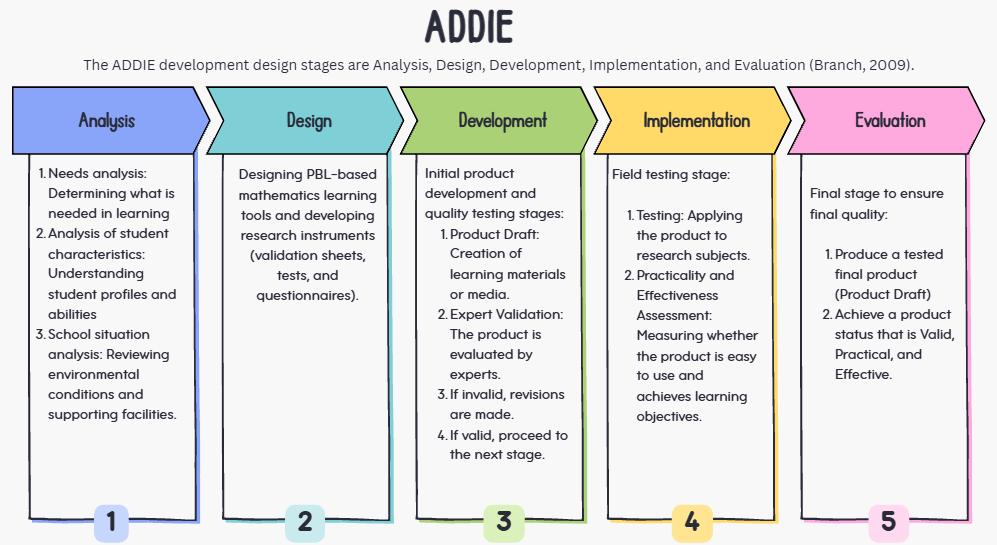
Figure 1. Stage of Development Research
The analysis aims to identify field facts and learning problems through observation and interviews with teachers and students at SMP N 1 Pleret. Development of PBL-based website learning media on polyhedron material to overcome low mathematical problem-solving skills, self-regulated learning, and students' difficulties in visualizing material and solving story problems. Utilization of website-based learning media based on the availability of school facilities.
The design stage includes a polyhedron learning website based on the PBL model that focuses on problem-solving skills and independent learning. The design plan includes the design of teaching modules, student worksheets, and website components. The trial planning includes two stages, namely a small-scale (10 students) for initial revision and a large-scale (31 students) to measure the validity, practicality, and effectiveness of the product. The assessment instruments include teacher and student assessments, observation sheets, problem-solving ability tests, and self-regulated learning questionnaires.
The third stage is to realize the product by developing a mathematics learning website as the main tool that integrates teaching modules, media, and student worksheets. The website is designed using the PBL model to improve students' mathematical problem-solving skills and self-regulated learning. The development of website features focuses on the visualization of polyhedron material and easy access to the material independently by students. The polyhedron material is organized based on learning outcomes (CP) and relevant references to support mathematical problem solving and self-regulated learning. At this stage, PBL-based LKPDs are developed that include complete components (cover, objectives, instructions, student activities, and exercises) to train problem solving and independence. Website feature development includes
1) Main menu and navigation (homepage, preface, instructions for use, and author information).
2) Student activities (integration of learning videos, digital LKPD, and interactive Geogebra media).
3) The learning design within the website follows the PBL steps.
4) Material and exercise menu (a collection of teaching materials and practice questions to strengthen students' mathematical problem-solving skills).
The initial display of the mathematics learning website can be seen in Figure 2.
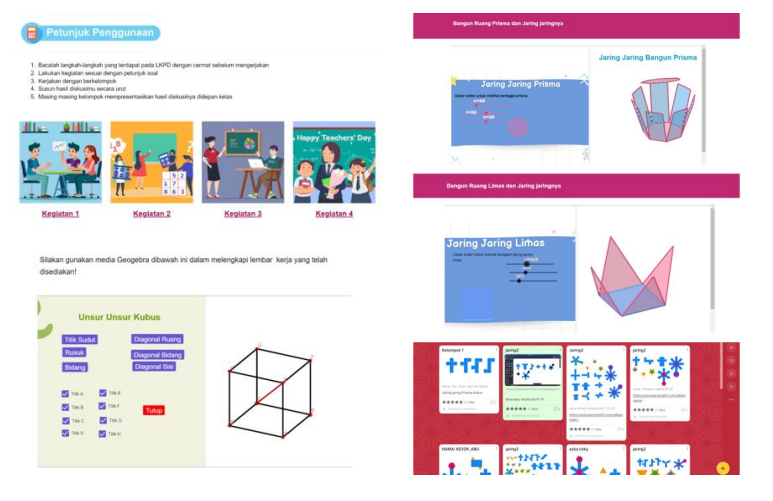
Figure 2. Media Display
The development stage is the process of realizing the design, expert validation, and conducting product trials and research instrument trials. The implementation stage is the stage of applying the product at SMP N 1 Pleret Bantul and the instrument at SMP N 1 Banguntapan. The subjects for the first stage of the media trial were 10 students, and the second stage trial involved 31 students. The self-regulated learning questionnaire involved 306 respondents, while the mathematical problem-solving ability test was administered to 55 respondents. The difference in the number of respondents was due to the different analysis requirements for each instrument. The self-regulated learning questionnaire required a larger number of respondents because it would be analyzed using construct validity. In applying construct validity, the minimum number of respondents required is ten times the number of items in the questionnaire. Guilford (1967) suggests that researchers need a minimum of 200 respondents as a sample to be able to perform construct validity analysis. This is done to ensure the accuracy and reliability of the construct validity analysis results for the self-regulated learning questionnaire. The results of the mathematical problem-solving ability test and independence questionnaire were used to determine the validity, reliability of the instruments, and practicality in learning.
The development and evaluation research on a Web-Based Mathematics Learning Environment Oriented to Problem-Based Learning (PBL) to Improve Problem Solving and Learning Independence was carried out for 4 weeks. This activity started from March 28, 2024, to April 25, 2024, at SMP N 1 Pleret. Learning activities were carried out by providing pretest questions, followed by providing treatment once a week using a learning module developed with a PBL approach oriented to a Web-Based Mathematics Learning Environment, and ending with providing posttest questions to measure Problem-Solving and Self-Regulated Learning after being given treatment.
The implementation stage consists of trials 1 and 2, which were conducted at SMP N 1 Pleret Bantul. Trial 1 was conducted before the learning process to obtain input data and suggestions from students as media evaluators. Trial 2 was conducted during the learning process to obtain data from teachers as media evaluators, media assessments by students, learning implementation assessment results, mathematical problem-solving test results, and student self-regulated learning questionnaires. The data obtained will be used to evaluate the website-based mathematics learning media that have been developed in terms of practicality and effectiveness. The implementation stage began at the first meeting with a pre-test of problem-solving skills, completion of a self-regulated learning questionnaire, and a trial of the website-based media. In the second to fourth meetings, the researcher applied the website-based media with the PBL model, teaching materials, and student worksheets to discuss the material on elements, nets, and the surface area and volume of flat-sided shapes. Furthermore, the fifth meeting focused on completing the volume material and filling out a practicality questionnaire by teachers and students. The series of activities ended at the sixth meeting with a post-test to measure the improvement in mathematical problem-solving skills and a self-regulated learning questionnaire after using web-based media.
The evaluation stage was conducted to evaluate website-based mathematics learning media using the PBL model based on the results of validation and trials that had been carried out previously. Data was obtained from data analysis, namely the validity, practicality, and effectiveness of website-based mathematics learning media. Furthermore, website-based media will be evaluated according to the results obtained based on assessments and input from validators, teachers, and students.
Data Collection Techniques and Instruments
The data analysis techniques in this study include validity, practicality, and effectiveness to determine the quality of the developed learning media and instruments. Validity data were obtained from assessments by expert validators related to the developed learning media and instruments. The practicality data were obtained from the results of observation of learning implementation by observers, teacher assessments, and student assessments. Effectiveness data were obtained from the results of the pre-test and post-test of mathematical problem-solving ability and self-regulated learning questionnaires. The types of data in this study comprise both qualitative and quantitative data. The qualitative data were obtained from input from expert validators, teachers, observers, and students related to the developed product. The data analysis was conducted according to the guidelines provided by Mardapi (2017). Here are the steps of validity, practicality, and effectiveness analysis.
Table 1. Quantitative to Qualitative Data Conversion (Mardapi, 2017)
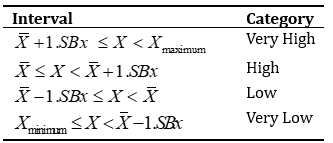
a. Analysis of the Data on Validity
The validity analysis aims to determine the quality criteria of products and instruments developed based on the assessment of expert validators. The components of the product must be based on a theoretical rationale, and all components must be consistently related to one another. If the developed products meet these requirements, they are considered valid (Nieveen, 1999, p. 127). The following interval conversion results are presented in Table 2
Table 2. Result of Media Interval Conversion in Terms of the Material and Media
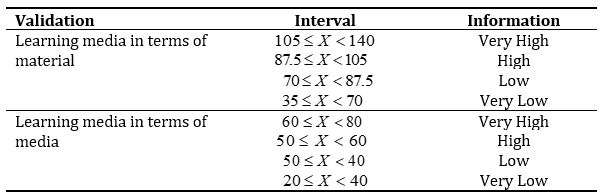
Table 2 shows that website-based mathematics learning media using the PBL model and problem-solving test instruments and self-regulated learning questionnaires are declared valid if they meet the minimum criteria of ‘high’. This learning media is considered suitable for use in the field after undergoing a revision process in accordance with the suggestions of expert validators. Therefore, the required validity evidence is content validity and construct validity. The validity used is content validity and construct validity. Content validity consists of two types, namely face validity and logical validity (Allen& Yen, 1979). The validity criteria for the mathematical problem-solving test instrument and self-regulated learning questionnaire are as follows.
Table 3. Interval Conversion of KPM and SRL Instruments
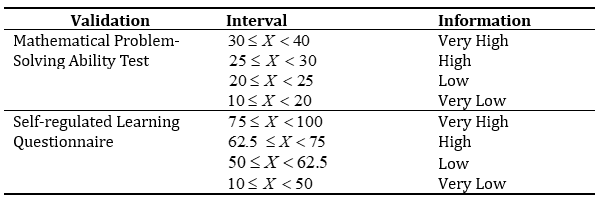
Table 3 shows that the problem-solving test instrument and self-regulated learning questionnaire were declared valid and suitable for use after meeting the minimum ‘high’ criteria based on expert assessment and calculation of the V Aiken index (Retnawati, 2016). Subsequently, the value of the validity index of the calculation was calculated by applying the formula from Aiken (Retnawati, 2016, p. 18)

Construct validity is used to see if an instrument can measure the concepts of the theory on which the test is based (Miller et al., 2009). Confirmatory Factor Analysis (CFA) is a method that determines the number of factors and patterns of previous indicators and evaluates how well the model fits into existing data (Brown, 2015). The results of the CFA construct validity analysis assessed the validity of the construct for each item in the self regulated-learning Instrument. A statement is declared valid if the loading factor is above > 0.50 (Hair et al., 2010). Certain items in the developed instrument had to be omitted when using CFA to obtain a measurement model that fit the data. Of the 25 items, seven items had a loading factor of less than 0.5, namely items 6, 8, 10, 13, 19, 21, and 25. So that there are 18 valid items left. Therefore, it can be concluded that 18 statements can be implemented. The following are the results of the CFA calculation.
Table 4. CFA Calculation Results
| No | Model Fit Index | Acceptable Index | Model Index | Category |
| 1 | Chi-Square | x2/df≤2 (good fit) | 165.649 | Marginal fit |
| 2 | RMSEA (Root Mean Square Error of Approximation) | ≤ 0.08 | 0.050 | Good Fit |
| 3 | RMSR (Root Mean Square Residual) | ≤ 0.05 | 0.039 | Good Fit |
| 4 | NFI (Normed Fit Index) | ≥ 0.9 | 0.913 | Good Fit |
| 5 | CFI (Comparative Fit Index) | ≥ 0.9 | 0.959 | Good Fit |
| 6 | GFI (Goodness of Fit Index) | ≥ 0.9 | 0.943 | Good Fit |
| 7 | NNFI (Non-Normed Fit Index) | ≥ 0.9 | 0.934 | Good Fit |
Table 4 indicates that this CFA model exhibits a good fit, except for the chi-square statistic, which suggests a marginal fit. However, since other indices, such as RMSEA, CFI, GFI, and NNFI, show a good match, this model can be considered feasible and can be implemented in the field.
Allen and Yen (1979) write that a test is considered reliable if the observed score has a high correlation with the actual score. The estimation of the reliability of the instrument was carried out by looking for the Cronbach Alpha reliability coefficient (α) for self-regulated learning questionnaires and mathematical problem-solving ability test questions (Allen& Yen, 1979). The reliability of the self-regulated learning Questionnaire, which yielded a Cronbach's Alpha estimate of 0.89, indicating high reliability. In the mathematical problem-solving ability test, a Cronbach's Alpha estimate of 0.89 was obtained, indicating reliability.
b. Practicality Data Analysis
Practicality analysis was used to determine the extent to which the developed learning media met the practicality criteria. This analysis involved data from teacher assessment questionnaires, student assessment questionnaires, and learning implementation observation sheets. The guidelines establish the categories of practicality based on Mardapi (2017).
Table 5. Conversion of Teacher Practicality
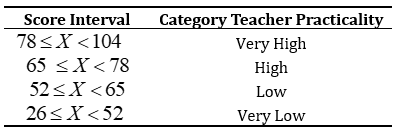
Table 6. Converting Student Practicality Intervals
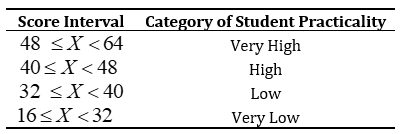
Tables 5 and 6 show that media development is considered practical if the results of the assessment conversion by teachers and students meet the minimum criterion of "high". Furthermore, the analysis of learning implementation data aims to calculate the percentage of learning success. The formulation of the analysis is as follows.

The learning media used in this study is considered practical if the percentage of learning implementation for each meeting reaches at least 80%.
c. Effectiveness Data Analysis
The effectiveness test was conducted to determine the effectiveness of learning activities designed using web-based mathematics learning focused on Problem-Based Learning (PBL) in improving problem-solving and learning independence. Prior to the effectiveness test, a normality immersion test was conducted. In this study, the normality test was conducted using the R program at a significance level of α = 0.05. The normality test was conducted as follows.
d. Normality Test for One-Sample t-Test
Before conducting the one-sample t-test, a normality test was first conducted. The results of the normality test are presented in the following table.
Table 7. Normality Test
| Instrument | Variables | Shapiro Wilk | p-value | Decision |
| Pre-test | Mathematical Problem-Solving Ability | .95 | .20 | Univariate Normal |
| - | Self-Regulated Learning | .97 | .66 | Univariate Normal |
| Post-test | Mathematical Problem-Solving Ability | .95 | .21 | Univariate Normal |
| - | Self-Regulated Learning | .95 | .19 | Univariate Normal |
Table 7 shows that at a significance level of.05, the pre-test and post-test class data for each variable are univariately normally distributed. This is due to the calculation results, where the p-value for the pre-test and post-test instruments is greater than.05 in the experimental class for mathematical problem-solving skills and independent learning.
e. Normality test for Paired Sample T-Test
First, a normality test was conducted by calculating the difference score, d = post - pre. The results of the normality assumption examination are presented in Table 8. The results of the normality test are presented in the following table.
Table 8. Normality Test
| Instruments | Variables | Shapiro Wilk | p-value | Results |
| pos – pre | Mathematical Problem-Solving Skills | .96 | .33 | Univariate normal |
| - | Self-regulated learning | .96 | .51 | Univariate normal |
Based on Table 8, at a significance level of.05, the pre-test and post-test data for each variable are univariately normally distributed. This is due to the results of the calculation, which showed a p-value greater than.05, indicating that students' mathematical problem-solving skills and self-regulated learning were not statistically significant
Inferential data analysis analyzes specific data sets to make conclusions about larger data sets (Kokoska, 2015, p. 11). Inferential statistical tests were used to test hypotheses in this research. This analysis aimed to reveal how well the developed media met the effective criteria set through mathematical problem-solving ability tests and self-regulated learning questionnaires.
The developed learning media was said to be effective if it met several criteria, namely:
1) The percentage of students who achieved the Learning Goal Achievement Criteria score on two dependent variables, namely mathematical problem-solving ability and self-regulated learning, was 80%≥.
2) The average post-test of students' problem-solving ability reached 69.99.
3) The average post-test self-regulated learning reached 44.
4) The average post-test mathematical problem-solving ability was more than the average pre-test.
5) The average post-test self-regulated learning is higher than the pre-test self-regulated learning.
Results
This study aims to develop website-based mathematics learning media that utilize the PBL model, which focuses on mathematical problem solving and student independent learning, ensuring feasibility and meeting the criteria of validity, practicality, and effectiveness. The results of the validity, practicality, and effectiveness of the developed website-based media are described as follows.
1. Validity of Website-Based Mathematics Learning Media with PBL Model
Product validation involves verification by experts in the fields of materials, media, and research tools. The assessment of the validity of mathematics learning media aims to determine the quality of the learning materials that have been developed. The results of the validity analysis of learning media for each aspect are presented in Table 9 below.
Table 9. Media Assessment by Experts
| No | Validation Components | Ideal maximum score | Val. I | Val. III | Average | Many Items | Criterion |
| 1 | Material Validation | 140 | 138 | 136 | 137 | 35 | Very high |
| 2 | Media Validation | 80 | 79 | 78 | 78.5 | 20 | Very high |
Table 9 presents the average assessment scores of learning media in terms of material (137) and media (78.5), both of which fall within a very high category. Thus, mathematics learning media with the PBL model are declared valid. Furthermore, the results of the validation of the mathematical problem-solving ability test instrument and the students' self-regulated learning questionnaire were analyzed using the Aiken index. The V-index is greater than 0.8. In this case, the validity of an item or instrument is considered very high, showing a strong ability to measure ideas reliably and accurately (Retnawati, 2016). The following are the results of the analysis of the mathematical problem-solving ability test, learning independence instruments, teacher practicality instruments, and student practicality instruments presented in Table 10.
Table 10. Instrument Assessment by Experts
| No | Validation Components | Ideal maximum score | Val. I | Val. III | Average | Many Items | Criterion |
| 1 | Validation of the Mathematical Problem-Solving Ability Test | 40 | 36 | 38 | 37 | 10 | Very High |
| 2 | Validation of the Self-regulated Learning Questionnaire | 100 | 99 | 99 | 99 | 25 | Very High |
| 3 | Validation of the Teacher Practicality Instrument | 104 | 103 | 103 | 103 | 26 | Very High |
| 4 | Validation of the Teacher Practicality Instrument | 60 | 59 | 54 | 56.5 | 15 | Very High |
Table 10 shows that the problem-solving ability test, the student self-regulated learning questionnaire, the teacher's practicality instrument, and the student practicality instrument collectively indicate that website-based media with the PBL model is a valid instrument. Furthermore, based on the results of the Aiken Index analysis, the research instruments developed showed a high level of validity. This can be seen from the scores for the mathematical problem-solving ability instrument of 0.9 and self-regulated learning of 0.99, both of which fall into the high category. Thus, all test and questionnaire instruments were declared valid, meaning that these mathematics learning media are suitable for use in the trial phase.
2. The Practicality of Website-Based Mathematics Learning Media with the PBL Model
Practicality aims to determine whether the developed product is practical or not. This research utilizes the results of student activities, learning implementation assessments, teacher evaluations, and student evaluations. The results of the analysis of learning implementation, which determine the practicality of mathematics learning media, are presented.
a. Analysis of Student Readability Testing Data
The practicality of mathematics learning media using the PBL model is evident from the results of implementation observation assessments, teacher evaluations, and student evaluations of the media. The results of the students' assessment of the media obtained an average score of 51.5, which is categorized as very high. Thus, the mathematics learning media with the PBL model is oriented towards mathematical problem solving and independent learning in the practical category.
b. Data Analysis of Teacher Assessment Results
The results of the practicality assessment by the teacher include the use of learning media. The assessment by teachers was conducted after a field trial of the application of the developed mathematics learning media, which is oriented towards mathematical problem-solving and self-regulated learning. The results of the learning media assessment by teachers obtained an average of 90.5 in the very high category. Thus, mathematics learning media with a PBL model oriented towards mathematical problem solving and self-regulated learning is considered practical.
c. Data Analysis of Large Class Trial Results of Student Responses
The results of the practicality assessment by the students include media assessments. Students of Grade VII F conducted the assessment. The results of the practicality assessment by 31 students obtained an average of 50.1 in the high category. Thus, website-based mathematics learning media are declared practical and can facilitate students' mathematical problem-solving and self-regulated learning abilities.
d. Analysis of Learning Implementation Results
Observers conduct observations of learning implementation during the learning process. The following are the results of observations on the implementation of learning, as shown in Table 11.
Table 11. Assessment of Learning Implementation
| Activity | Meeting 1 | Meeting 2 | Meeting 3 | Meeting 4 | Mean |
| Teacher | 93% | 94% | 93% | 95% | 94% |
| Student | 90% | 90% | 91% | 95% | 92% |
| Average | 92% | 92% | 92% | 95% | 93% |
Based on Table 11, the average percentage obtained is > 80%. Therefore, the implementation of mathematics learning with PBL-based learning media has met the minimum limit that has been determined. Therefore, it can be concluded that website-based mathematics learning media using the PBL model can facilitate the mathematical problem-solving ability and self-regulated learning of students who meet the practicality criteria from the aspect of learning implementation.
3. Effectiveness of Mathematics Learning Media-Based Website with PBL Model
The effectiveness of learning media is evaluated to measure the extent to which mathematics learning media incorporating the PBL model can achieve the set learning goals. The following analysis examines mathematical problem-solving skills and describes students' self-regulated learning data.
a. Description of Mathematical Problem-Solving Abilities
Students' mathematical problem-solving ability was measured using pre-test and post-test instruments in the form of four-question descriptive questions. The scores obtained by students were analyzed descriptively. The descriptive statistical data for mathematical problem-solving skills are presented in Table 12 below.
Table 12. Description of Mathematical Problem-Solving Abilities
| No | Description | Pre-test | Post-test |
| 1 | Number of Students | 31 | 31 |
| 2 | Average | 48.08 | 84.78 |
| 3 | Highest Score | 59,38 | 100 |
| 4 | Lowest Score | 21.88 | 71.88 |
| 5 | Ideal Maximum Score | 100 | 100 |
| 6 | Ideal Minimum Score | ||
| 7 | Standard Deviation | 14.97 | 8.86 |
| 8 | Mastery Percentage | 3% | 97% |
Table 12 shows that the mathematical problem-solving skills in the experimental class have improved. This improvement is evident in the average pretest mathematical problem-solving skills, which increased by 48.08. The average posttest mathematical problem-solving skills were 84.78. The percentage of students who were able to achieve the minimum score was only 6%, while the standard set to determine the percentage of students who were able to achieve the minimum score was 75%. The pretest percentage results did not reach the minimum standard of 75%. Meanwhile, the percentage of complete mathematical problem-solving skills was > 80%. Thus, it can be concluded that the use of mathematical learning tools in conjunction with the PBL model is effective in facilitating mathematical problem-solving skills.
b. Description of Students' Self-Regulated Learning
In this study, students' self-regulated learning was measured using a questionnaire consisting of 18 statements. The data obtained from the students' scores will be analyzed descriptively. The descriptive statistical data is as follows.
Table 13. Results of the Self-Regulation-Based Learning Questionnaire
| No | Description | Pre-test | Post-test |
| 1 | Number of Students | 31 | 31 |
| 2 | Average | 49.19 | 60.13 |
| 3 | Highest Score | 55 | 69 |
| 4 | Lowest Score | 44 | 51 |
| 5 | Ideal Maximum Score | 72 | 72 |
| 6 | Ideal Minimum Score | 18 | 18 |
| 7 | Standard Deviation | 2.98 | 5.39 |
Table 13 shows that students' self-regulated learning has improved. The average score for students' self-regulated learning on the pre-test was 49.19 and 60.13 on the post-test. The average score on the questionnaire increased by 10.94 points from the pre-test to the post-test. Thus, learning using PBL-based learning tools has met the effectiveness criteria evaluated based on students' self-regulated learning.
c. One-Sample t-Test
Before conducting hypothesis testing, a prerequisite test was first conducted, namely, a normality assumption test. Univariate normality testing was conducted on the results of students' mathematical problem-solving abilities and self-regulated learning before and after the intervention. The learning effectiveness test was used to evaluate the effectiveness of learning with the PBL model and learning media. This test uses the one-sample t-test assisted by the R program.
Table 14. One-Sample T-test Result
| Variables | t | tα(n-1) | p-value | Decision | Effect Size |
| Mathematical Problem-Solving Skills | 9.07 | 1.69 | .00* | H0 rejected | 2.98 |
| Self-regulated learning | 16.66 | 1.69 | .00* | H0 rejected | 2.51 |
Table 14 shows that, for the variable of mathematical problem-solving ability, the p-value obtained is <.05 or tα(n-1) (9.07>1.69) w hich means H0 rejected. This indicates that the average mathematical problem-solving ability is greater than 69.99. Next, the results obtained for the variable of students' self-regulated learning p-value <.05 or tα(n-1) tα(n-1) (9.07>1.69) which means H0 rejected. This indicates that the average self-regulated learning of students is greater than 44. The effect size value for Mathematical Problem-Solving Skills is 2.98 > 1.30, and the effect size value for self-regulated learning is 2.51 > 1.30, which shows that the difference in average scores between the two groups is statistically and practically significant. Thus, it can be concluded that website-based media with the PBL model is effective in facilitating mathematical problem-solving skills and self-regulated learning of students.
d. Paired Sample t-Test
The learning effectiveness test was used to evaluate the effectiveness of learning with the PBL model and the developed learning media. This effectiveness test used a paired t-test assisted by the R programming language. The paired t-test was used to determine whether the average post-test score for mathematical problem-solving ability was greater than the average pre-test score for mathematical problem-solving ability. The test results are presented in Table 15 below.
Table 15. Paired S ample T-test Results
| Variables | t | tα(n-1) | p-value | Results | Effect S ize |
| Mathematical Problem-Solving Skills | 17.44 | 1.69 | .00* | H0 rejected | 3.19 |
| Self-regulated learning | 10.8 | 1.69 | .00* | H0 rejected | 1.96 |
Table 15 shows that t had a positive value of 17.44 > 1.69 and a p-value of <.05, so that H0 was rejected. This means that the average post-test score of mathematical problem-solving ability is greater than the average score of mathematical problem-solving ability. Then, the result showed that the positive value of t was 10.88 > 1.69, and the p-value was <.05, indicating that H0 was rejected. The effect size value for Mathematical Problem-Solving Skills is 3.19 > 1.30, and the effect size value for self-regulated learning is 1.96> 1.30. This indicates that the difference in mean scores between the two groups is statistically significant, and indicates that the implementation of the PBL model has a strong influence on improving problem-solving skills and independent learning. Furthermore, the average post-test score for students' independent learning skills was higher than the average pre-test score. This indicates an increase from the pre-test score to the post-test score.
Discussion
The findings from this study indicate that website-based mathematics learning media using the PBL model meet the criteria of being valid, practical, and effective. The website-based media was developed following the steps in the PBL model. The media uses the stages of the PBL model, which begins with contextual problems relevant to daily life. Teaching steps include problem orientation, organizing students for learning, group investigations, producing problem-solving results, and analyzing and evaluating the problem-solving process. Characteristically, PBL begins with learning with authentic or non-routine problems that are relevant in daily life (Ahmad et al., 2024; Arends& Kilcher, 2010; Eggen& Kauchak, 2012; Malmia et al., 2019; Savery, 2006). Starting with these problems, students will be further motivated to learn how to build flat-sided spaces. The problem with surface area in daily life is illustrated in Figure 3.
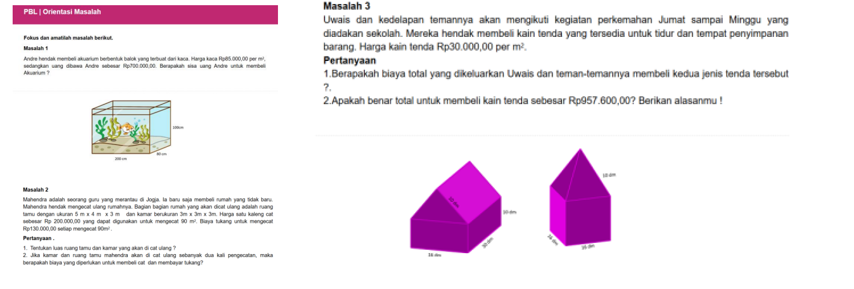
Figure 3. Contextual Issues
The mathematical problem-solving ability at this stage requires students to understand the problem presented by writing information in accordance with the relevant data provided in the problem. At this stage, students apply their knowledge to understand the given problem (Wijnia et al., 2024). Self-regulated learning begins with planning how to solve independently by determining what steps to take in solving math problems. Students independently read and understand the description of the problem, identify important information about it, and consider how to solve the problem. The initial steps of PBL have a positive impact on mathematics learning, improving students' understanding and ability to apply concepts in daily life (Boye & Agyei, 2024).
The second stage of the PBL model involves organizing students to learn. Students are formed in small groups to explore math problems given by teachers. This activity involves dividing tasks among groups and engaging in discussions related to the problems. The teacher helps students define and organize study assignments related to the problem. Students are divided into groups to discuss problems and plan the next stage of the project. The characteristic of the PBL model is learning. Before solving the above problem, the teacher asks students to discuss the following activity with their group to gain a better understanding of the concept before tackling the contextual problem. The student activities are as follows.
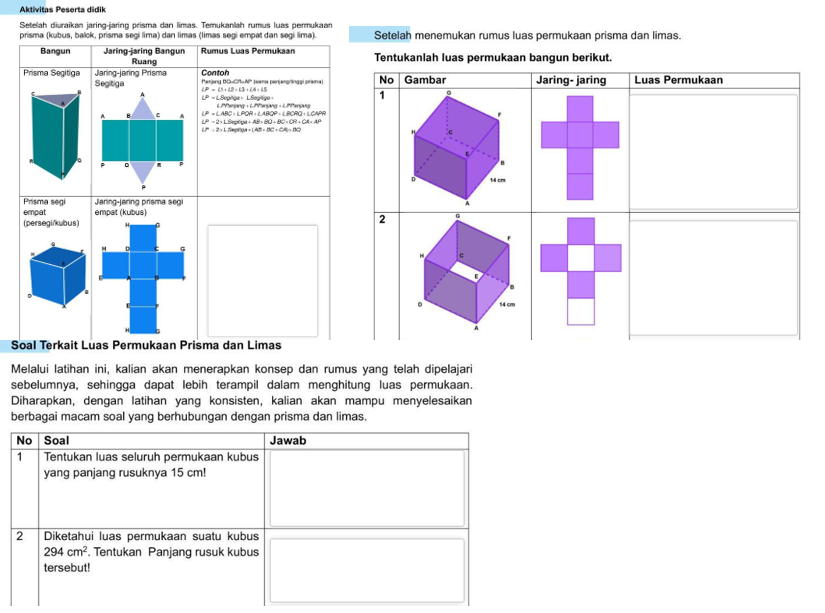
Figure 4. Group Investigations
Before solving the problem, students will find the formula for surface area through the example of a prism and limas net. After obtaining the formula, students will use it to determine the area of the building surface of a flat-sided space. Students’ problem-solving skills develop when they discuss with groups, share ideas, and work together to understand problems and formulate effective problem-solving strategies. Furthermore, students discuss learning planning and strategies in small groups in the phase of learning independence.
The next stage is to assist in investigating the problem independently and in groups. At this stage, the teacher, as a facilitator, provides the necessary guidance during the investigation process and guides and facilitates students ' discussion. The characteristics of PBL at this stage are student-centered learning, with the teacher serving as a facilitator who guides learning, and students are actively involved, both independently and collaboratively, in solving problems. The students conducting the group investigation stage are as follows.
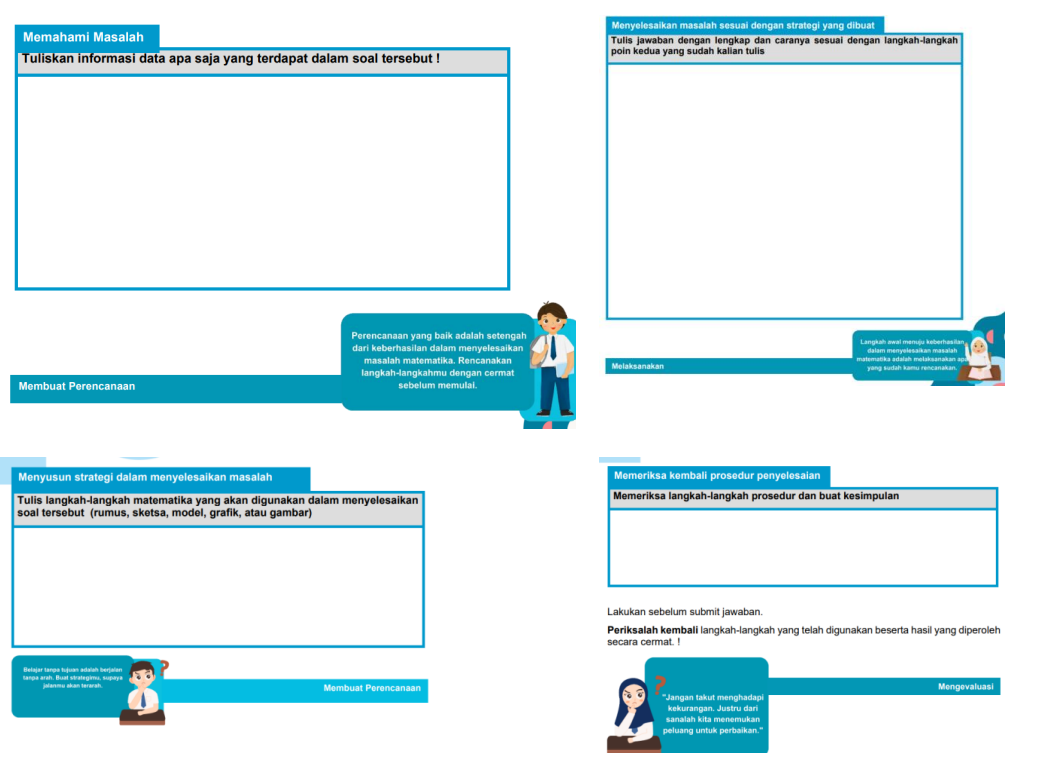
Figure 5. Implementation of Strategies Based on the Problems Presented
The mathematical problem-solving ability at this stage involves applying a strategy that has been created beforehand. Students write down formulas and stages that will be used in solving problems according to the strategies they have made beforehand. Learning independence at this stage involves students beginning to implement plans independently. Students and their groups use pre-developed strategies and collaborate, demonstrating independent learning initiatives in problem-solving.
The next stage is to develop and present results. At this stage, after solving a math problem, students develop and present the results. This stage involves an oral presentation. The characteristic of PBL at this stage is that students demonstrate problem-solving skills. The students present the results of problem-solving as follows.
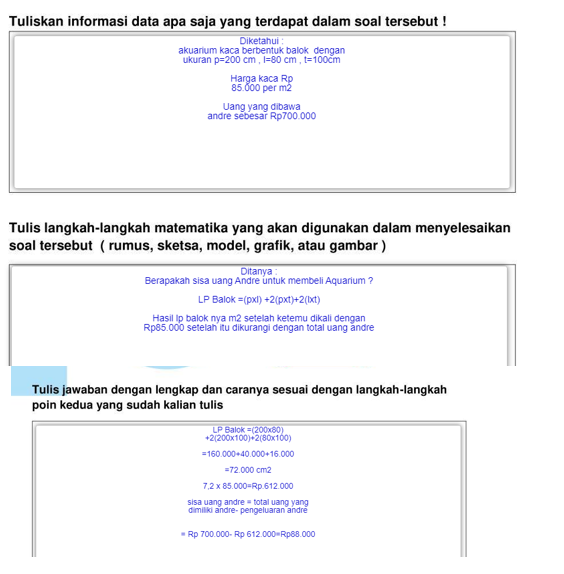
Figure 6. Example of Presentation of Problem-Solving Results
Mathematical problem-solving skills enable students to solve problems according to the strategies that have been prepared, examine the stages of completion, and develop the results. Learning independence at this stage involves students checking the effectiveness of the strategies they have prepared. Students then plan improvement steps and develop further. The last stage is to analyze and evaluate the problem-solving process. The teacher and students analyze the problem-solving process that has been carried out, evaluating the effectiveness of the problem-solving used. Through reflective analysis of real and complex problems, students can apply their theoretical knowledge to solve real-world scenarios, thereby bridging the gap between theory and practice.
Problem-solving skills involve students examining and evaluating solutions, ensuring they are applied effectively, and assessing the overall learning process. At this stage, learning independence means that students are responsible for reflecting on and self-improving throughout the learning process. Students also plan an evaluation of the process and results. Through learning with website-based learning media using the PBL model, it is expected that students' mathematical problem-solving skills and self-regulated learning abilities will improve.
The assessment results by the material expert validator obtained an average score of 137, which is categorized as "very high." The assessment results by the media expert validator obtained an average score of 78.5, which is categorized as "very high." Therefore, the mathematics learning tool development product is valid and can be used. Furthermore, the assessment results by the problem-solving ability test instrument validator and the student independence questionnaire instrument were declared very valid. The assessment results by the validator have shown that they meet the validity criteria. The high validity indicates that website-based media components, learning materials, research instruments, and learning designs that integrate students' mathematical problem-solving abilities and self-regulated learning have strong internal consistency in supporting PBL steps. If the product meets these requirements, then it is considered valid (Nieveen, 1999). This research is relevant to Pagiling et al. (2024), resulting in the development of valid, practical, and effective differentiated learning-based mathematics learning modules.
Sutarto et al. (2022) conclude that problem-based learning (PBL) has a significant effect on students' metacognitive abilities. However, this research provides a more specific contribution to independent learning on digital platforms. The research by Riyanto et al. (2019) led to the development of mathematical modeling tasks, which resulted in valid and practical high school math modeling tasks, lesson implementation plans, and student worksheets. The research by Hidayat et al. (2022) resulted in a PBL-based e-module, developed to be both valid and practical, aimed at improving students' mathematical reasoning skills, particularly in solving problems related to rows and sequences.
The practicality of the product development tool using the PBL model is based on assessments by teachers, observers, and students. The results of the practicality assessment from teachers obtained an average score of 90.5 with very high criteria. In addition, the results of the practicality assessment from students obtained an average score of 50.16 with very high criteria. These results indicate that the mathematics learning tool is practical to be applied in learning to facilitate problem-solving skills and student learning independence. The practicality of the web-based learning media, which was highly rated by teachers and students, proves that the integration of the PBL model into the web platform facilitates the learning process. The practicality of a high-quality product lies in its ease of use, as teachers and experts consider it easily accessible to both teachers and students (Nieveen, 1999). These results indicate that the mathematics learning media is practical to be applied in learning to facilitate problem-solving skills and student learning independence. Based on the results of several practicality analyses, the mathematics learning media has met the criteria for practicality of the product being developed.
An effective product is one whose results of the tests carried out in the field align with the objectives. Product development can be considered adequate if students appreciate the implementation of the learning program in accordance with the plan and the operation of the product that has been developed, resulting in the expected outcomes. (Nieveen, 1999). The effectiveness of this learning media is seen from the results of the mathematical problem-solving ability test and the student self-regulated learning questionnaire. The results of the student problem-solving ability test were obtained, with over 80% of students completing it. Based on the results of the learning effectiveness test, it can be concluded that the learning media with the PBL model is effective. Test results: one-sample t-test p-value<.05. These results demonstrate that mathematics learning media incorporating the PBL model is effective in enhancing mathematical problem-solving skills. Test results, paired sample t-test p-value <.05, reinforce evidence that media intervention can improve mathematical problem-solving skills above the population average.
The effectiveness of the PBL learning model can provide benefits to student learning outcomes. This is supported by research by Bikić et al. (2016). They write that learning through PBL makes a positive contribution to student success in mathematics, with the most significant progress observed in average-performing and below-average students. In contrast, the best-performing students show no statistically significant differences. The research Boye and Agyei (2024) and Malmia et al. (2019) suggests that the PBL model is effective because it encourages student-centered learning, improves student and facilitator interaction, fosters student cooperation to achieve learning goals, promotes teamwork in small groups, and enhances student communication. The study by Rézio et al. (2022) suggests that learning mathematics through PBL is oriented towards problem-solving activities, while providing opportunities for students to think critically, present their own creative ideas, and communicate mathematically with their peers. The PBL model enables students to build their own knowledge through interaction with a given contextual problem, where they play an active role in understanding new information (Kajander, 2018).
These findings are similar to those of a study by Arifin et al. (2021), which found that the development of interactive mobile PBLs can improve mathematical problem-solving skills. According to the study's results, the application of PBL enhances student interaction, fosters cooperation, promotes critical thinking, and facilitates effective communication. The activities in the PBL syntax make students problem solvers; that is, students try to solve problems that have been packaged by the teacher through a student worksheet at the beginning of learning, by discussing with their classmates. In addition, students are actively involved in direct group discussions, investigating real problems, and actively constructing mathematical concepts presented by the teacher. The PBL model also has a positive impact on students' self-regulated learning. In line with what is stated by Boye and Agyei (2024) and Eggen and Kauchak (2012), PBL enables students to solve problems independently.
Additionally, the PBL model enables students to construct their own knowledge through interaction with a specific contextual problem (Kajander, 2018). Based on several results of the effectiveness analysis, the developed product can facilitate two mathematical problem-solving skills and self-regulated learning in students, meeting the criteria of validity, practicality, and effectiveness. Research by Afdareza et al. (2020) demonstrates that 21st-century skill-based learning media, incorporating problem-based learning to enhance critical thinking skills, is a valid, practical, and effective approach. Thus, this learning media is suitable for use in mathematics learning activities.
Conclusion
The conclusions of this study are as follows.
1. This research produces a website-based mathematics learning media with the PBL model. This media is designed to improve students' mathematical problem-solving and self-regulated learning skills. This learning media utilizes the steps of the PBL model, is accessible online through the website, and provides various types of interactive content.
2. Based on expert assessments, the learning media with this PBL model are declared valid.
3. Based on the results of teacher and student assessments, learning media with the PBL model is practical to use.
4. The developed learning media have proven to be effective, shown by the percentage of student mastery (> 80%). The results of statistical tests, including the one-sample t-test and the paired sample t-test, showed that the implementation of Google Site media with the PBL model in mathematics learning primarily focuses on building flat side spaces, with a focus on improving students' problem-solving and self-regulated learning skills.
6. For teachers, this media proves that the use of websites with the PBL model can overcome obstacles to independent learning and improve problem-solving skills in polyhedron material
7. This study combines self-regulated learning and mathematical problem-solving skills with the PBL model. This can be a reference for other researchers to develop media with different materials.
8. This study suggests that schools provide support for teachers to create innovations, as this can improve the quality of student understanding in the classroom.
Recommendations
Based on the research conclusions, the following suggestions can be made for developing mathematics learning media using the Google site website with the PBL model.
(1) There is a need for further development in website-based media, namely, developing learning videos that help students who have difficulty understanding the material.
(2) The components in the media need a clear and easy-to-understand guide for students, so that students can be more effective in working together to solve problems.
(3) Components in web-based media need clear guidelines that are easy for students to understand, so that students can be more effective in working together in solving problems.
Limitations
This study was systematically designed to achieve the expected objectives. However, during the process, researchers encountered several obstacles in developing website-based mathematics learning media using the PBL model. The process of designing learning activities that deeply integrate PBL-based media to effectively improve mathematical problem-solving skills and challenging independent learning requires careful consideration. This is due to the complexity of aligning learning materials with learning objectives. Second, the researchers also encountered technical obstacles, namely that some schools were slow in granting permission for the research trial, thereby hampering the process of collecting the necessary data. Third, during the implementation of the research, there were obstacles such as unstable internet connections or incompatible media, which disrupted students' access to website-based learning media. Fourth, this study has limitations because it did not use a control group to compare the effectiveness of the media. Fifth, this study was conducted over a short period of time. Therefore, this study cannot confirm whether students' problem-solving and self-regulated learning abilities will develop in the long term after the media is no longer used.