


Introduction
Entrepreneurship education in higher education seeks to prepare professionals who can identify opportunities, respond to social and productive challenges, and develop viable initiatives that contribute to economic development and job creation (Saputra et al., 2023; Velásquez Carrascal et al., 2020; Yunikawati et al., 2024). Its integration into university curricula also aims to promote proactive and innovative mindsets and equip students with the knowledge and skills required to initiate and develop business ventures across diverse contexts (Mohamad, 2023).
Active teaching methodologies provide alternatives to exclusively teacher-centered instruction and may improve students’ engagement and academic outcomes (Muntaner Guasp et al., 2020). In entrepreneurship education, university courses may also contribute to the development of entrepreneurial skills; however, their outcomes can vary depending on factors such as whether participation is compulsory or elective and the students’ level of family embeddedness (Hahn et al., 2020). Entrepreneurship education requires students to participate actively in identifying problems, generating ideas, making decisions, and applying knowledge to real-world challenges. Accordingly, constructivist and student-centered methodologies have gained relevance because they position learners as active agents, promote autonomy, and connect academic content with contextualized problem solving (Barbosa-Quintero & Estupiñán-Ortiz, 2023; Buenaño-Barreno et al., 2021; Contreras, 2021).
Among these active approaches, Project-Based Learning (PBL) provides a framework in which students apply academic knowledge while addressing contextually meaningful problems and developing concrete products or proposals (Castro-Valle, 2022). In entrepreneurship education, project-based experiences have been associated with creativity, collaboration, communication, critical thinking, self-awareness, and problem solving, although the outcomes reported vary according to the instructional context and the constructs measured (Crespí et al., 2022; Harahap, 2023; Khotimah et al., 2024).
The studies reviewed above focus primarily on the outcomes of Project-Based Learning in entrepreneurship education or on the general functions of digital scaffolding. They do not directly examine an interactive instructional guide designed to provide step-by-step support during university-level business-plan development. Accordingly, the present study examines this specific instructional use by describing students’ group-level response patterns and their perceptions of the guide’s usefulness within a higher education entrepreneurship course. Examining these resources is relevant because their instructional value may depend not only on the digital format but also on how their content, activities, and guidance are aligned with the stages of the project.
In response, the guide was developed for the course Business Innovation and Creativity within the Administration program of the Open Education System at Universidad Veracruzana. The guide was designed to support the progressive development of a business plan within a PBL framework. Accordingly, this study aimed to examine its educational value by describing group-level response patterns related to students’ self-reported entrepreneurship and business-planning knowledge and by exploring their perceptions of the guide’s usefulness.
The following research questions guided the study:
- RQ1. What group-level response patterns are observed in students’ self-reported knowledge of entrepreneurship and business-planning concepts before and after the intervention?
- RQ2. How do students perceive the usefulness of the guide for supporting business-plan development and their learning experience?
Literature Review
Entrepreneurial Competencies
In this study, entrepreneurial competencies are understood as the knowledge, skills, and attitudes involved in identifying opportunities, formulating viable initiatives, making decisions under uncertainty, and transforming ideas into contextually relevant projects (Contreras Suárez & Vinueza Burgos, 2024; Velásquez Carrascal et al., 2020). In higher education, the development of entrepreneurial competencies requires learning experiences that connect disciplinary knowledge with practical tasks, reflection, collaboration, and problem solving (Crespí et al., 2022; Velásquez Carrascal et al., 2020).
Previous studies converge on the importance of applied learning, although they emphasize different dimensions of entrepreneurial development. Crespí et al. (2022) and Khotimah et al. (2024) focus on transversal abilities such as creativity, collaboration, communication, and critical thinking. In the context of basic education, Contreras Suárez and Vinueza Burgos (2024) similarly emphasize critical thinking, problem solving, autonomous learning, collaboration, and motivation. Łobacz and Matuska (2020) examined the challenges and benefits of PBL in entrepreneurship education, including its potential to foster proactive attitudes and strengthen connections between educational institutions and external organizations. These differences indicate that entrepreneurial competencies constitute a broad construct and that conclusions should be aligned with the particular outcomes measured in each study.
Taken together, the reviewed studies suggest that entrepreneurship education becomes particularly relevant when students apply concepts to authentic activities, make project-related decisions, and examine the feasibility of their proposals. However, the diversity of constructs, contexts, and instruments limits direct comparison among findings. Consequently, the present study does not attempt to evaluate entrepreneurial competence as a single broad construct. Instead, it focuses on students’ self-reported knowledge of entrepreneurship and business-planning topics and their perceptions of the instructional guide.
Project-Based Learning in Entrepreneurship Education
Project-Based Learning (PBL) provides a student-centered framework in which university students apply entrepreneurial knowledge through contextually meaningful projects. In higher education entrepreneurship courses, these projects may involve identifying needs or opportunities, designing solutions, preparing venture plans, and presenting entrepreneurial proposals. For example, Organ et al. (2022) implemented a challenge-based project within a university entrepreneurship curriculum in which students developed a social-technology venture plan and an audiovisual elevator pitch. Similarly, Zhai and Chen (2024) designed and implemented a semester-long foundational entrepreneurship course based on PBL and focused on developing opportunity-related, business-management, and interpersonal competencies among university students.
This approach is consistent with experiential learning because students move through concrete experience, reflective observation, abstract conceptualization, and active experimentation while developing and refining their projects (Kolb, 2015). Rather than receiving entrepreneurial concepts only through lectures, students apply them to decisions involving feasibility, resources, markets, operations, and value creation.
The reviewed studies generally report favorable but non-equivalent outcomes of PBL in entrepreneurship education. Crespí et al. (2022) associate project-based experiences with creativity, teamwork, communication, and self-awareness, whereas Harahap (2023) and Khotimah et al. (2024) emphasize problem solving, collaboration, and critical thinking. Research on experiential entrepreneurship education also highlights the participation of multiple stakeholders and the development of external strategic relationships that connect university learning with broader entrepreneurial contexts (Morland et al., 2021). Masdarini et al. (2024), in turn, examine the relationship between PBL, entrepreneurial self-efficacy, and entrepreneurial readiness, suggesting that structured project experiences may contribute to students’ preparedness for entrepreneurial activity.
Overall, these findings indicate that the outcomes associated with PBL vary according to the educational context, project design, type of support, research methodology, and outcomes measured. Therefore, they should not be interpreted as evidence of a uniform effect.
In the present study, business-plan development serves as the central project through which students apply entrepreneurial concepts. A digital-business project has been used as an applied PBL activity in which students developed technical skills while designing a sustainable business model through the Business Model Canvas (Nursaadah et al., 2025). More comprehensive business-plan frameworks may integrate market, organizational, operational, resource, and financial information into a coherent proposal (Ismail et al., 2024). An integrated business-plan framework can also help organize the principal components involved in its preparation (Ismail et al., 2024). Within this instructional structure, the business plan provides the applied project, while the guide provides structured support for completing its components.
Interactive Digital Scaffolding in Entrepreneurship Learning
In the studies reviewed here, digital scaffolds were used to make complex project activities more manageable and to support shared regulation, teamwork, and project completion (Cortázar et al., 2022; Peng et al., 2022).
Studies of technology-supported PBL indicate that structured digital scaffolds can assist with project management, socially shared regulation, and teamwork, although their contribution may vary according to students’ prior achievement and instructional needs (Cortázar et al., 2022; Peng et al., 2022). Because these studies were not conducted specifically in university entrepreneurship courses, they provide evidence about the functions of digital scaffolding rather than direct evidence that a guide develops entrepreneurial competencies. Nevertheless, their findings suggest that purposeful digital guidance may be relevant when students must coordinate complex tasks and integrate market, organizational, operational, and financial information into a business proposal.
When considered alongside the university-level PBL evidence reviewed in the previous section, these findings provide an indirect conceptual basis for examining how structured digital guidance may support the application of entrepreneurial knowledge during business-plan development. In this framework, the intervention combines an authentic PBL task with digital scaffolding: the business plan provides the applied project, while the guide sequences its components, aligns instructions with project deliverables, and provides organized access to examples and multimedia resources.
These functions may support students in organizing entrepreneurial concepts, understanding the relationships among market, organizational, operational, and financial components, and applying this knowledge during business-plan preparation. Accordingly, the study examines response patterns in the conceptually aligned questionnaire items and students’ perceptions of instructional support. It does not assume that the guide independently produces broad improvements in leadership, creativity, social responsibility, or other entrepreneurial competencies that were not directly measured.
Methodology
Research Design
This study employed a quantitatively driven embedded mixed-methods design (QUAN + qual) within an exploratory one-group pre–post educational intervention. In this type of design, the quantitative strand is assigned priority, while the qualitative strand is embedded to provide complementary information that supports interpretation of the quantitative findings (Creswell & Plano Clark, 2018). Accordingly, the quantitative strand consisted of closed-ended questionnaire responses collected before and after the intervention, whereas the embedded qualitative strand comprised open-ended responses concerning students’ previous knowledge, anticipated challenges, learning experiences, and perceptions of the guide. Both strands were collected at the two measurement points, analyzed separately, and integrated during the interpretation stage, with the qualitative findings used to contextualize and explain the descriptive quantitative patterns.
The study is presented as an exploratory one-group educational intervention because all participants belonged to the same course, contributed to the development of the guide, used it during business-plan preparation, and evaluated the experience at the end of the course. No comparison or control group was included; consequently, the observed response patterns cannot be attributed exclusively to the guide. They may reflect the combined influence of guide creation, teamwork, course instruction, instructor feedback, continued exposure to entrepreneurial content, repeated measurement, and use of the resource itself. The findings are therefore interpreted as exploratory and do not establish causal effects on entrepreneurial competencies.
Context and Participants
The intervention was conducted in the course Business Innovation and Creativity, taught within the Administration program of the Open Education System at Universidad Veracruzana. The course included 28 undergraduate students, all of whom were invited to participate in the study. Each questionnaire received 27 valid responses.
The questionnaires were anonymous and collected only submission timestamps; they did not request names, student identification numbers, email addresses, demographic information, or a common identification code. Consequently, diagnostic and final responses could not be linked at the individual level and were treated as anonymous group-level measurements. The study therefore used a census approach to recruitment rather than probabilistic sampling. Participation was voluntary, and only the responses recorded in each questionnaire administration were analyzed.
PBL Intervention and Interactive Instructional Guide
The intervention was organized around the collaborative development of a business plan for an innovative product or service. Students worked in teams of four to five members to identify a problem, need, or business opportunity and propose a corresponding product or service. Within the PBL approach, the business plan constituted the authentic project, while the guide functioned as a digital scaffold that sequenced the activities and provided conceptual and procedural support throughout its development.
The PBL process was implemented through the following stages:
- Identification of a need, problem, or business opportunity and definition of the proposed product or service.
- Search for and analysis of information relevant to the proposed venture.
- Planning of team activities and distribution of responsibilities.
- Progressive development of the business description, market analysis, technical study, organizational structure, and financial analysis.
- Review of project advances and incorporation of formative feedback.
- Revision and integration of the complete business plan.
- Presentation of the final proposal in a course forum.
The students were responsible for investigating the selected business opportunity, making project-related decisions, preparing the components of the business plan, contributing instructional content to the guide, reviewing their progress, and presenting the final proposal.
The instructor-researcher was responsible for defining the project requirements, explaining the PBL stages, establishing the assessment criteria, organizing the work sequence, reviewing the academic accuracy of the guide, providing formative feedback, monitoring team progress, administering the questionnaires, and coordinating the final presentation.
Based on the available records, the intervention was conducted between the completion of the diagnostic questionnaire on June 16, 2025, and the administration of the final questionnaire on July 5, 2025, covering approximately three calendar weeks. Because the same students collaboratively developed the guide, used it during business-plan preparation, and subsequently evaluated it, this dual role may have influenced their final perceptions of the resource.
Course Assessment Scheme
The course assessment scheme comprised four components: final business-plan development, collaborative preparation of the guide, progress reviews, and presentation of the final resource and proposal. Table 1 is included solely to describe how the PBL activities were incorporated into the course. Because individual grades and criterion-level rubric scores were not part of the research dataset, the assessment scheme was not treated as a validated research instrument or analyzed as an independent outcome measure.
Table 1. Assessment System for the Course Business Innovation and Creativity (2025)
| Assessment Component | Specifications | Weight (%) |
| Business plan design | Development of the business description, market analysis, technical study, organizational structure, and financial analysis. Teams of four to five students proposed a business plan for an innovative product or service. | 40 |
| Development of the guide | Collaborative development of instructional content and resources for business-plan preparation. | 30 |
| Progress reviews | Timely submission, review, and revision of project advances. | 15 |
| Presentation of the guide | Presentation of the final instructional resource and business proposal in a course forum. | 15 |
| Total | 100 |
Structure and Use of the Guide
The guide was developed in Genially and integrated with multimedia content hosted on YouTube. The guide accompanied the successive stages of business-plan preparation rather than being implemented as a separate activity, and it is available at the following link: https://view.genially.com/683f4f56c7c3c246931364bd/guide-plan-de-negocios.
The aim of the guide was to provide structured conceptual and procedural support for the progressive development of an innovative business plan. Its content was organized around the five principal components assessed in the course: business description, market analysis, technical study, organizational structure, and financial analysis. Each component connected key concepts with project instructions, student deliverables, multimedia resources, and formative knowledge checks. Table 2 summarizes the instructional objective, principal topics, student activities, and interactive support included in each component of the guide.
Table 2. Structure and Instructional Content of the Guide
| Guide component | Instructional objective | Main topics | Student activity or deliverable | Interactive support |
| Business description | Define the proposed venture and its value proposition | Business idea, product or service, mission, vision, objectives, and corporate image | Prepare the general description and identity of the proposed business | Conceptual explanations, procedural instructions, examples, and knowledge checks |
| Market analysis | Examine the market context and target customers | Customer needs, competitors, market study, competitive advantage, and SWOT analysis | Develop and document the market analysis | Multimedia resources, prompts, examples, and formative questions |
| Technical study | Describe how the product or service will be produced or delivered | Production process, location, equipment, resources, and operational requirements | Prepare the technical component of the business plan | Step-by-step guidance, multimedia materials, and comprehension checks |
| Organizational structure | Define the organization and distribution of responsibilities | Organizational chart, positions, functions, training, development, and occupational safety | Design the organizational structure and assign responsibilities | Models, instructions, examples, and review questions |
| Financial analysis | Examine the financial feasibility of the venture | Initial investment, costs, revenues, financing, and financial projections | Prepare the financial section of the business plan | Procedural guidance, examples, prompts, and knowledge checks |
Figure 1 illustrates the sequential organization of the guide according to the principal components of business-plan development. Each stage combined key concepts with procedural guidance and project deliverables.
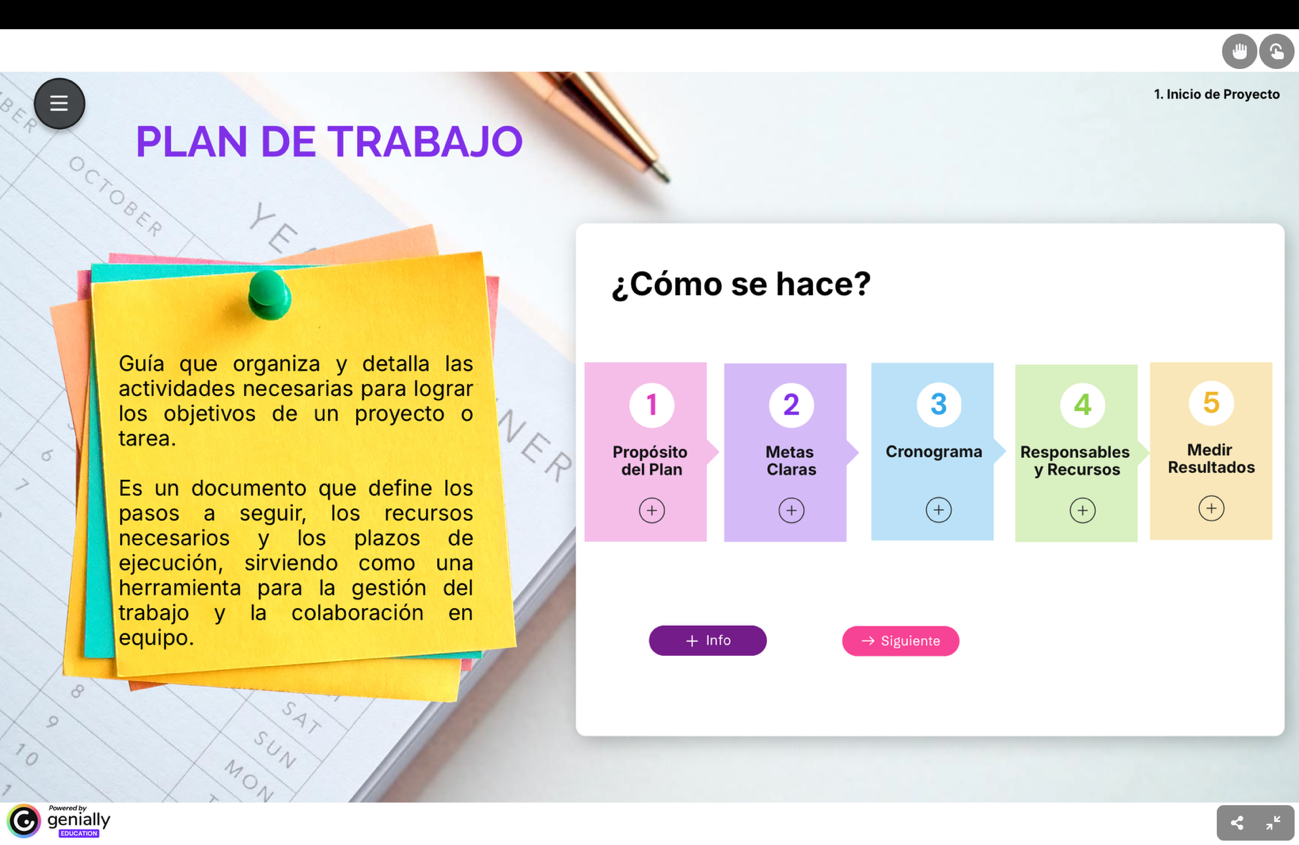
Figure 2 presents an example of the conceptual explanations provided before students applied the content to their team projects.
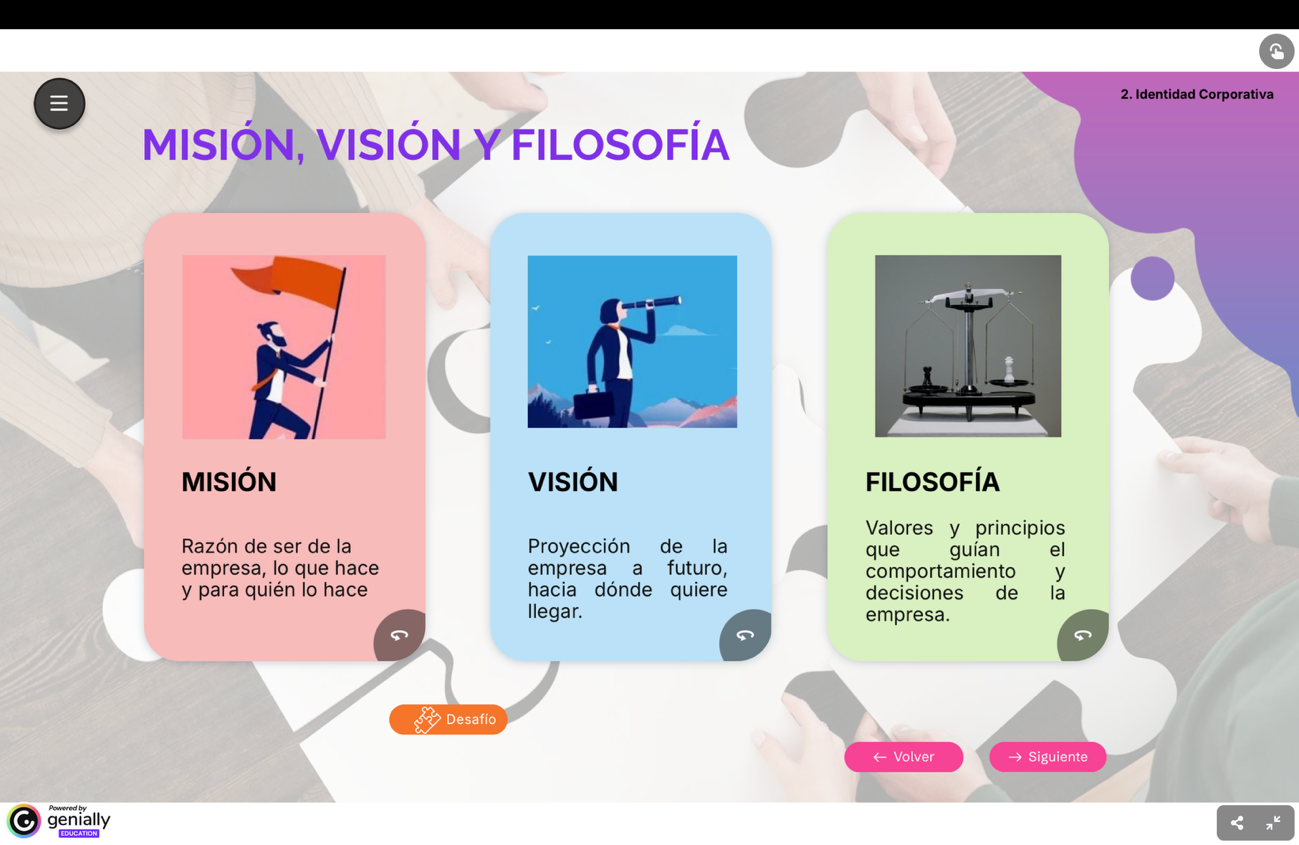
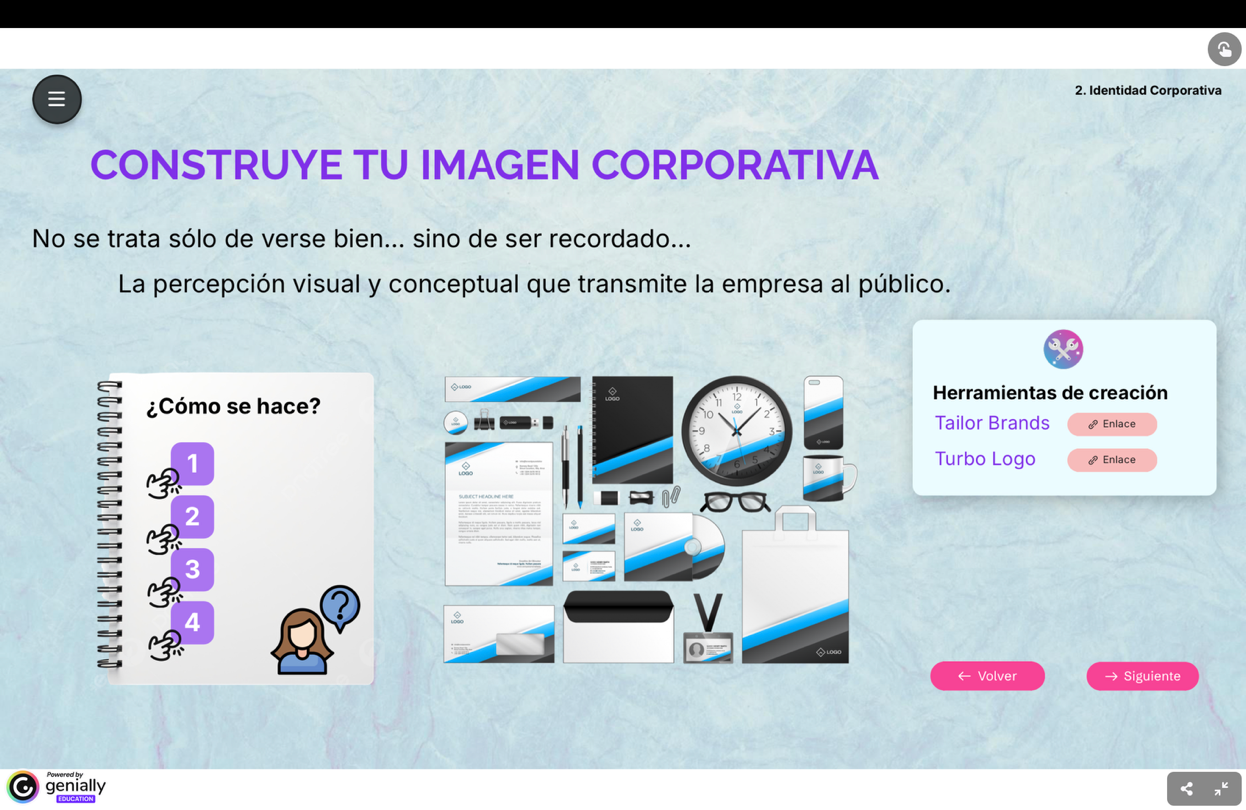
Figure 3 shows the step-by-step instructions associated with the activities and products required at each stage of the project.
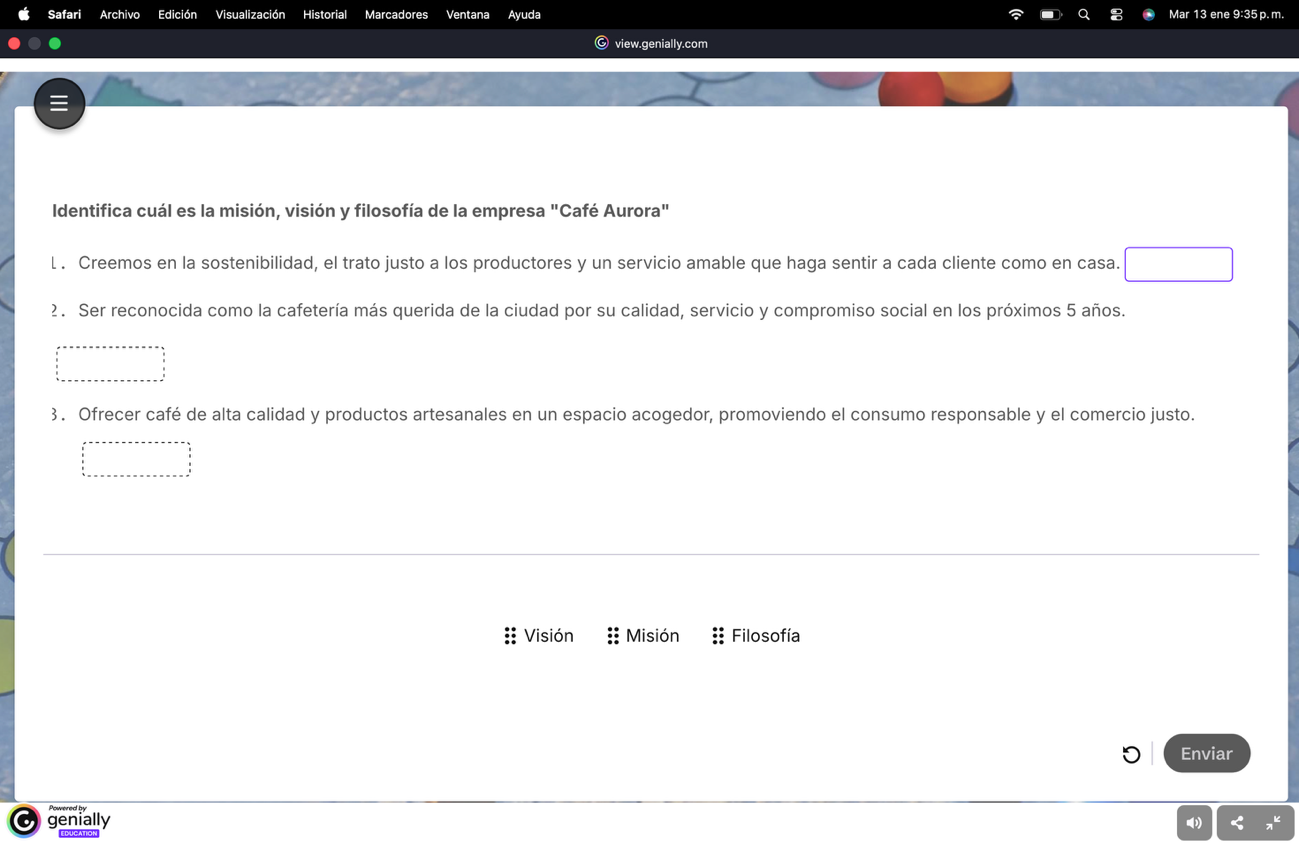
The guide also incorporated multiple-choice knowledge checks that provided immediate confirmation or correction of students’ responses before they advanced to the next component, as illustrated in Figure 4.
The resource remained accessible throughout the project, allowing students to consult conceptual explanations, procedural instructions, multimedia materials, and formative activities corresponding to the stage under development. No platform analytics, access logs, or systematic consultation records were collected; therefore, the frequency of individual use could not be quantified. The available records also did not provide a verified count of the multimedia resources consulted by each participant. Consequently, the intervention is described as the use of one integrated guide rather than as a specified number of individual videos or digital activities.
Instruments
Two anonymous online questionnaires were developed by the instructor-researcher specifically for the Business Innovation and Creativity course: a diagnostic questionnaire administered before the implementation of the guide and a final questionnaire administered after completion of the business-plan project. Their content was aligned with the course objectives, instructional sequence, expected outcomes, and principal components of a business plan. The instruments were not adapted from a previously published standardized scale.
The diagnostic questionnaire consisted of 30 dichotomous Yes/No items and five open-ended questions. The dichotomous format was selected to provide a brief categorical indicator of students’ previous experience, familiarity, perceived knowledge, and self-assessed ability while facilitating completion within the course context. Because this format does not capture different degrees of knowledge or competence, the responses were interpreted as categorical self-reports rather than as objective measures of academic achievement. The closed-ended items addressed entrepreneurship, socially and economically viable ideas, prototypes, business models, business plans, mission and vision, corporate image, competitive advantage, SWOT analysis, market studies, organizational structures, training and development, and occupational health and safety. The open-ended questions explored students’ understanding of creativity and innovation, the principal components of a business model, the expected usefulness of a guide, anticipated challenges, and additional comments.
The final questionnaire included 25 dichotomous items that assessed students’ self-reported knowledge and abilities following the intervention. In addition, it incorporated two Yes/No perception questions, five open-ended questions addressing creativity, innovation strategies, the support provided by the guide, preparedness for business-plan development, and the overall learning experience, as well as a numerical usefulness rating on a scale from 1 to 10.
A content-mapping procedure identified 23 conceptually aligned items across the diagnostic and final questionnaires. These items addressed entrepreneurship, prototype and business-model development, business-plan preparation, organizational identity, competitive and market analysis, organizational structure, training and development, and occupational health and safety.
The item pairs were considered conceptually aligned rather than identical because their wording and measurement focus were not always equivalent. Some diagnostic items examined prior experience, familiarity, or need for support, whereas the corresponding final items assessed perceived knowledge, ability, application, or support after the intervention. Table 3 presents the complete wording of each pair and the analytical decision adopted according to its degree of correspondence.
Table 3. Conceptual Correspondence Between Diagnostic and Final Questionnaire Items
| No. | Construct or Topic | Diagnostic Questionnaire Item | Final Questionnaire Item | Type of Correspondence and Analysis Decision |
| 1 | Concept of entrepreneurship | D1. “I know the concept of entrepreneurship.” | F1. “Knowledge of the concept of entrepreneurship.” | Closely aligned. The same concept is assessed at both measurement points. |
| 2 | Socially relevant and economically viable ideas | D3. “I have the competencies to generate socially relevant and economically viable ideas.” | F3. “Development of competencies to generate socially relevant and economically viable ideas.” | Partially aligned. The diagnostic item measures perceived possession of competencies, whereas the final item refers to their perceived development. |
| 3 | Prototype based on market needs | D4. “I know how to develop a business prototype based on market needs.” | F4. “Knowing how to develop a business prototype based on market needs.” | Closely aligned; minor grammatical change. |
| 4 | Business-model design | D5. “I have the knowledge required to design a business model.” | F5. “I know how to design a business model.” | Closely aligned. Both assess perceived knowledge or ability to design a business model. |
| 5 | Concept of a business plan | D6. “I know what a business plan is.” | F6. “Knowing what a business plan is.” | Closely aligned; same conceptual content. |
| 6 | Business plans and organizational problems | D7. “A business plan can provide solutions to organizational problems.” | F7. “Knowing that a business plan can provide solutions to organizational problems.” | Closely aligned; same proposition. |
| 7 | Business-plan preparation | D8. “I have developed a business plan at least once.” | F8. “Developing a business plan.” | Conceptually related but not equivalent. The diagnostic item measures previous experience, whereas the final item refers to perceived ability or course achievement. It should be interpreted separately. |
| 8 | Components of a business plan | D9. “I know exactly which elements a business plan should contain.” | F9. “Knowing exactly which elements a business plan should contain.” | Closely aligned; same content. |
| 9 | Description of the company | D10. “I have the competencies to describe the characteristics of a company for the preparation of its business plan.” | F10. “Development of competencies to describe the characteristics of a company for the preparation of its business plan.” | Partially aligned. It changes from perceived possession to perceived development of competencies. |
| 10 | Business model, business plan, and prototype | D11. “I fully understand the difference between a business model, a business plan, and a product or service prototype.” | F11. “Fully understanding the difference between a business model, a business plan, and a product or service prototype.” | Closely aligned; same conceptual distinction. |
| 11 | Product or service prototype | D13. “I know how to create a product or service prototype.” | F13. “Creating a product or service prototype.” | Partially aligned. The diagnostic item measures prior perceived knowledge, while the final item refers to perceived application. |
| 12 | Guide for prototype development | D14. “I need a guide to create a product or service prototype.” | F14. “Using a guide to create a product or service prototype.” | Conceptually related but differently oriented. The diagnostic item measures need, whereas the final item measures use or support received. Raw affirmative percentages should not be interpreted as direct improvement. |
| 13 | Mission, vision, and organizational philosophy | D15. “I know how to distinguish between the mission, vision, and philosophy of a company.” | F15. “Understanding the differences among and writing the mission, vision, and philosophy of a company.” | Partially aligned. The final item expands the construct from differentiation to written application. |
| 14 | Business-plan objectives | D16. “I can correctly write the objectives of a business plan.” | F16. “Knowing how the objectives of a business plan should be written.” | Closely aligned, although the diagnostic item emphasizes ability and the final item emphasizes knowledge. |
| 15 | Corporate image | D17. “I fully understand what corporate image means.” | F17. “Learning what corporate image means and creating one.” | Partially aligned. The final item expands the content from understanding to creation. |
| 16 | Competitive advantage | D18. “I can clearly define what a competitive advantage is.” | F18. “Knowing and applying the concept of competitive advantage.” | Partially aligned. The final item includes application in addition to conceptual knowledge. |
| 17 | SWOT analysis | D19. “I know what SWOT analysis is.” | F19. “Applying SWOT analysis.” | Partially aligned. The focus changes from conceptual knowledge to practical application. |
| 18 | Elements of SWOT analysis | D20. “SWOT analysis consists of six elements.” | F20. “Knowing that SWOT analysis consists of four elements.” | Reverse and factually corrected item. An affirmative diagnostic response indicates a misconception, whereas an affirmative final response indicates correct knowledge. The diagnostic item must be reverse-interpreted and should not be compared through raw “Yes” percentages. |
| 19 | Ability to conduct a market study | D23. “With my current knowledge, I am capable of conducting a market study.” | F21. “I understand and am capable of conducting a market study.” | Closely aligned. The final item adds explicit understanding to perceived ability. |
| 20 | Production process and market study | D24. “The production process is part of the market study.” | F22. “Understanding that the production process is part of the market study.” | Factually incorrect item at both measurement points. The production process belongs to the technical or operational study rather than to the market study. Therefore, a “No” response was interpreted as correct, and raw affirmative-response percentages were not treated as evidence of improvement. |
| 21 | Organizational structure | D26. “I know exactly what organizational structure consists of.” | F23. “Knowing what organizational structure consists of.” | Closely aligned; same conceptual content. |
| 22 | Training and development | D29. “I fully understand what training and development refer to in an organization.” | F24. “Fully understanding what training and development refer to in an organization.” | Closely aligned; same wording and content. |
| 23 | Occupational health and safety | D30. “I know the definitions of occupational health and safety.” | F25. “Knowing the definitions of occupational health and safety.” | Closely aligned; same conceptual content. |
Note. D = diagnostic questionnaire item; F = final questionnaire item. The items were administered in Spanish and are presented here in English translation. The correspondence analysis identified items that addressed similar content; however, they should be described as conceptually aligned items, not as identical matched items. Several items differ in wording, scope, response orientation, or level of application. Consequently, the comparisons were conducted descriptively at the item level and were not combined into a single pre–post score.
Validity and Reliability
The content relevance, clarity, and alignment of the questionnaire items with the study objectives were qualitatively reviewed by three experts in entrepreneurship education and instructional design. Minor wording adjustments were made in response to their recommendations. Because individual numerical ratings were not recorded, no quantitative content-validity coefficient was calculated.
Because the closed-ended items were dichotomous, internal consistency was examined using the Kuder–Richardson Formula 20 coefficient, which was developed to estimate the reliability of instruments composed of dichotomously scored items (Kuder & Richardson, 1937). The 23 conceptually aligned diagnostic items yielded KR-20 = .67, indicating modest internal consistency, whereas the corresponding final items yielded KR-20 = .82, indicating acceptable internal consistency. These estimates should be interpreted cautiously because the questionnaires addressed heterogeneous content, including previous experience, perceived familiarity, self-assessed ability, misconceptions, instructional-support needs, and different components of business-plan development.
Consequently, the questionnaires were treated as exploratory, course-specific instruments rather than as unidimensional measures of entrepreneurial competence. The analysis emphasized item-level quantitative patterns and qualitative themes to provide a contextualized description of students’ self-reported knowledge and perceptions.
Procedure
Data collection and intervention activities were organized into three stages. First, the anonymous diagnostic questionnaire was administered online between June 11 and June 16, 2025, before students began the collaborative development and use of the guide. Second, the PBL intervention and collaborative guide-development process were implemented over approximately three calendar weeks, following the stages, responsibilities, and instructional activities described above. Finally, after the teams completed and presented their business plans, the anonymous final questionnaire was administered on July 5, 2025.
Data Analysis
Quantitative analysis was conducted at the group and item levels. To answer RQ1, frequencies and percentages were calculated for each of the 23 conceptually aligned items, and the diagnostic and final response distributions were compared descriptively. Because the questionnaires were anonymous and individual responses could not be matched, no paired statistical tests, individual learning-gain estimates, paired confidence intervals, p values, or effect sizes were calculated. Items unique to one questionnaire were analyzed separately, and no composite score was created because the instruments addressed heterogeneous content.
For the quantitative component of RQ2, the 1–10 usefulness rating was summarized using the mean, standard deviation, minimum, maximum, and number of valid responses.
The qualitative component of RQ2 was addressed through an inductive thematic analysis of the open-ended responses. The procedure involved familiarization with the data, initial coding, grouping of related codes, review and refinement of emerging themes, definition of the final themes, and selection of representative excerpts. Diagnostic responses were examined for initial conceptions, expectations, and anticipated challenges, whereas final responses were analyzed for perceptions of instructional clarity, guide usefulness, application of concepts, difficulties encountered, and overall evaluation of the experience.
An external researcher with no direct involvement in the intervention conducted the coding iteratively and reviewed the codes, categories, and themes against the original responses to promote consistency and preserve participants’ meanings. Because a second independent coder was not involved, intercoder reliability was not estimated; this limitation was considered when interpreting the qualitative findings.
Quantitative and qualitative findings were initially analyzed separately and subsequently integrated during interpretation. Convergence was identified when the descriptive quantitative patterns corresponded with students’ qualitative accounts; complementarity occurred when the open-ended responses provided additional context or explanations; and divergence was retained when the two sources reflected different patterns. A joint display in the Results section summarizes the relationships among the quantitative findings, qualitative themes, and integrated interpretations.
Results
This section presents the descriptive findings obtained from the course assessment records and the diagnostic and final questionnaires. Course assessment scores are reported only as contextual information about the implementation of the PBL project and not as an independent measure of the guide’s effectiveness. The remaining findings are organized around students’ self-reported entrepreneurship and business-planning knowledge, perceived usefulness of the guide, qualitative reflections on the learning experience, and the integration of quantitative and qualitative evidence.
Course Assessment Results
Table 4 presents the aggregate scores obtained by the six student teams using the course assessment scheme described in the Methodology section.
Table 4. Descriptive Team Scores Across the Course Assessment Components
| Assessment Component | Illusionists | Eureka | Creativity | Innovator | Koala | Guide |
| Business plan design | 35 | 40 | 40 | 35 | 40 | 40 |
| Guide development | 30 | 30 | 30 | 25 | 30 | 30 |
| Reviews | 8 | 12 | 15 | 10 | 15 | 15 |
| Guide presentation | 15 | 15 | 15 | 15 | 15 | 15 |
| Total | 88 | 97 | 100 | 85 | 100 | 100 |
The six team scores ranged from 85 to 100 points, with a mean of 95.00 (SD = 6.75) and a median of 98.50. Three teams obtained 100 points, while the remaining teams obtained 97, 88, and 85 points, respectively. These scores indicate relatively high course-assessment results across the six teams but do not demonstrate equivalence among teams or establish that the instructional approach caused the observed results. Because the course assessment scores were calculated at the team level and the questionnaire responses were collected anonymously from individual students, the two sources could not be linked or statistically associated. Team scores are therefore presented only as contextual information about project performance, whereas the questionnaire findings describe group-level patterns in students’ self-reported knowledge and perceptions.
Self-Reported Knowledge and Business-Planning Topics
Each questionnaire administration received 27 valid responses. However, because the questionnaires were anonymous, it was not possible to confirm that the same 27 students responded at both measurement points. The descriptive comparison focused on the 23 conceptually aligned items identified across the two instruments. As explained in the Methodology section, these items addressed related content but were not always identical in wording, scope, or response orientation. Table 5 presents the frequencies and percentages obtained for all 23 items at the pre- and post-intervention questionnaire administrations, together with the corresponding descriptive interpretation.
Table 5. Pre- and Post-Intervention Group-Level Responses to the 23 Conceptually Aligned Items
| No. | Topic | Pre-intervention, n (%) | Post-intervention, n (%) | Descriptive interpretation |
| 1 | Concept of entrepreneurship | 27 (100.0) | 27 (100.0) | Affirmative responses were universal at both measurement points. |
| 2 | Socially relevant and economically viable ideas | 15 (55.6) | 27 (100.0) | The final questionnaire showed a higher affirmative-response percentage; the items differed slightly because the final item referred to competency development. |
| 3 | Prototype based on market needs | 18 (66.7) | 27 (100.0) | A descriptive increase of 33.3 percentage points was observed. |
| 4 | Business-model design | 14 (51.9) | 27 (100.0) | A descriptive increase of 48.1 percentage points was observed. |
| 5 | Concept of a business plan | 15 (55.6) | 26 (96.3) | Affirmative responses were higher in the final questionnaire. |
| 6 | Business plans and organizational problems | 23 (85.2) | 27 (100.0) | The final responses showed universal recognition of this relationship. |
| 7 | Business-plan preparation | 23 (85.2) | 27 (100.0) | The items were not directly equivalent: the diagnostic item assessed previous experience, whereas the final item referred to undertaking business-plan preparation. |
| 8 | Components of a business plan | 14 (51.9) | 25 (92.6) | A descriptive difference of 40.7 percentage points was observed. |
| 9 | Description of the company | 12 (44.4) | 27 (100.0) | The final item referred to perceived competency development rather than prior possession of the competency. |
| 10 | Difference among a business model, business plan, and prototype | 18 (66.7) | 27 (100.0) | The percentage of affirmative responses was descriptively higher after the intervention. |
| 11 | Product or service prototype | 18 (66.7) | 26 (96.3) | The final item emphasized application, while the diagnostic item assessed previous perceived knowledge. |
| 12 | Guide for prototype development | 24 (88.9) | 26 (96.3) | Direct change should not be inferred because the diagnostic item assessed the need for a guide and the final item assessed its use. |
| 13 | Mission, vision, and organizational philosophy | 19 (70.4) | 26 (96.3) | Responses remained high; the final item expanded the task from distinction to understanding and writing these elements. |
| 14 | Business-plan objectives | 22 (81.5) | 27 (100.0) | A descriptive difference of 18.5 percentage points was observed. |
| 15 | Corporate image | 27 (100.0) | 26 (96.3) | The post-intervention percentage was slightly lower, changing from 100.0% to 96.3%. However, the final item expanded the task from understanding the concept to creating a corporate image, which limits direct comparison. |
| 16 | Competitive advantage | 18 (66.7) | 27 (100.0) | The final item expanded the assessed content from definition to knowledge and application. |
| 17 | SWOT analysis | 21 (77.8) | 26 (96.3) | Affirmative responses were high at both measurement points; the final item emphasized practical application. |
| 18 | Elements of SWOT analysis¹ | 22 (81.5) | 27 (100.0) | Correct responses increased descriptively. The pre-intervention item was reverse-oriented and required a “No” response. |
| 19 | Ability to conduct a market study | 26 (96.3) | 27 (100.0) | Affirmative responses were high at both measurement points. |
| 20 | Production process and market study | 13 (48.1) | 4 (14.8) | The percentage of correct responses decreased from 48.1% in the diagnostic questionnaire to 14.8% in the final questionnaire. |
| 21 | Organizational structure | 26 (96.3) | 27 (100.0) | The final questionnaire showed universal affirmative responses. |
| 22 | Training and development | 27 (100.0) | 23 (85.2) | The affirmative-response percentage was lower at post-intervention, changing from 100.0% to 85.2%. This pattern may reflect continued uncertainty regarding the topic or differences in item interpretation and should not be considered evidence of individual decline. |
| 23 | Occupational health and safety | 24 (88.9) | 27 (100.0) | Affirmative responses were higher in the final questionnaire. |
Note. Values represent group-level affirmative responses, except for Item 18, for which the correct pre-intervention response was “No” because the statement incorrectly indicated that SWOT analysis comprises six elements. Several item pairs differed in wording, scope, response orientation, or level of application and were therefore interpreted as conceptually aligned rather than strictly equivalent measures. For Item 20, a “No” response was considered correct because the production process belongs to the technical or operational study rather than to the market study.
As shown in Table 5, post-intervention affirmative-response percentages were higher for several conceptually aligned topics, remained unchanged for one topic, and were lower for others. The largest interpretable descriptive differences were observed for company description, business-model design, socially relevant and economically viable ideas, and knowledge of the components of a business plan.
Several topics already showed high affirmative-response percentages before the intervention, including the concept of entrepreneurship, the ability to conduct a market study, organizational structure, business-plan objectives, and occupational health and safety. The SWOT-elements item was interpreted according to response correctness because the diagnostic statement was reverse-oriented. Corporate image and training and development showed lower post-intervention percentages; however, these patterns should be interpreted cautiously because of differences in item wording, scope, and measurement focus.
Figure 5 provides a visual summary of the item-level response patterns reported in Table 5. The figure should be interpreted together with the item wording and correspondence decisions presented in the table, particularly for items that differed in scope, response orientation, or level of application. It does not represent a composite measure of entrepreneurial knowledge or an estimate of individual change.
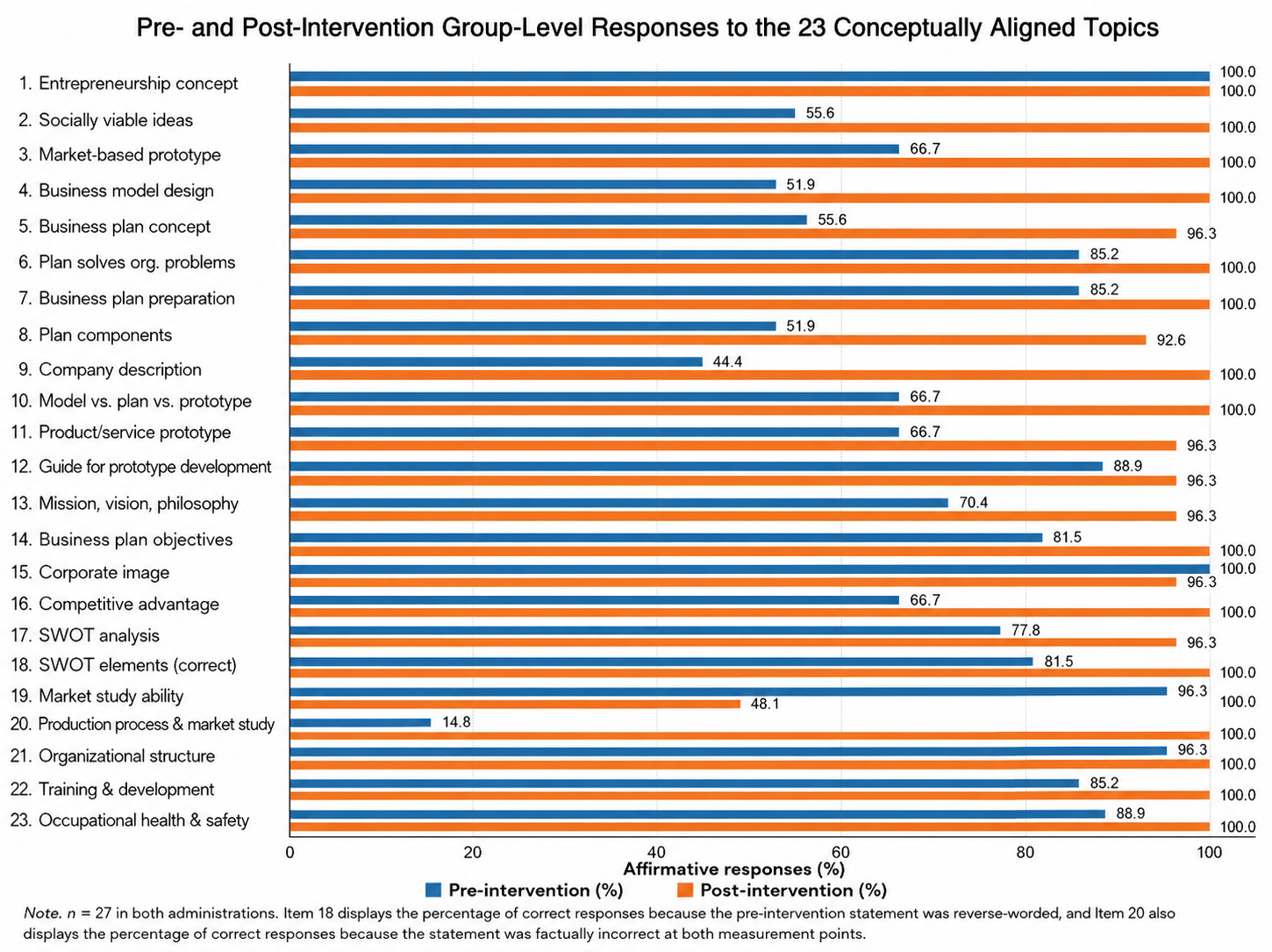
Because the questionnaires were completed anonymously by students from the same course cohort, participant-level responses could not be linked. It was therefore impossible to verify either participant-level pairing or independence between the two response sets. Consequently, neither a paired categorical test nor an independent-group chi-square test was considered appropriate. The observed differences are reported as descriptive group-level patterns rather than as statistically significant improvements or confirmed individual learning gains.
Perceived Usefulness of the Guide
Students evaluated the usefulness of the guide on a scale ranging from 1 to 10. The 27 final responses produced a mean rating of 9.81 (SD = 0.48), a median of 10, and a range from 8 to 10. Table 6 presents the distribution of the ratings assigned by the students.
Table 6. Distribution of Students’ Perceived Usefulness Ratings for the Guide
| Rating | n | % |
| 8 | 1 | 3.7 |
| 9 | 3 | 11.1 |
| 10 | 23 | 85.2 |
| Total | 27 | 100.0 |
Note. M = 9.81; SD = 0.48; median = 10; range = 8–10.
As shown in Table 6, most respondents assigned the highest possible rating: 23 students (85.2%) selected 10, three (11.1%) selected 9, and one (3.7%) selected 8. These results indicate a highly favorable perception of the guide among the students who completed the final questionnaire. However, the ratings represent students’ appraisal of the resource and should not be interpreted as evidence that the guide independently developed entrepreneurial competencies.
Qualitative Perceptions and Reflections
The open-ended responses were analyzed using the inductive thematic procedure described in the Methodology section. Theme frequencies represent the number of participants whose responses included at least one code associated with the corresponding theme. Because a response could contribute to more than one theme, the frequencies were not mutually exclusive.
The diagnostic themes centered on students’ need for procedural structure, concerns about market and financial viability, and uncertainty regarding the knowledge required to prepare a business plan. In the final responses, the most prominent themes concerned step-by-step guidance, project organization, clarity and formalization, and practical application to the entrepreneurial project. Most participants expressed a positive overall appraisal; however, two responses qualified this favorable pattern by reflecting critical, mixed, or ambiguous perceptions. These responses were retained to avoid portraying the students’ experiences as uniformly positive.
Table 7. Qualitative Themes, Participant Contributions, and Representative Quotations
| Stage | Theme | Participants contributing, n | Representative quotation | Interpretation |
| Diagnostic | Need for procedural structure and sequencing | 17 | “It would be like a map that guides me along the entrepreneurial path.” | Students expected the guide to organize the process and reduce omissions. |
| Diagnostic | Market, financial, and viability concerns | 13 | “The main challenge would be obtaining and analyzing accurate information, especially about the market, competition, and real costs.” | Students anticipated difficulty evaluating whether the proposed venture was feasible. |
| Diagnostic | Uncertainty about the idea and required knowledge | 8 | “Not knowing how it is done.” | Some students lacked clarity regarding the business idea, value proposition, objectives, or plan-development process. |
| Final | Step-by-step guidance and project organization | 15 | “It helped me know the steps to follow.” | The most frequent perceived contribution was the sequencing and organization of project tasks. |
| Final | Clarity, completeness, and formalization | 9 | “It is easy to understand and quite complete in terms of resources.” | Students valued the clarity of the explanations and the formal structure provided to the proposal. |
| Final | Practical application to the entrepreneurial project | 9 | “It was fundamental for carrying out the launch of our product.” | Students connected the guide with the preparation or implementation of their own projects. |
| Final | Positive overall appraisal | 23 | “The experience was very educational.” | Most participants expressed satisfaction with the course or the instructional resource. |
| Final | Critical or mixed appraisal | 2 | A brief negative response “No.” and an additional response expressing uncertainty about the availability or use of the guide. / “No, I did not know of any guide I could rely on.” | A small number of responses qualified the predominantly favorable pattern and were retained as contrasting evidence. |
Note. Theme frequencies were calculated from the valid open-ended responses available for each questionnaire administration. Because individual responses could contribute to multiple themes, theme frequencies are not intended to sum to the total number of participants. All quotations were translated from Spanish while preserving their original meaning.
The relationships between these qualitative themes and the quantitative findings are presented in the mixed-methods integration below.
Integration of Quantitative and Qualitative Findings
The quantitative and qualitative findings were integrated through the joint display presented in Table 8. The display identifies areas of convergence, complementarity, and divergence between the closed-ended response patterns, usefulness ratings, and qualitative themes.
Table 8. Mixed-Methods Integration of Quantitative and Qualitative Findings
| Quantitative Finding | Related Qualitative Finding | Type of Integration | Integrated Interpretation |
| Higher post-intervention affirmative-response percentages for several business-planning topics | Step-by-step guidance, project organization, clarity, and formalization | Convergence | Both strands suggest that students perceived greater clarity and organization during business-plan preparation. |
| High usefulness rating (M = 9.81; 85.2% selected 10) | Positive overall appraisal and descriptions of the guide as an organizational and procedural resource | Convergence | Closed- and open-ended responses consistently indicate a favorable perception of the guide’s usefulness. |
| Higher final affirmative-response percentages for application-oriented topics, including prototype development, competitive advantage, and SWOT analysis | Practical application of the guide to students’ business ideas and projects | Complementarity | The qualitative findings clarify how students perceived the guide as helping them apply selected business-planning concepts to their projects. |
| Predominantly favorable closed-ended responses and usefulness ratings | Two critical or mixed student responses | Divergence | Favorable group-level patterns were not uniform; the contrasting responses qualify interpretations of the guide’s perceived value. |
Note. Team-level course scores were not included in the mixed-methods integration because they represented collaborative products and could not be linked to the anonymous individual questionnaire responses.
Overall, the integrated findings indicate that several entrepreneurship and business-planning topics received higher affirmative-response percentages in the final questionnaire and that students generally perceived the guide favorably. The qualitative findings provide context for these patterns by identifying procedural organization, clarity, and practical application as the characteristics most valued by students, while the critical and mixed responses show that perceptions were not uniform. Given the anonymous, unlinked, one-group design, the integrated findings should not be interpreted as statistically significant improvements or as evidence that the guide independently caused the observed response patterns.
Discussion
The findings of this study should be interpreted as descriptive evidence from an exploratory one-group educational intervention rather than as proof of instructional effectiveness. Across the two anonymous questionnaire administrations, higher affirmative-response percentages were observed for several conceptually aligned entrepreneurship and business-planning topics. Students also assigned high usefulness ratings to the guide and described it primarily as a resource that provided procedural organization, clarity, and step-by-step support. Although the six teams obtained relatively high course-assessment scores, these scores represented collaborative products and could not be linked to the anonymous individual questionnaire responses. Accordingly, the interpretation of the findings is restricted to group-level patterns in self-reported entrepreneurial knowledge, business-plan understanding, course-project performance, and perceived usefulness.
The findings share specific similarities with previous studies of PBL in entrepreneurship education. Organ et al. (2022) and Zhai and Chen (2024) describe university entrepreneurship courses in which students applied entrepreneurial knowledge through venture development, opportunity analysis, and the preparation of business proposals. Similarly, the present intervention required students to integrate market, technical, organizational, and financial information into a business plan. The principal similarity therefore lies in the use of an authentic and integrative project through which students applied course concepts, rather than in evidence of uniform development across all entrepreneurial competencies.
Previous studies have also associated project-based experiences with creativity, collaboration, communication, critical thinking, and problem solving (Crespí et al., 2022; Khotimah et al., 2024). However, the present study did not administer validated scales for these competencies and therefore cannot confirm comparable changes. Instead, its findings extend this literature more narrowly by showing how students perceived a business-plan project and its accompanying guide as supporting the organization and application of entrepreneurship-related content.
The qualitative findings offer a possible explanation for the favorable response patterns. Students most frequently described the guide in terms of sequencing, step-by-step guidance, project organization, clarity, and formalization. These perceptions are consistent with research indicating that structured digital scaffolds can help learners manage complex project activities, clarify expected products, coordinate tasks, and monitor progress (Cortázar et al., 2022; Peng et al., 2022). In the present intervention, dividing the business plan into successive components may have reduced the complexity of the task, while the alignment of conceptual explanations, project instructions, examples, multimedia resources, and knowledge checks may have helped students connect course content with the deliverables required from their teams.
A plausible explanation for the observed group-level patterns is therefore the interaction between the authentic PBL task and the procedural scaffolding provided by the guide. Students did not encounter entrepreneurial concepts only as isolated theoretical content; they were required to apply them while defining a business idea, examining the market, designing an organizational structure, specifying operational requirements, and considering financial feasibility. This repeated application may have increased students’ familiarity with the concepts and contributed to their perception that the guide facilitated business-plan preparation. Nevertheless, because the guide was implemented together with teamwork, regular course instruction, instructor feedback, and project revision, its independent contribution cannot be isolated.
The findings can also be considered in relation to Ofem et al. (2025), who used questionnaire data from 1,678 students at six universities to examine personality characteristics as mediators between instructional effectiveness and entrepreneurial-program viability. Their study suggests that the outcomes associated with entrepreneurship instruction may depend not only on the design of the educational activities but also on differences among learners. The present study did not measure personality characteristics, motivation, entrepreneurial self-efficacy, or prior achievement; consequently, it cannot determine whether these factors influenced students’ responses. The presence of a small number of critical or mixed qualitative responses, despite the predominantly favorable ratings, may indicate that students did not experience the instructional resource in an identical manner.
Several alternative explanations for the findings must also be considered. First, the novelty of using an interactive Genially resource and multimedia content may have contributed to students’ favorable evaluations independently of its specific instructional features. Second, students participated in the collaborative creation of the guide before using and evaluating it. This co-creation process may have increased their familiarity with the material, sense of ownership, and commitment to the resource, thereby influencing both their knowledge-related responses and their usefulness ratings. The favorable perceptions may therefore reflect not only the guide as a finished product but also students’ participation in its development.
Instructor support constitutes another possible explanation. The instructor-researcher defined the project requirements, explained the PBL stages, reviewed the guide’s academic content, monitored team progress, and provided formative feedback. These activities may have contributed to students’ understanding of the business-plan components and cannot be separated from the influence of the guide. Similarly, collaboration among team members may have facilitated the exchange of information, clarification of concepts, and completion of project tasks. The observed patterns should therefore be understood as outcomes associated with the broader instructional environment rather than with the digital resource alone.
Social desirability may also have influenced the final responses. Because the students knew the instructor-researcher, participated in developing the resource, and evaluated it within the course context, they may have been inclined to report favorable perceptions. Although the questionnaires were anonymous, anonymity does not completely eliminate the possibility of favorable-response bias. The two critical or mixed qualitative responses are important in this regard because they show that students’ perceptions were not uniformly positive and qualify the high overall usefulness rating.
Repeated exposure to entrepreneurship and business-planning content provides an additional explanation. Students encountered similar concepts during regular instruction, guide development, project preparation, formative feedback, and the diagnostic and final questionnaires. Familiarity with the terminology and repeated exposure to related questions may have contributed to the higher final affirmative-response percentages. Furthermore, several pre- and post-intervention items differed in wording, scope, or level of application, which limits their interpretation as equivalent measures of change. Without a comparison group and linked participant-level responses, the study cannot distinguish the possible contribution of instruction, repeated measurement, testing effects, teamwork, guide creation, or use of the resource itself.
For these reasons, the findings do not support claims that the intervention improved leadership, management, creativity, communication, critical thinking, teamwork, or social responsibility. These competencies were not directly assessed through validated competency scales or independent performance measures. The conclusions are therefore limited to students’ self-reported knowledge of selected entrepreneurship and business-planning topics, their understanding of business-plan components, the contextual team-level course scores, and their perceptions of the guide’s usefulness.
The principal contribution of the study is thus the description of how a collaboratively developed guide was embedded within a PBL experience to support business-plan preparation. The findings suggest that students particularly valued the sequencing of the content, the connection between concepts and project activities, and the availability of procedural guidance. These features provide a potentially useful instructional framework for entrepreneurship courses; however, claims regarding effectiveness, competency development, or transferability require further research using comparison groups, validated outcome measures, linked pre–post data, and designs capable of distinguishing the contribution of the guide from other instructional factors.
Conclusion
The findings showed promising results within this specific educational context. Regarding the first research question, the final questionnaire presented higher affirmative-response percentages for several entrepreneurship and business-planning topics, although these patterns represent anonymous group-level responses rather than verified individual learning gains. Regarding the second research question, students generally perceived the guide as useful for organizing the business-plan process, clarifying its components, and providing step-by-step procedural support.
A central insight derived from the integration of the quantitative and qualitative findings is that students valued the guide primarily for its organizational and procedural functions rather than simply for its digital or interactive format. This finding suggests that, in this educational context, the perceived value of the resource was associated with how it sequenced the business-plan components, connected conceptual explanations with project deliverables, and provided step-by-step support throughout the process.
From a practical perspective, the guide provides an instructional example that may inform the design of similar business-plan activities in entrepreneurship courses. However, it should not yet be considered an effective or broadly replicable model for higher education, because the findings were obtained from one course and a small group of students.
The principal limitation is the exploratory one-group design, together with anonymous and unlinked questionnaire responses, the absence of a comparison group, and the combined influence of guide co-creation, teamwork, instructor support, and repeated exposure to the course content. Consequently, the study does not establish that the guide independently improved entrepreneurial competencies. Further research should examine this instructional approach with larger and more diverse samples, validated outcome measures, linked pre–post data, and comparison groups.
Recommendations
For practice, instructors should align the guide with course objectives, project stages, deliverables, and assessment criteria. Each section should include concise explanations, step-by-step instructions, examples, multimedia resources, and formative knowledge checks. The guide should complement instructor feedback and progress reviews rather than replace them.
Future research should examine the intervention with larger samples, comparison groups, and participants from different institutions. Validated measures should be used when assessing competencies such as creativity, leadership, teamwork, or critical thinking, and delayed assessments should evaluate knowledge retention and transfer.
Further studies should also document how students use the guide and distinguish its contribution from other factors, including co-creation, instructor support, teamwork, repeated exposure, and technological novelty.
Limitations
Regarding study limitations, it is important to note that the intervention was implemented within a single course with a small, non-random sample and no comparison group, which limits the generalizability of the findings and prevents attributing the observed patterns exclusively to the guide.
The study relied mainly on self-reported perceptions, and the pre- and post-intervention questionnaires were conceptually aligned but not identical. Anonymous responses could not be matched, possible testing effects were not controlled, and course performance was assessed through team-level grades rather than individual measures. In addition, students co-created and evaluated the guide, which may have influenced their perceptions, and no long-term follow-up was conducted to examine knowledge retention or transfer.
Ethics Statement
The institution did not have a formal research ethics committee for this type of course-based educational study; therefore, no institutional approval number or approval date was available.
Before data collection, students were informed about the purpose of the study, the voluntary nature of their participation, and the confidential treatment of their responses. Informed consent was obtained electronically before participants accessed the questionnaire. Participation or non-participation had no effect on course grades or academic standing. The questionnaires were anonymous and did not collect names, student identification numbers, email addresses, or other direct identifiers. All data were analyzed and reported only in aggregate form.
Authorship Contribution Statement
Lendechy: Conceptualization and design, data acquisition, critical revision of manuscript, supervision. Garizurieta: data analysis and interpretation, drafting manuscript, statistical analysis, final approval